-
E-mail
jwdry8166@163.com
-
Phone
13915898166
-
Address
Jiaoxi Industrial Park, Zhenglu Town, Tianning District, Changzhou City, Jiangsu Province
Changzhou Jinwang Drying Equipment Co., Ltd
What is the working principle of the hollow blade dryer?
Date: 2025-07-17Read: 49
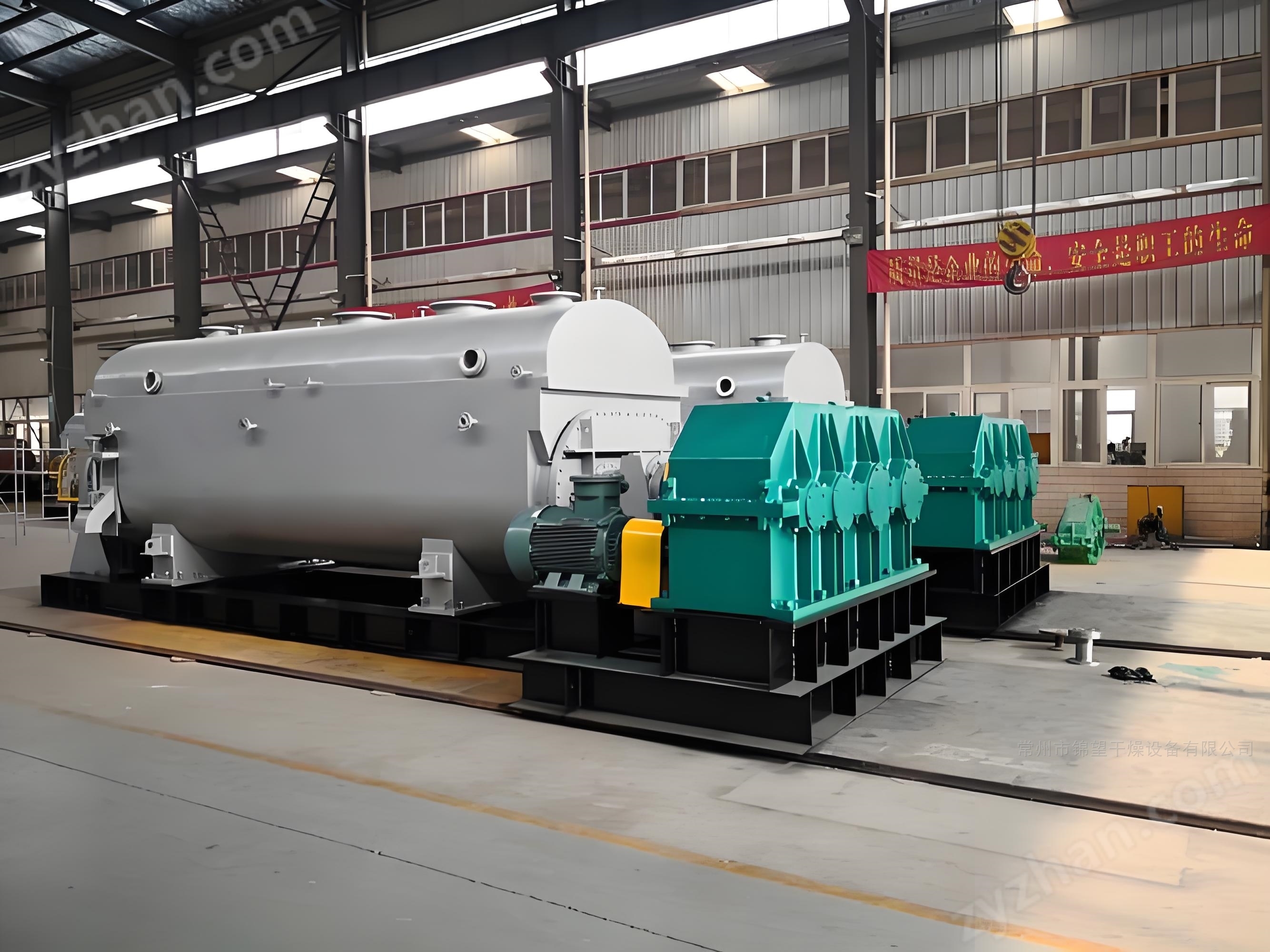
Hollow blade dryer This product can indirectly heat or cool paste, granular, powdered, and slurry materials, and can complete unit operations such as drying, cooling, heating, sterilization, reaction, and low-temperature combustion. The special wedge-shaped stirring heat transfer blade in the equipment has high heat transfer efficiency and self-cleaning function of the heat transfer surface.
The working principle of the hollow blade dryer is based on a dual mechanism of heat conduction as the main action and mechanical stirring as the auxiliary action. The specific process is as follows:
1. Dual heat source conduction heating
The heat carrier (steam, thermal oil or hot water) is introduced into the jacket of the equipment shell to heat the metal wall, and at the same time, it enters the hollow main shaft and the densely arranged hollow blades through the rotating joint, forming a dual heating surface. This dual heating design significantly increases the heat transfer area per unit volume, and heat is directly conducted to the material through the metal wall, resulting in high thermal efficiency.
2. Dynamic mixing and propulsion
Wet materials are continuously fed into the dryer through a screw conveyor, and are constantly sheared and flipped by low-speed rotating wedge-shaped blades. The special inclined design of the blade forces the material to slide and update the heat transfer interface, and the 'compression expansion' effect generated by its meshing motion can break up lumps and enhance mixing. The relative motion between the material and the blade also achieves self-cleaning function, preventing the accumulation of attachments on the heating surface.
3. Water evaporation control
The surface moisture of the material is heated and vaporized, and the steam is carried away by a small amount of carrier gas (or vacuum system). The drying process forms an axial 'piston flow', which is divided into two stages: a constant speed stage (surface moisture evaporation) and a deceleration stage (internal moisture diffusion). The moisture is discharged after being sealed by the purification system.
4. Precise adjustment of discharge
After drying, the material rotates with the blade to form a spiral trajectory and moves towards the discharge port. By adjusting the height of the overflow plate to control the retention time, precise control of the final moisture content is achieved.