-
E-mail
longlichg@163.com
-
Phone
13501296723
-
Address
No.1 Northeast Junzhuang, Baliqiao, Chaoyang District, Beijing
China Aerospace Manufacturing Technology Research Institute
One click coating machine safety operation and efficient operation precautions manual
Date: 2025-11-21Read: 8
One click coating machineManual of Precautions for Safe Operation and Efficient Operation
1、 Precautions for preparation before startup
Equipment inspection
Confirm that the body is placed steadily, the anchor bolts are tightened, there is no looseness or tilting, and the grounding device is connected reliably (to prevent static electricity or leakage risks).
Check whether the coating room, spray system (spray gun, pipeline, nozzle), hot air system (air inlet, air outlet, filter) and dust removal device are clean and free of residual materials to avoid cross contamination.
Verify that the one key control system (touch screen, buttons, sensors) responds normally, the parameter display is clear, and there are no error prompts; Check that the calibration of instruments such as barometers, thermometers, and tachometers is valid.
Check that the sealing of the liquid barrel, infusion pump, and pipeline connections is good and there is no leakage; The nozzle is unobstructed without any blockage, and the atomization effect is normal in the pre-test.
Preparation of materials and auxiliary materials
The material to be coated should be dry, with uniform particle size and no clumps or impurities (clumped materials should be crushed and sieved to avoid clogging the nozzle or affecting the uniformity of the coating).
The coating solution shall be accurately prepared according to the formula proportion, fully stirred and dissolved (or evenly dispersed), and filtered to remove impurities when necessary to prevent blocking the spray pipeline.
Confirm the compatibility between the material and coating solution to avoid coating failure or equipment corrosion caused by ingredient reactions.
Parameter preset specification
Based on the material characteristics (specific gravity, particle size, moisture absorption) and coating requirements, preset parameters such as pot rotation speed, inlet air temperature, outlet air temperature, atomization pressure, spray liquid flow rate, etc. (manual review is required after one click preset to avoid parameter errors).
The inlet temperature should be gradually increased (recommended gradient of 5 ℃/min) to avoid sudden rise and drop that may cause the material to become damp or the coating film to crack.
The atomization pressure is generally controlled at 0.2-0.4 MPa, and the spray flow rate should be matched with the pot speed and hot air volume to prevent material adhesion or uneven coating.
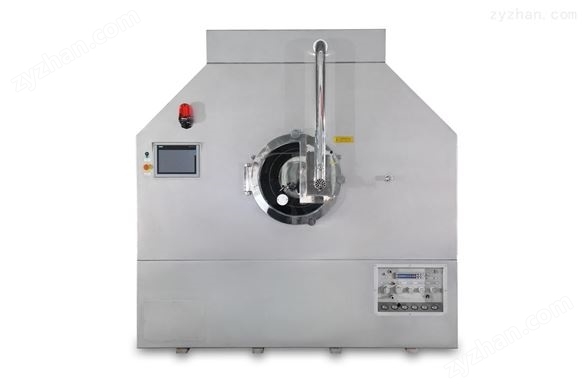
2、 Precautions for operation of one key coating machine during operation
Real time monitoring and adjustment
After starting the device, observe the rolling state of the material in real-time through the observation window (it should be in a uniform fluidized state, without sticking to walls, clumping, or material throwing). If any abnormalities occur, adjust the speed or air volume through the one click adjustment function.
Monitor the temperature difference between the inlet and outlet air (normal difference 5-10 ℃). If the temperature difference is too large, check whether the filter is blocked or the heating tube is faulty, and clean or shut down for maintenance in a timely manner.
Observe the spray state: the spray nozzle shall be evenly atomized without dripping or spray drift. In case of blockage, the nozzle shall be cleaned after shutdown and pressure relief (disassembly during operation is prohibited).
Maintain a stable negative pressure in the coating room (usually -50~-150Pa) to prevent dust from escaping and to avoid excessive negative pressure causing material to be drawn away.
Safety operation standards
During operation, it is forbidden to open the door of the coating room, cover plate of the spray system and other protective devices, and it is forbidden to reach into the pot with hands or tools to contact materials or rotate parts.
Operators should wear protective masks, gloves, and goggles to avoid inhaling dust or contact with skin/eyes.
Overloading feeding is prohibited (the feeding amount should not exceed 60% of the effective volume of the pot) to prevent material rolling or equipment overload.
If there are abnormal situations such as abnormal equipment noise, increased vibration, sudden temperature rise, leakage, etc., immediately press the emergency stop button, cut off the power and gas sources, and troubleshoot the problem.
Supplement of materials and auxiliary materials
When supplementing the coating solution, it is necessary to first reduce the spray flow rate and slowly add it to avoid uneven atomization caused by adding a large amount at once; After supplementation, it needs to be stirred evenly to prevent sedimentation.
It is prohibited to directly add dry materials to the pot during equipment operation. After stopping the machine, open the feeding port to add, and gradually restore the parameters after restarting.
3、 Maintenance precautions for one key coating machine after shutdown
Equipment cleaning
After shutting down, turn off the heat source and power supply first. Wait for the temperature of the boiler to drop to room temperature (≤ 40 ℃) before cleaning to avoid contact with equipment at high temperatures that may cause burns.
Disassemble the spray gun, nozzle, liquid barrel, and infusion pipeline, clean them with purified water or specialized solvents (depending on the composition of the coating solution), remove residual coating film, air dry them, and assemble them.
Wipe the interior walls and observation windows of the coating room with a soft cloth, clean the air inlet/outlet filters (which can be washed or replaced), and ensure smooth air ducts.
Clean the surface of the equipment, remove dust and liquid residue, and prohibit direct flushing of electrical control systems and motors with high-pressure water guns.
maintenance
Check whether the sealing ring of the pot body and the sealing element of the spray pipe are aged or damaged, and replace them in time.
Add lubricating oil to the rotating shaft of the pot body, infusion pump and other moving parts (select the model according to the equipment manual requirements) to ensure smooth operation.
Regularly calibrate temperature, pressure, flow and other instruments, check sensor sensitivity, and ensure accurate parameter detection.
Clean the dust removal devices (such as dust collection bags and dust collectors) to avoid dust accumulation that may affect their next use.
Safe storage
After cleaning and maintenance are completed, close all valves (air and water sources), cut off the main power supply, and unplug the plug.
The equipment should be stored in a dry, ventilated, and non corrosive gas environment, avoiding direct sunlight and humid environments that may cause component corrosion.
When it is not used for a long time (more than one month), desiccants should be placed in the coating room, covered with dust covers, and the equipment status should be checked regularly.