-
E-mail
446637721@qq.com
-
Phone
15537136258
-
Address
Yingyu Industrial Zone, Gongyi City, Henan Province
Gongyi Yuhua Instrument Co., Ltd
Process principle of small rotary evaporator
Date: 2025-08-19Read: 4
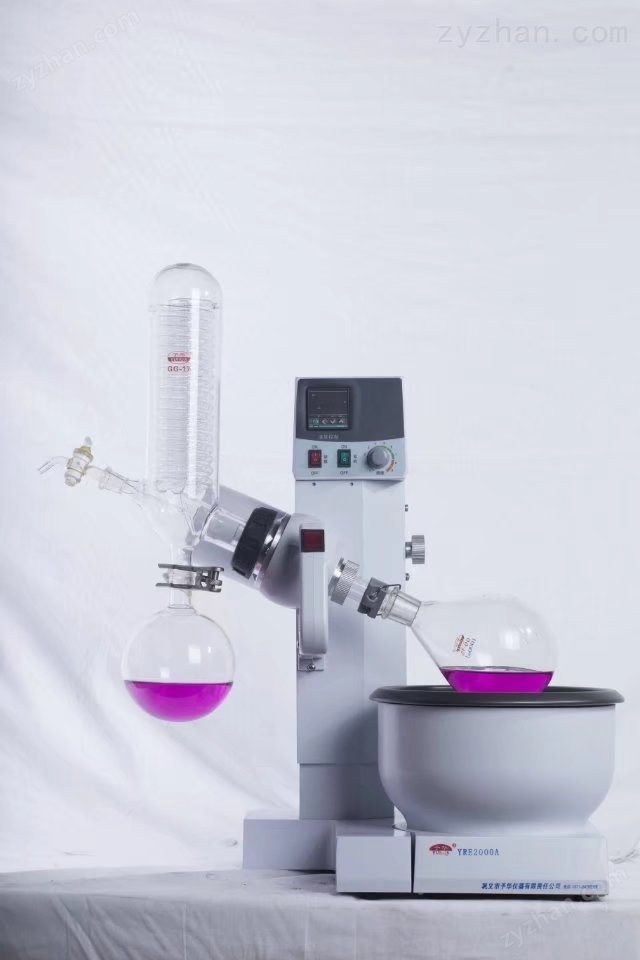
The process principle of a small rotary evaporator is based on vacuum distillation technology, which reduces the boiling point of the solvent by lowering the system pressure, thereby achieving efficient evaporation at lower temperatures and avoiding damage to thermosensitive substances. The equipment mainly consists of a rotating motor, a distillation flask, a heating pot, a condenser tube, and a vacuum pump, among which the rotating action is the key. It can drive the distillation flask to rotate at a speed of 50-160 revolutions per minute, so that the liquid forms a uniform thin film on the bottle wall, significantly increasing the evaporation area (usually 5-10 times larger than static distillation), and preventing boiling phenomenon.
Heating systems typically use constant temperature water baths or oil baths to provide a stable heat source to promote solvent evaporation; At the same time, under the action of a vacuum pump, the system pressure can be reduced to 400-600 mmHg or below (such as -0.09 megapascals), causing a significant decrease in boiling point (for example, water can boil at around 50 ° C), achieving rapid distillation. The solvent vapor generated by evaporation enters the condenser, rapidly liquefies under the action of cooling medium (such as circulating water), and is finally collected in the receiving bottle to complete the separation and concentration of the solvent. This process is widely used in small-scale experiments in fields such as chemistry and biomedicine, and is particularly suitable for the treatment of volatile solvents.
In summary, small rotary evaporators optimize evaporation efficiency and solvent recovery through the synergistic effects of pressure reduction, rotation, heating, and condensation, ensuring safe and reliable operation.