-
E-mail
info-china@gerresheimer.com
-
Phone
18661195281
-
Address
Building 3, Rail Transit Industrial Park, No. 355 Longjin Road, Changzhou City, Jiangsu Province
Gresham Plastic Packaging (Changzhou) Co., Ltd
Application of silicone oil free pre filled syringe in ophthalmology
Date: 2025-10-20Read: 4


Ophthalmic medication
Pre filled syringes (PFS) have been proven to be an excellent primary packaging and a medical device that can be safely administered for cataract surgery and the treatment of ophthalmic diseases such as intraocular pathological vascular hyperplasia. Over the years, the market for ophthalmic anti angiogenic drugs has steadily grown, making pre filled syringes (PFS) increasingly popular. This article outlines the key characteristics of silicone free pre filled syringes for ophthalmology, and discusses the safety and functionality of silicone free pre filled syringes, which can be considered as a substitute for existing siliconized pre filled syringes for ophthalmic injection in the market.
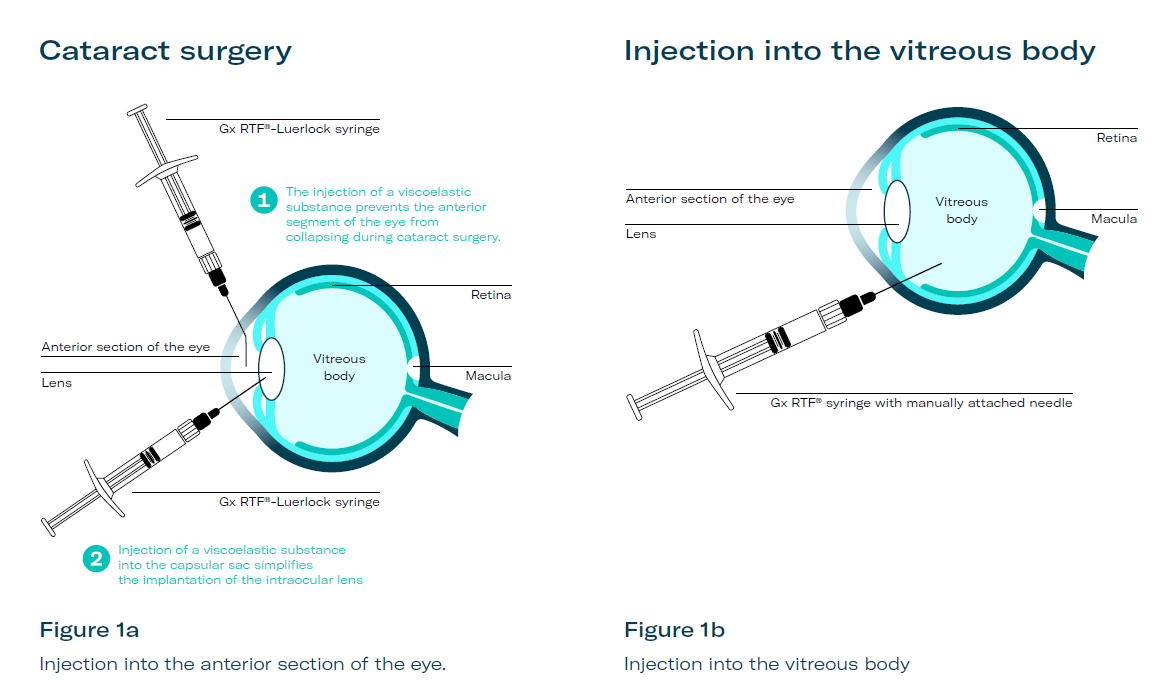
In ophthalmic treatment applications, pre filled syringes are often filled with drugs for treating different eye diseases. Ophthalmology usually has two major treatment areas: cataract surgery performed on the anterior portion of the eye and treatment for pathological vascular hyperplasia in the inner corner of the eye. In cataract surgery, a syringe is used to inject viscoelastic agents such as hyaluronic acid (Table 1) into the anterior chamber and crystalline body cavity of the eye. On the one hand, this can ensure that the anterior chamber of the eyeball remains stable; On the other hand, this substance helps to improve the visibility of eye tissue (Figure 1a). Intraocular injection of recombinant monoclonal antibodies (mAbs) - anti vascular endothelial growth factor (anti VEGF) protein (Table 1) - can prevent the growth of diseased blood vessels. This relatively novel treatment can be used for non-surgical treatment of wet macular degeneration, diabetes macular edema, retinal vein occlusion and other diseases (Fig. 1b).

Ophthalmic drug market
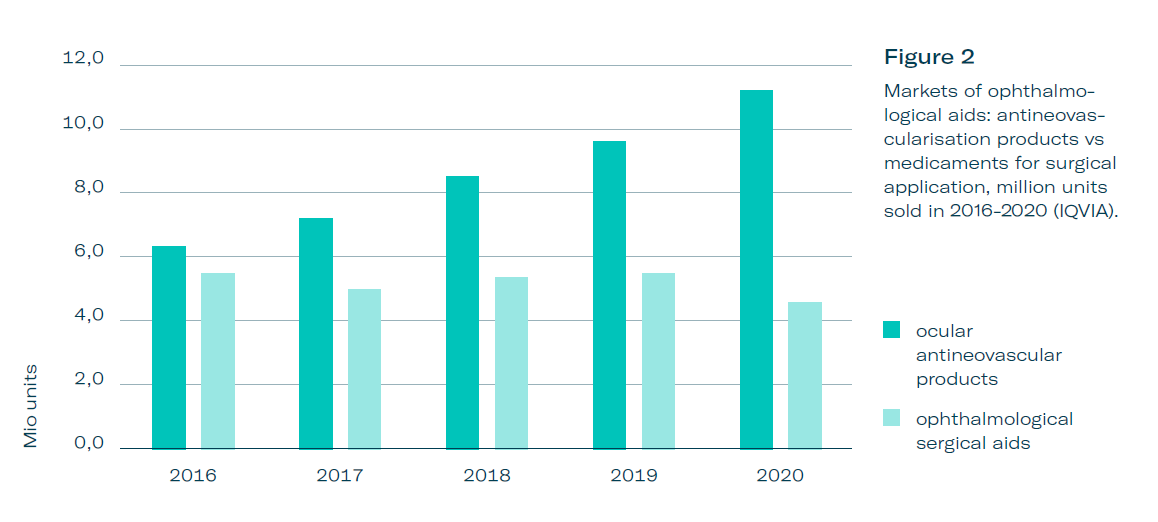
In recent years, the market for anti angiogenic agents used in ophthalmology has steadily grown, while the market for surgical aids has remained unchanged or even declined. This fully reflects the aging population, the increasing indications for anti vascular endothelial growth factor therapy, and the repeated use of products (Figure 2). Although the development of anti vascular endothelial growth factor products will move towards prolonging their therapeutic efficacy and reducing the number of intravitreal injections, it is expected that their growth trend will continue.
Compared with traditional packaging systems, the advantages of pre filled syringes are:
There are different schemes for preparing anti vascular endothelial growth factor drugs for intravitreal injection:
There are different schemes for preparing anti vascular endothelial growth factor drugs for intravitreal injection:
The medication can be stored in penicillin bottles and then transferred to a filter needle for injection using the following method (doctor).
In addition, anti vascular endothelial growth factor drugs can be stored in pre filled syringes directly used for ophthalmic injection. This can be a glass syringe with baked silicone oil (BOS). The newly developed silicone free glass material or cyclic olefin polymer (COP) injector must undergo further ophthalmic application testing.
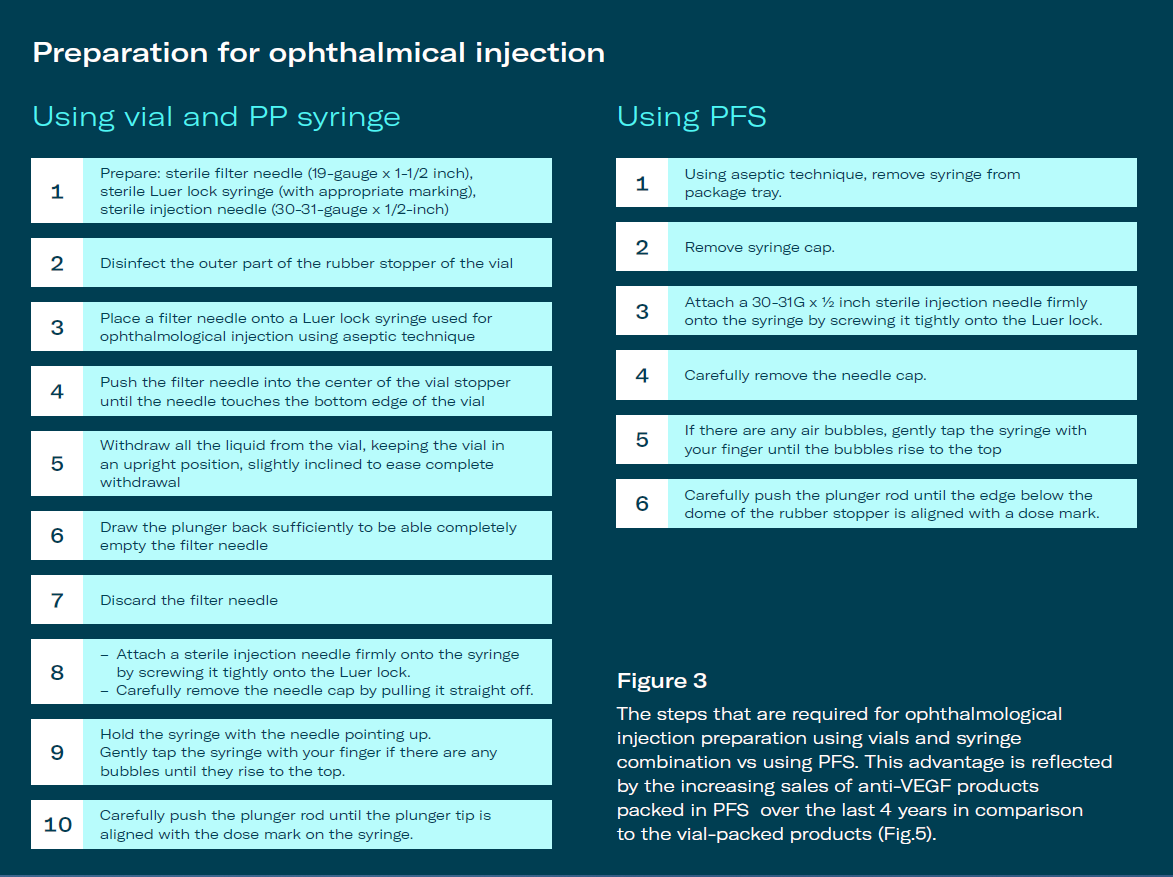
Compared to the combination of penicillin bottles and syringes, the advantage of using PFS is that it eliminates many preparation steps and minimizes dosage errors as PFS already contains the required injection volume and correct concentration of the drug (Figure 3).
Compared with products packaged in penicillin bottles, the sales of anti vascular endothelial growth factor products packaged in pre filled syringes have been continuously increasing in the past 4 years, reflecting this advantage (Figure 4).
In addition, the study by S.M. Dounce et al. [8] showed that the particle content of glass pre filled syringes containing baked silicone oil (BOS) and COP syringes without silicone oil was lower than that of traditional silicone oil spray injectors.

Key characteristics of ophthalmic syringes
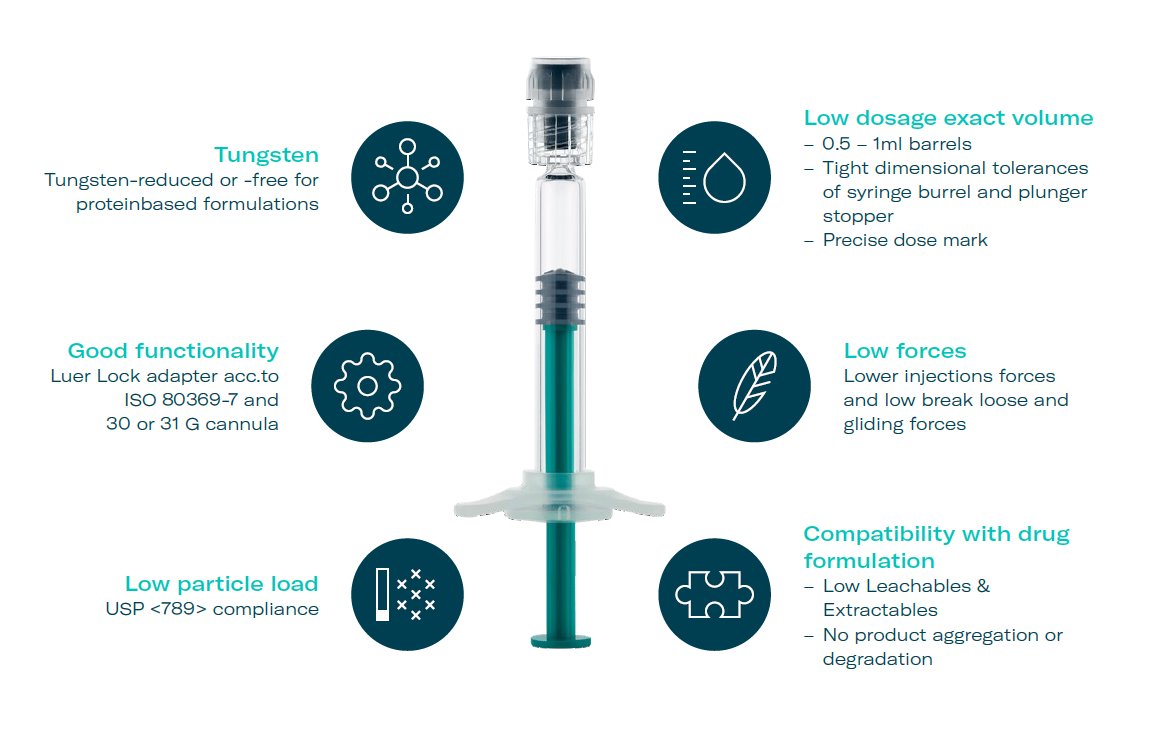
The syringe used for ophthalmic injection must meet the following requirements: it must be able to deliver small doses of drugs accurately and repeatedly, have good functionality and low particle content, and be compatible with the predetermined drug formula (Figure 5). All of these characteristics will be described in detail below.
Small capacity precise dosage
In the process of ophthalmic treatment, precise doses must be repeatedly injected, which is crucial for the efficacy of drugs and the safety of patients. Many drugs used in ophthalmology have high viscosity and low injection volumes, typically ranging from 50-100 μ l. The most suitable are 0.5 and 1ml pre filled syringes, which have a relatively small inner diameter, good injectability, strict dimensional tolerances, and very precise graduations to measure dosage.
Dimensional tolerances and precise dosage markings or scale printing are typically completed during the manufacturing process. At Gerresheimer, the printed size and accuracy (distance from the tip of the syringe to the dose mark) are detected by a proprietary camera system to ensure 100% control. The inner diameter tolerance of pre filled syringes made of glass can be set to ± 0.05 or ± 0.1 mm, and automated printing processes typically result in a tolerance of ± 0.25 mm for dose marking positions. Shoulder shapes typically generate an additional tolerance of ± 0.5 mm. Considering all parameters, the worst-case change in discharge volume is ± 22.4 μ l [9]. Basically, the tolerance of 0.5ml pre filled syringes is smaller, while COP syringes have much smaller dimensional tolerances due to the special manufacturing process based on molding.
It should be noted that the design of the piston, as well as the naked eye and thumb, can also affect the accuracy of intraocular injection dosage. Therefore, it is recommended to use quantitative devices such as Congruence MDS [10].
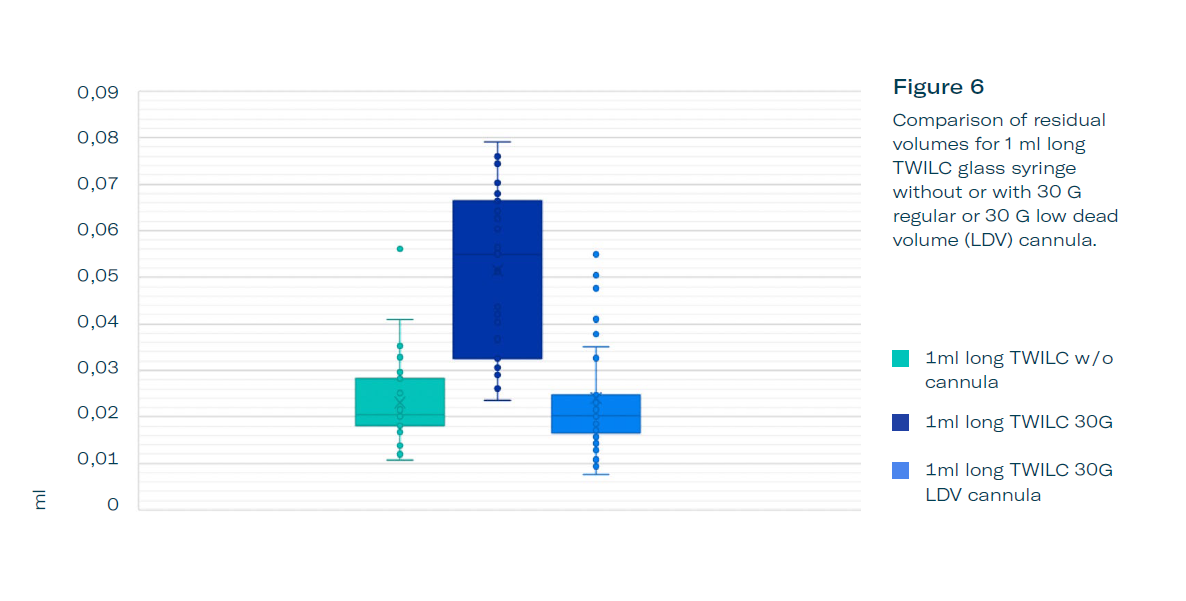
Biotechnology drugs used for the treatment of vascular endothelial growth factor (VEGF) are usually very expensive, so the remaining volume in pre filled syringes (including the capacity of the needle, cone, and shoulder) is particularly important and must be optimized to avoid unnecessary drug waste. In addition, it is recommended to use special needles with low dead space (LDV) (Figure 6).
Low particle content - meets USP standards
Although silicone oil is harmless to the human body, intravitreal injection therapy for neovascular retinal diseases is repetitive, and the vitreous body is a small enclosed space, which may increase the risk of treatment complications such as floating particles, intraocular inflammation, and high intraocular pressure [11-14]. In addition, besides silicone oil, other particles, rubber, or secondary particles generated by the interaction between drugs, silicone oil, or other particles that detach from the syringe body and the inner surface of the syringe can also pose such safety risks.
Although silicone oil is harmless to the human body, intravitreal injection therapy for neovascular retinal diseases is repetitive, and the vitreous body is a small enclosed space, which may increase the risk of treatment complications such as floating particles, intraocular inflammation, and high intraocular pressure [11-14]. In addition, besides silicone oil, other particles, rubber, or secondary particles generated by the interaction between drugs, silicone oil, or other particles that detach from the syringe body and the inner surface of the syringe can also pose such safety risks.
Therefore, PFS used for ophthalmic applications must comply with USP's ophthalmic product particle requirements. However, it should be considered that USP specifies the particle content of drug/device combination products, so the particle count of the device should be lower.
The study by Dounce S.M. et al. in 2021 showed that compared to insulin injectors and plastics lubricated with oil amide, glass injectors with baked silicone oil (BOS) and COP injectors without silicone oil had significantly lower particle content [8]. The particle content of the latest syringe (1-100 μ m) greatly exceeds the requirements of USP.
In this experiment, the purpose is to examine other silicone free systems, including a glass silicone free injector and three different rubber plugs, all of which have special designs and coatings that can be used with silicone free syringes (further referred to as plugs 1, 2, or 3) [15]. Two of them use polytetrafluoroethylene (PTFE) coating (rubber plugs 1 and 2), but the rubber formula and manufacturing process are different; Another approach is to use thermoplastic elastomers (TPE) without the need for additional coatings. We will compare the glass silicone free system with the silicone free COP system with the same plugs (plugs 1, 2, 3), as well as glass injectors with BOS and modern coated plugs.
Inject water for injection (WFI) into the syringe and seal it with laboratory equipment. According to the United States Pharmacopeia, after real-time storage for 3 months (T1), sub visible particles were measured using the light shielding method, as shown in Figures 7, 8, and 9. [15].


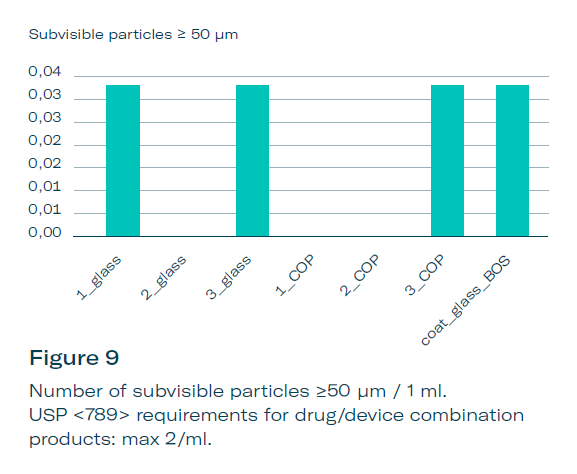
It is evident that the particle count of silicone oil free injectors is very low. No statistical differences were found between the glass tube and COP tube, or between the three different rubber plugs. In addition, the baked silicone oil (BOS) injector displays a particle content comparable to that of a silicone free injector, indicating that both are highly suitable for ophthalmic applications. Both silicone free and baked silicone oil (BOS) pre filled syringes meet USP<789>requirements, providing additional buffering for particles from drugs.
Excellent functionality
Although intravitreal drug delivery is one of the most common surgeries today [16], in order to minimize pain and adverse side effects during the surgical process, injection itself requires high-quality professionals on one hand, and the syringe also needs to have good functionality to generate acceptable injection force on the other hand. Especially for certain drug formulations, which are usually protein based, these factors become particularly important because they have high viscosity.
Although intravitreal drug delivery is one of the most common surgeries today [16], in order to minimize pain and adverse side effects during the surgical process, injection itself requires high-quality professionals on one hand, and the syringe also needs to have good functionality to generate acceptable injection force on the other hand. Especially for certain drug formulations, which are usually protein based, these factors become particularly important because they have high viscosity.
The most important performance factors for reducing injection force are the inner diameter of the needle and the syringe itself. In ophthalmic practice, the use of syringe needles is more or less regulated, limited to the use of 30G and 31G needles [17], which can ensure that patients experience less pain during the injection process. The improvement of thin-walled needles and micro conical needles has also been proven to reduce injection force, allowing patients to perform intravitreal injections more comfortably [18]. In order to reduce the risk of needle detachment and allow the use of special ophthalmic needles, it is necessary to use a Ruhr lock syringe that complies with ISO 80367-7 standard.
If choosing an ophthalmic syringe, it is necessary to choose the smallest syringe diameter possible, so that a choice can be made between 0.5 milliliters or 1 milliliter long syringes. On the one hand, good lubrication of the inner surface of the syringe can ensure good starting and sliding force, fracture loosening, and sliding force (BGLF) curve. On the other hand, silicone oil may interact with the formula and produce side effects.
In order to test the functionality of the silicone free glass and COP pre filled syringes mentioned above, their BGLF curves were tested at different time points: T0-3 days after sealing; T1-3 months RT real-time aging; T1 accelerated aging at 40 ° C/75% relative humidity for 3 months (=1 year), and real-time aging at RT for T2-6 months; T2 accelerates aging at 40 ° C/75% relative humidity for 3 months (=3 years).
After accelerated aging for 3 months, the BLGF of both glass syringes and COP silicon free syringes was below 20 N (Figure 10, only data for glass syringes are shown here). The numerical value and result reproducibility of rubber plug 1 are better. For plug 2, the results of the COP syringe are not optimistic because the sliding force increases in the length direction of the syringe, which may indicate a mismatch between the plug and the COP syringe (data not shown).

For all three types of stoppers, the change in values at the first 5 millimeters of the syringe can be explained as the transition from a dry surface to a wet surface during this stage. A moist surface helps the rubber plug slide and ensures good sliding force. Adjusting the plug hole process may also help improve the looseness value.
No aging effect or even positive aging effect was observed on the sliding force of all the modified syringes and stoppers (data not shown).
In summary, these results indicate that silicone free syringes can become a viable alternative to ophthalmic baked silicone oil (BOS) syringes after additional system adjustments such as proper selection of stoppers and improved stopper processes. Of course, both glass and COP options can be considered to have acceptable functionality, with very low particle content even after long-term storage. However, there is no doubt that such systems should undergo rigorous testing in the final product.
Reduce or eliminate tungsten
For most glass syringes, tungsten needles are used during the needle barrel molding process to achieve pinhole molding. Tungsten, as a trace element, is a noteworthy issue in pre filled syringes, mainly used in combination with protein preparations. Studies have shown that tungsten can participate in protein cleavage and aggregation in drug solutions, which may lead to increased immunogenicity, but this situation is more likely to occur during subcutaneous injection [19].
For most glass syringes, tungsten needles are used during the needle barrel molding process to achieve pinhole molding. Tungsten, as a trace element, is a noteworthy issue in pre filled syringes, mainly used in combination with protein preparations. Studies have shown that tungsten can participate in protein cleavage and aggregation in drug solutions, which may lead to increased immunogenicity, but this situation is more likely to occur during subcutaneous injection [19].
The anti vascular endothelial growth factor (VEGF) product widely used in the field of ophthalmology is a monoclonal antibody that is itself a protein. Therefore, it is necessary to accurately study the tungsten issue of pre filled syringes used for the storage and administration of anti vascular endothelial growth factor (VEGF).
Different regulatory documents and methodological recommendations clearly specify the requirements for such pre filled syringes:
Inject protein preparations using tungsten reduction or metal free syringes.
Further investigate the sensitivity of protein formulations to tungsten when using tungsten containing syringes.
Inject protein preparations using tungsten reduction or metal free syringes.
Further investigate the sensitivity of protein formulations to tungsten when using tungsten containing syringes.
There are various methods to reduce or eliminate tungsten. Practice has proven that introducing a cleaning step after the formation of standard glass tubes can significantly reduce the amount of tungsten residue. In addition, other materials can also be considered as molding needles, such as ceramic needles or COP syringes (produced through molding without using tungsten needles).
summary
In ophthalmic applications, especially in the continuous treatment of ocular pathological vascular hyperplasia, pre filled syringes (PFS) have shown their advantages over penicillin bottles and transfer filter needles. The specificity of intraocular drug delivery procedures and the properties of drugs used to treat macular diseases coincide with the key characteristics of pre filled syringes recommended for ophthalmology: accurate dosage, good functionality, low particle content, and excellent drug compatibility. In this case, low tungsten, tungsten free, silicone free, or baked silicone oil glass Luer lock syringes can serve as a good platform for ophthalmic drugs.
In ophthalmic applications, especially in the continuous treatment of ocular pathological vascular hyperplasia, pre filled syringes (PFS) have shown their advantages over penicillin bottles and transfer filter needles. The specificity of intraocular drug delivery procedures and the properties of drugs used to treat macular diseases coincide with the key characteristics of pre filled syringes recommended for ophthalmology: accurate dosage, good functionality, low particle content, and excellent drug compatibility. In this case, low tungsten, tungsten free, silicone free, or baked silicone oil glass Luer lock syringes can serve as a good platform for ophthalmic drugs.
Author:Dr. Tatiana Cheusova Pharmaceutical Support Manager Gx Biological Solutions