-
E-mail
info-china@gerresheimer.com
-
Phone
18661195281
-
Address
Building 3, Rail Transit Industrial Park, No. 355 Longjin Road, Changzhou City, Jiangsu Province
Gresham Plastic Packaging (Changzhou) Co., Ltd
Comprehensive solution to address unmet demand for intravitreal injection (IVI)
Date: 2025-09-26Read: 5

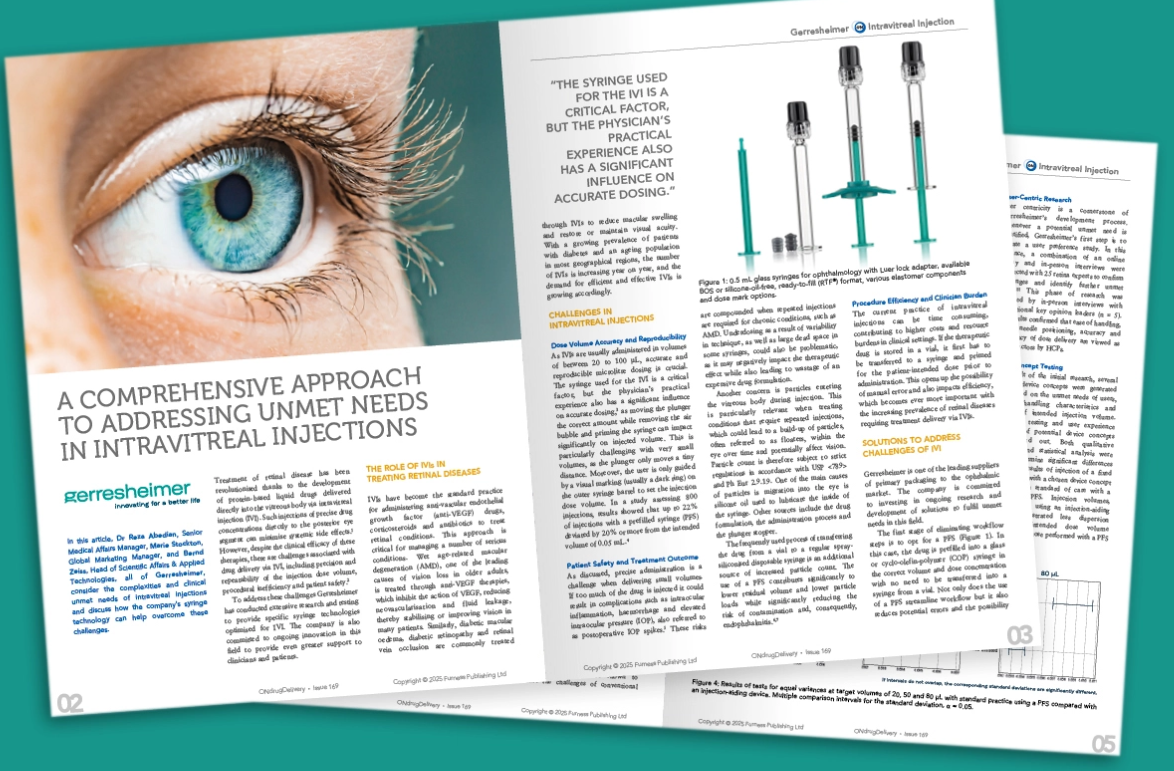
In this article, Dr. Reza Abedian, Senior Medical Affairs Manager at Gerresheimer, Marie Stockton, Global Marketing Manager, and Bernd Zeiss, Head of Scientific Affairs and Applied Technology, discuss the complexity and unmet clinical needs of intravitreal injection (IVI) and explain how Graresheimer syringe technology can help overcome these challenges.
The direct delivery of protein based liquid drugs to the vitreous through intravitreal injection (IVI) has changed the treatment approach for retinal diseases. IVI can deliver precise concentrations of drugs directly to the posterior segment of the eye while minimizing systemic side effects ¹. Although IVI has shown significant clinical efficacy, it still faces many challenges, including the accuracy of injection dosage and repeatability of operation, low efficiency of operation process, and patient safety issues. Therefore, Gracheim has developed syringe technology optimized for IVI through in-depth research and testing, and continues to invest in innovation to better serve clinical needs and benefit patient health.
The core role of IVI in the treatment of retinal diseases
Intravitreal injection (IVIs) has become the standard method for treating retinal diseases by injecting anti VEGF drugs, corticosteroids, and antibiotics. This method is crucial for treating various serious eye diseases. Wet age-related macular degeneration (AMD) is one of the main causes of vision loss in the elderly. Anti VEGF treatment can inhibit VEGF activity, reduce neovascularization and fluid leakage, thereby stabilizing or even improving the vision of many patients. Similarly, diseases such as diabetes macular edema, diabetes retinopathy and retinal vein occlusion are also often injected into the vitreous to reduce macular edema and restore or maintain the patient's vision. With the increase of the number of diabetes patients and the aging of the population in most regions, the demand for intravitreal injection (IVIs) has increased year by year, and the demand for efficient and effective IVI treatment has also increased.
Dose accuracy: dual challenges of injector and operating experience
Challenges faced by IVI: Ensuring the accuracy of dosage and injection volume, as well as the reproducibility of operations
Due to the usual intravitreal injection volume of 20-100 microliters (μ L), precise and reproducible microliter level administration is crucial. The syringe used is a key factor, but the doctor's operational experience also greatly affects the accuracy of the dose. During the injection process, the piston is pushed to expel bubbles and complete the pre filling operation of the syringe. The accuracy of the injection amplitude will also affect the final dose injected. This is particularly challenging when the injection dose is very small, as the push rod can only move a very small distance. In addition, traditional syringes rely solely on visual markings on the outer cylinder (such as black rings) to locate the dose, further increasing the risk of errors. A study evaluating 800 injections showed that 22% of injection dose deviations exceeded 20% of the target volume (0.05mL) when using pre filled syringes (PFS).
Patient safety and treatment effectiveness
As mentioned earlier, precise administration is a challenge when injecting small doses of medication. If injected excessively, it may cause complications such as intraocular inflammation, bleeding, and elevated intraocular pressure (IOP), also known as postoperative intraocular pressure elevation ⁵. For chronic diseases such as wet age-related macular degeneration (AMD) that require repeated injection therapy, these risks will further increase.
On the other hand, due to differences in operating techniques and the presence of large dead space in some syringes, insufficient dosage may be administered, which may reduce the therapeutic effect and also result in the waste of expensive drugs.
Another issue worth noting is the entry of particles into the vitreous body during the injection process. This issue is particularly important in the treatment of diseases that require repeated injections, as over time, these particles may accumulate in the eye (commonly known as "floaters") and may affect vision. Therefore, the United States Pharmacopeia (USP<789>) and the European Pharmacopoeia (Ph Eur 2.9.19) have strict regulatory requirements for particle count. The particles that enter the vitreous body during injection mainly come from the lubricating silicone oil on the inner wall of the syringe, the drug prescription itself, the administration process, and the sealing plug.
The process of transferring drugs from penicillin bottles to regular siliconized syringes significantly increases the risk of particle contamination. The use of pre filled syringes (PFS) can significantly reduce residual volume and particle load, while significantly reducing the risk of contamination, thereby reducing the occurrence of endophthalmitis 6,7.
Operational efficiency and clinical burden
At present, IVI operations are often time-consuming, which increases costs and burdens resources in clinical settings. If the therapeutic drug is stored in the form of penicillin bottles, it must be transferred to a syringe and pre filled according to the patient's required dosage before administration. This process not only increases the possibility of human error, but also reduces the overall efficiency of the operation. As the incidence of retinal diseases requiring IVI treatment continues to increase, optimizing processes to improve efficiency is particularly important for reducing medical costs and resource consumption.
Solutions to address IVI challenges
As a global provider of ophthalmic packaging solutions, Gresham is committed to continuous research and innovation to address the unmet needs in this field.
The pre filled syringe (PFS) (Figure 1) is the first step in optimizing the injection process. In this way, the drug has been pre filled into the glass or cyclic olefin polymer (COP) syringe in the correct volume and dosage concentration, without the need to transfer it from the penicillin bottle to the syringe. The use of pre filled syringes not only simplifies the operation process, but also reduces the potential for errors and contamination. Most importantly, recent studies have shown that using pre filled syringes (PFS) for intravitreal injection (IVIs) can significantly reduce the incidence of intraocular inflammation.

Figure 1: 0.5mL glass syringe (including Luer lock connector), optional BOS baked siliconized or silicone free design, supports RTF ®) No wash, no extinguish configuration and multiple dose labeling options.
BOS baked siliconized syringe
Unlike traditional spray silicone oil processes that are suitable for various drugs and applications, only special low particle silicification processes (such as baking silicification, abbreviated as BOS) can form thinner, more uniform, and more stable silicone oil layers. This is because silicone oil is bonded to the surface through hydrogen bonds and partial covalent bonds. This greatly reduces the risk of silicone oil migrating into the drug during its shelf life and injection process, thereby avoiding the risk of aggregation, drug interactions, and particle migration into the vitreous humor. BOS has been proven to meet the requirements of USP<789>for ophthalmic drug particles.
Silicone free injector
The silicone free injector launched by Gresham marks a significant innovation in injector technology. This type of syringe eliminates silicone lubricants to avoid particle formation caused by silicone oil, as silicone oil may induce protein aggregation before injection into the vitreous. The release of silicone oil from the syringe may exacerbate this process and lead to an increase in protein aggregation particles in the formulation. Therefore, removing silicone oil can help improve the compatibility between packaging materials and sensitive protein drugs, and reduce the risk of aggregation.
Verified syringe performance
In a study evaluating the performance of baked siliconized (BOS) syringes and silicone free syringes, it was found that their particle levels were significantly lower than the requirements of the United States Pharmacopeia<789>, confirming their suitability for ophthalmic applications (Figure 2). During the testing process, injection water was used to evaluate syringes made of glass and cyclic olefin polymer (COP) materials under real-time and accelerated storage conditions. The results showed that under all testing conditions, the number of particles remained at a low level. The comparative analysis of BOS and silicone oil free syringes shows that both options are safe and effective, and comply with USP<789>standard requirements.
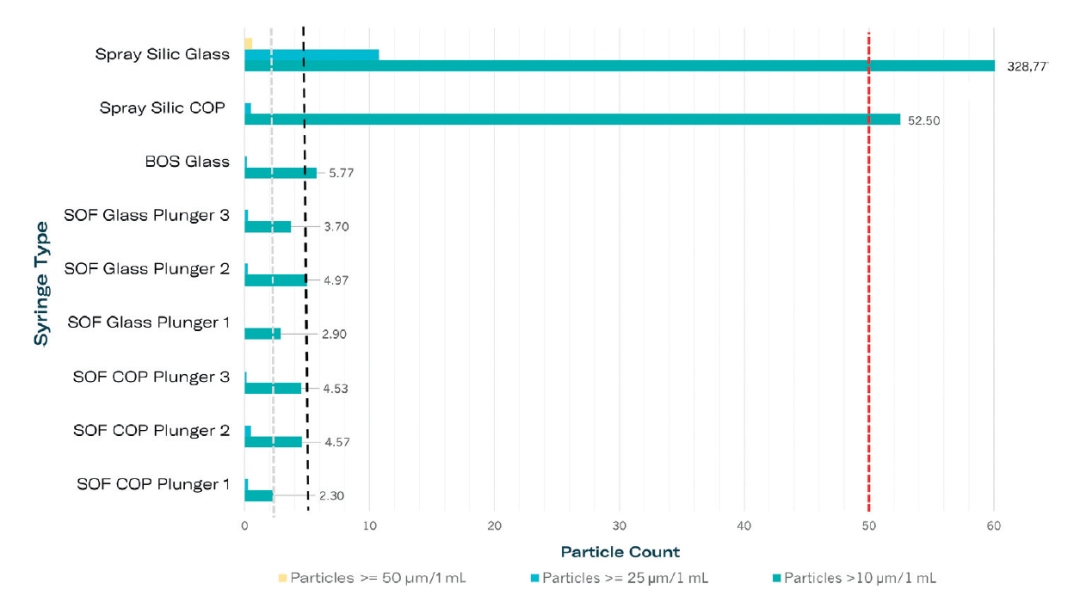
Figure 2: According to the USP<789>standard, particle measurements were conducted on a 1ml syringe without silicone oil and a siliconized system. The dashed lines in the figure represent the three types of particle limits that comply with the USP<789>standard. All test syringes were filled with injection water. The specific explanation is as follows: COP/Glass represents the material of the syringe; Spray Silicon refers to the treatment of sprayed silicone oil; BOS indicates baking silicification treatment, and each material is equipped with a coated rubber plug. In addition, SOF (silicone oil free injector) injectors related to plugs 1-3 are characterized by the use of different types of plug designs.
Dose accuracy
In order to accurately deliver micro doses, pre filled syringes (PFS) with a capacity of 0.5 mL or 1 mL are required due to their smaller inner diameter. The inner diameter tolerance of glass syringes can be set to ± 0.1 mm, even up to ± 0.05 mm, to meet the most stringent requirements. The cyclic olefin polymer (COP) injector adopts injection molding technology, which means that its dimensional tolerance is smaller, thereby achieving higher dose volume accuracy.
Dose labeling is an important visual aid tool for ophthalmologists when performing such low-dose injections. This visual dose marking helps to accurately determine the stopping position of the rubber stopper, thereby achieving precise injection of the required dose to the patient. Gracheim has adopted an advanced visual inspection system in its glass syringe production plant to ensure accurate dose markings on the syringes, with an error range as low as ± 0.25 mm.
Starting force and sliding force
The BLGF testing further validated the applicability of these syringes for intravitreal injection (IVIs). After three months of accelerated aging testing (equivalent to three years of actual storage), the BLGF values of all silicone free glass syringes were below 20 N, indicating excellent performance. The sliding force is not affected by aging, highlighting the stability and reliability of the syringe system (Figure 3).
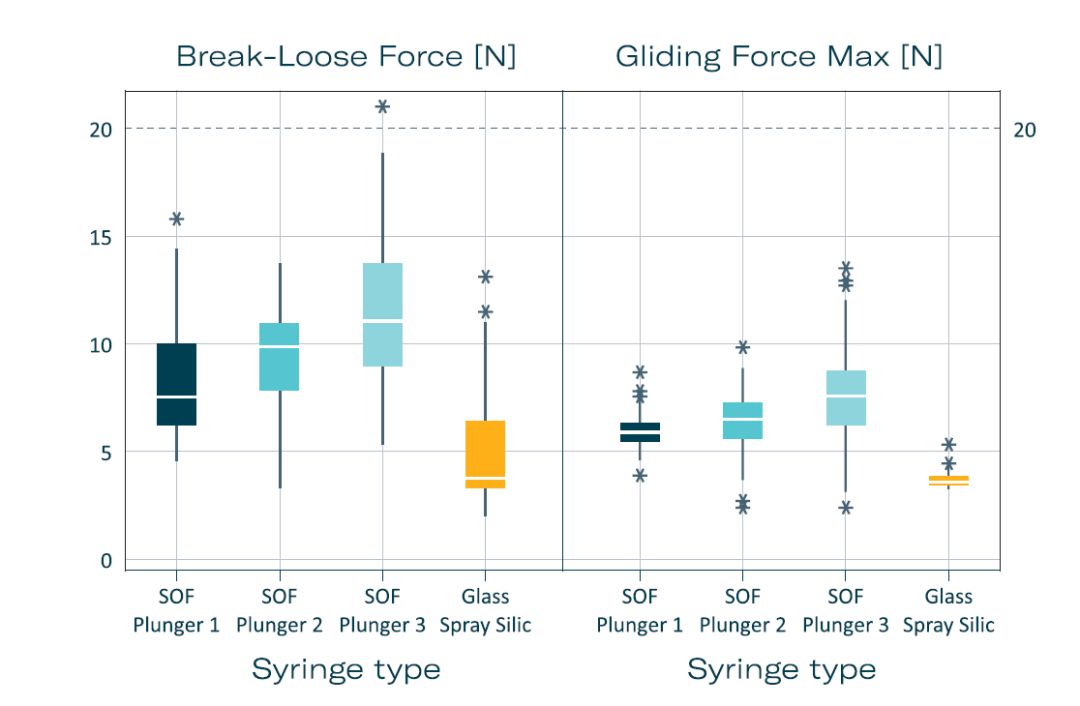
Figure 3: Comparison of starting force and sliding force between silicone oil free injector and spray silicone oil injector. Push injection speed: 270 millimeters per minute. Each syringe is 1 milliliter long and thin, equipped with a regular 27G thick needle, and filled with injection water. Each test was tested in parallel 160 times: a total of [T0 (3 days after perfusion), T1 (3 months), T1 acceleration (accelerated aging according to ICH standards for 3 months), T2 acceleration (accelerated aging according to ICH standards for 6 months), T2 (6 months)]. Note: SOF with plungers 1-3: Silicone free injector with three special rubber plugs from different manufacturers; Glass Spray Sili: 0.5mg spray silicone oil glass syringe+coated rubber stopper.
Meet the needs of patients and clinical doctors
While promoting innovation, Gracheim always prioritizes improving the experience of patients and clinical doctors during intravitreal injection. The solution provided by the company significantly improves patient safety by reducing or even eliminating silicone oil particles and ensuring smooth injection of pre filled syringes (PFS). For clinical doctors, using pre filled syringes simplifies preparation work, shortens operation time, and reduces administration errors and contamination risks. This not only significantly improves the efficiency of workflow, but also allows healthcare professionals (HCPs) to focus more on patient care.
Can IVI operations be further optimized?
Gresham's syringe has significantly improved the challenges faced by intravitreal injection. However, the judgment, operational skills, and clinical experience of ophthalmologists still have an impact on the accuracy, reproducibility, and patient comfort of microliter level administration. These factors are particularly critical when dealing with extremely low doses - for example, when treating retinopathy of prematurity, the injection dose may be as low as 20 μ L. In such cases, the safety and comfort of patients need to be given more attention. In addition, the treatment window of the medication should also be considered: if the treatment window is narrow, excessive or insufficient dosage may have a greater impact on the treatment effect. Therefore, Gresheim initiated an innovative project aimed at developing an auxiliary injection device to further optimize the accuracy, safety, and operational efficiency of intravitreal injection, better meeting the needs of patients and healthcare professionals.
Conduct user centered research
Putting users at the center is the core philosophy of the Gresham development process. Whenever potential unmet needs are identified, the company first conducts user preference research. In this case, a combination of online questionnaires and face-to-face interviews were conducted to conduct in-depth research on 25 retinal experts, with the aim of identifying challenges in clinical practice and uncovering more unmet needs. Subsequently, the research team also conducted in-depth interviews with five international authoritative opinion leaders (KOLs). The research results indicate that the convenience of operation, the accuracy of needle positioning, and the accuracy and consistency of drug dosage are considered key factors by medical staff.
Preliminary concept testing
Based on preliminary research, the team proposed multiple envisioned device concepts, focusing on unmet user needs such as operational characteristics and accuracy of predetermined injection doses. Subsequently, validation testing and user experience verification were conducted on these device concepts. Using a combination of qualitative evaluation and statistical analysis, determine whether there is a significant difference in the results of conventional treatment using pre filled syringes with auxiliary devices and manual injections. The results showed that compared with manual injection, device assisted injection reduced the variability of delivery volume, and dose consistency was significantly better than manual operation (Figure 4).

Figure 4: Results of variance equality test between pre filled syringe injection and manual injection using an auxiliary device for injecting 20, 50, and 80 μ L samples. Multiple comparison intervals of standard deviation, α = 0.05。
Deep testing of prototype devices
Subsequently, an upgraded prototype of the injection assist device was successfully developed, and its injection accuracy and repeatability were rigorously tested at target doses of 20, 50, and 80 μ L. Five users used pre filled syringes (PFS) with injection assist device prototypes and pre filled syringes with visual dose labeling as the standard operating method for current IVI, injecting each target dose volume (each user injected 10 times for each target dose) (Figure 5).

Figure 5: Histogram of dose distribution for injection of 20, 50, and 80 μ L samples using a pre filled syringe with an auxiliary device versus manual injection.
The results indicate that the fluctuation of injection volume is smaller when using the injection device compared to manual injection. Statistical analysis confirms that injection with auxiliary devices has better consistency. The potential advantages of this device are multifaceted: by improving key aspects of the injection process, the injection assist device can improve patient safety by reducing dosage errors, while also potentially shortening operation time, benefiting both patients and clinical doctors.
Gresham is committed to working closely with experts in the field to ensure that the final product meets the highest safety and efficacy standard12. The future development steps include further testing to optimize device design and validate its performance in real-world environments. The research project is still ongoing, and the next stage of research results have also been adopted.
Conclusion
IVI is a very important treatment method in ophthalmology, but there are still challenges in ensuring the accuracy, safety, and efficiency of drug administration, especially in the treatment of demanding retinal diseases. Gerresheimer has always been committed to patient-centered innovation, constantly identifying and meeting unresolved needs. Through this approach, the company has always been at the forefront of intravitreal drug delivery solutions, assisting medical professionals in achieving optimal treatment outcomes for patients.
literature
1. Angermann R et al, “Changes in systemic levels of vascular endothelial growth factor after intravitreal injection of aflibercept or brolucizumab for neovascular age-related macular degeneration”. Retina, 2022, Vol 42(3), pp 503–510.
2. Agra LM et al, “Accuracy, Precision, and Residual Volume of Commonly Used Syringes for Intravitreal Injections and the Impact on Intraocular Pressure”. Ophthalmol Retina, 2023, Vol 7(10), pp 892–900.
3. Meyer CH et al, “Routes for Drug Delivery to the Eye and Retina: Intravitreal Injections”. Dev Ophthalmol, 2016, Vol 55, pp 63–70.
4. Raju JR and Weinberg DV, “Accuracy and precision of intraocular injection volume”. Am J Ophthalmol, 2002, Vol 133(4), pp 564–566.
5. Dounce S et al, “Particulate Matter from Syringes Used for Intravitreal Injections”. Retina, 2020, Vol 41(4), pp 827–833.
6. Levin AM et al, “Intraocular Pressure Elevation Following Intravitreal Anti-VEGF Injections: Short- and Long-term Considerations”. J Glaucoma, 2021, Vol 30 (12), pp 1019–1026.
7. Louis AM et al, “Impact of Prefilled Syringes and Masking on Postintravitreal Injection Endophthalmitis”. J Vitreoretin Dis, 2023, Vol 7(5), pp 382–388.
8. Melo GB, “Potential Implications of Silicone Oil From Syringes.” Retinal Physician, 2022, Vol 19, pp 40–42.
9. Schargus M et al, “Contamination of anti-VEGF drugs for intravitreal injection: How do repackaging and newly developed syringes affect the amount of silicone oil droplets and protein aggregates?” Retina, 2018, Vol 38(10), pp 2088–2095.
10. Shetty G, Zeiss B, “Microlitre Dosing with Prefillable Syringes – When Does a Device Make Sense?”, ONdrugDelivery, Issue 97 (May 2019), pp 28–31.
11. Abedian R et al, “Facilitating microliter dosing for intravitreal application: A User-Preference Study”. Gerresheimer, Oct 2023.
12. Abedian R et al, “A User-preference Study on an Ophthalmic Injection Device to Facilitate Microliter Dosing for Intravitreal Injections”, Proceedings of PDA Universe of PFS and Injection devices, Oct 2024.