-
E-mail
gzsinoinstrument@163.com
-
Phone
13802743802
-
Address
Room 2201-03, Building A1, Greenland Central Plaza, No. 112 Science Avenue, Huangpu District, Guangzhou City
Guangdong Southeast Sci Tech Innovation Technology Co., Ltd
Experience Sharing | Proper Use of Legguards
Date: 2025-12-29Read: 3
The leg guards are Brookfield LV andRV series standard viscometer/rheometerA part of verification and calibration. We should understand its purpose and use, as well as the potential impact on measurement data. With a profound understanding in this area, users can even improve the operations recommended by BrookfieldMethod to adapt to one's actual needs.

Brookfield standard viscometer/RheometerThe initial design purpose of the leg guards was to protect the rotor during use (see figure below).Brookfield viscometerThe first application is to use a handheld viscometer to measure fluid viscosity in a 55 gallon drum shaped drum. Obviously, the potential damage to the rotor would be severe under those conditions. The initial leg guard design included the use of a sleeve to prevent the rotor from being impacted from the side. Early RV leg guards were connected to dial shaped shells, while LV leg guards were connected to pivot cups using a twist locking device.
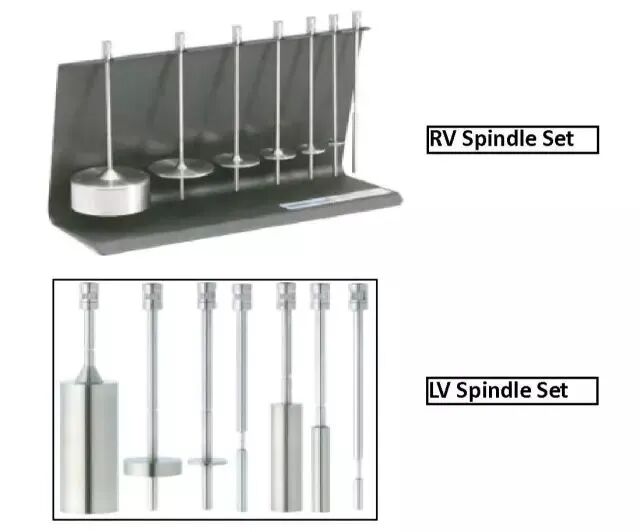
Applicable models
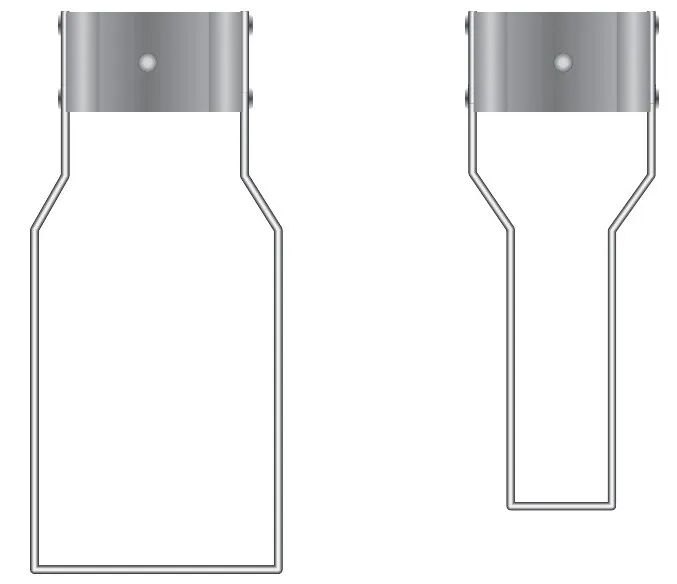
At present,Brookfield standard viscometer/RheometerThe leg guard is a U-shaped metal ring with a bracket, which is connected at the top to the shaft cup of the Bole viscometer/rheometer. Because it must be connected to the pivot cup, the cone type instrument cannot use leg guards. Leg guards are used for all LV and RV series instruments, but not for HA or HB series. The leg guards are designed for rotors and have the shape shown in the following figure. The left side is the RV leg guard and the right side is the LV leg guard. Due to the large diameter of the 2nd rotor of the RV, the RV leg guard (left) is wider than the LV leg guard (right), and the two cannot be used interchangeably.
Definition of measurement conditions
The calibration of Brookfield standard viscometer/rheometer requires the use of a 600 mL shallow beaker. The calibration of LV and RV series standard instruments must be equipped with leg guards. The beaker wall (HA/HB instrument) or leg guards (LV/RV instrument) define the "outer boundary" of the measurement. The rotor coefficients of LV, RV, and HA/HB rotors are calculated based on the above boundary conditions. The rotor coefficient is used to convert instrument torque (expressed as dial reading or% torque value) intoLi PoIn theory, if measurements are taken under different boundary conditions, such as without leg guards or in a non-600 mL beaker, the rotor coefficients in the coefficient table cannot be used for accurate calculation of absolute viscosity. The change of boundary conditions will not alter the viscosity of the fluid, but it will change the torque of the instrument converted into viscosity values. If the original rotor factor is still used under the new boundary conditions, the viscosity calculated by the instrument torque will be incorrect.

Real world applications
Actually, use LV and RV rotor sets (note: RV/The impact of leg guards is the greatest for rotors 1 and 2 in HA/HB (excluding rotor 1). Other LV (3&4) or RV (3)The correct results can be obtained with or without leg guards for rotors numbered 7 in a 600mL beaker. The HA/HB series viscometers/rheometers do not provide leg guards to reduce potential issues when measuring high viscosity materials. The 3rd to 7th rotors of HA/HB are the same as the RV rotor. HA/HB 1numberAnd 2numberThe rotor and RV rotor have slight differences in size. Different sizes allow RV and HA/HB1numberAnd 2Even under different boundary conditions, the rotor can cause the instrument torque to change in the same proportion.
Some users find it inconvenient to strictly follow the recommended steps, which involve using a 600ml beaker and leg guards. At the same time, leg guards are also a component that needs to be cleaned. In some applications, it may not be possible to immerse the rotor in a 500ml measurement sample in a 600ml beaker. In fact, smaller containers can be used and leg guards can be removed in actual production. Brookfield viscometer/rheometer can obtain accurate and reproducible torque readings in any measurement environment. However, only when the rotor coefficient is used under specified conditions, converting the torque reading to centipoise is correct.
In the book 'More Solutions to Sticky Problems', Brookfield introduces a method for recalibrating Brookfield viscometers/rheometers in any testing environment. It is worth noting that for many users of viscometers/rheometers, the actual viscosity value is not necessarily more important than the measurement value that can be repeated every day. Without changing the measurement environment, this repeated measurement value can be obtained. However, it must be noted that even if Brookfield coefficients are used, their boundary conditions do not comply with Brookfield regulations, so this type of torque reading cannot be converted to the correct centipoise value.