-
E-mail
15298818928@163.com
-
Phone
15298818928
-
Address
No. 27 Guotai North Road, Zhangjiagang City, Jiangsu Province
Jiangsu Guolang Machinery Manufacturing Co., Ltd
Structure, Application, and Operation Guide of WF Series Small Universal Crusher
Date: 2025-10-20Read: 3
In scenarios such as small-scale material processing in laboratories and production in small processing plants, the WF series small universal crusher has become a commonly used equipment for material crushing due to its adaptability to various materials. Its compact structural design and flexible usage can meet the low-dose crushing needs in fields such as medicine, food, and chemical engineering. Understanding its structural composition and operation methods can better leverage the practical value of the equipment.
1、 Adaptation scenario: covering small batch crushing needs in multiple fields
The WF series small universal crusher is suitable for processing small batches and multiple types of materials due to its compact size and easy operation. Common application scenarios include:
•pharmaceutical fieldUsed for crushing traditional Chinese medicinal materials (such as licorice and angelica) and Western medicine raw materials, meeting the needs of laboratory formula research and development or small batch production in small pharmaceutical factories. The crushing process can reduce material pollution and meet the hygiene requirements of the pharmaceutical industry.
•food sectorSuitable for crushing grains (such as rice and millet), nuts (such as walnuts and almonds), and spices (such as star anise and cinnamon), it can be used in home workshops or small food factories to produce meal replacement powders, seasoning powders, and other products. It is safe to operate and easy to clean.
•chemical engineering fieldProcessing small batches of chemical raw materials (such as resins and pigments), helping small chemical plants complete raw material pretreatment, equipment materials can withstand slight corrosion of some chemical materials, and reduce component loss.
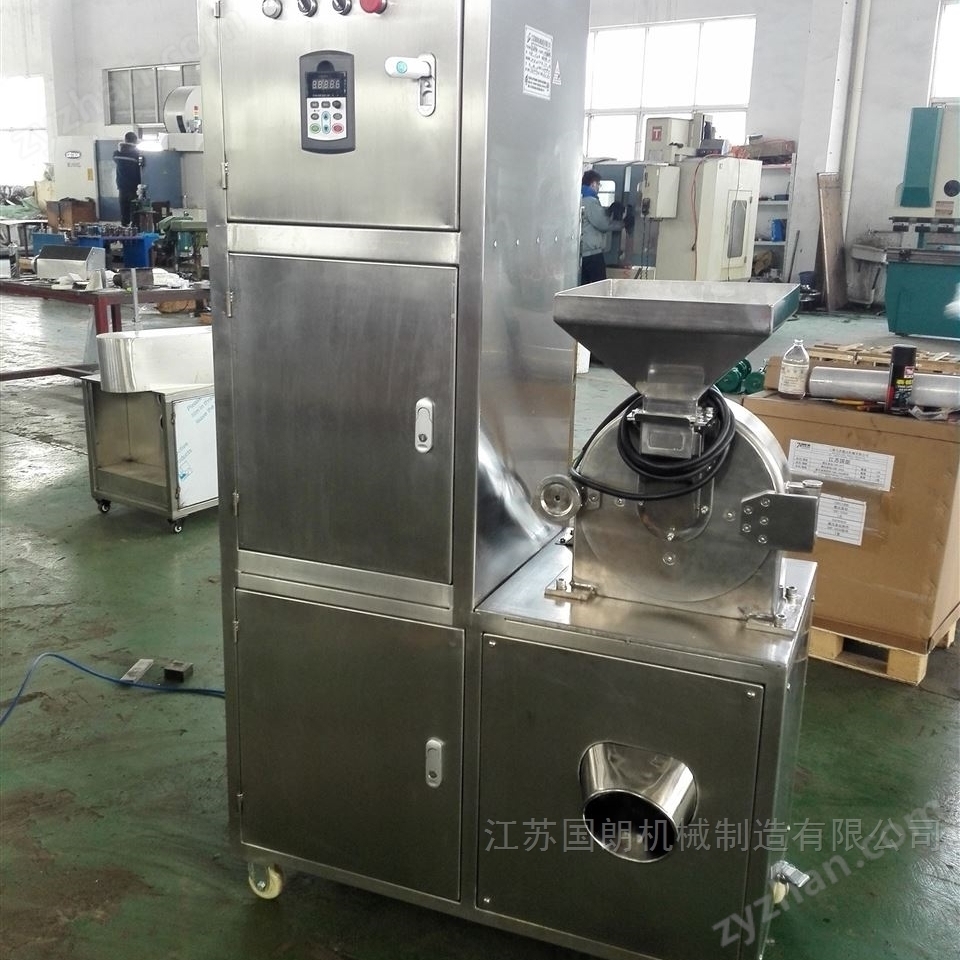
2、 Structural composition: Each component collaborates to achieve crushing function
The structure of the WF series small universal crusher is designed around "efficient crushing" and "convenient operation", with clear core component functions that can be understood without complex parameters:
•Feeding systemIt mainly consists of a feeding hopper and a feeding control device. The opening of the feeding hopper is moderate, making it convenient for manual or small conveying equipment to add materials; The control device can adjust the feeding speed to avoid material accumulation at the inlet of the crushing chamber and prevent equipment overload.
•Crushing chamber and crushing componentsThe crushing chamber is the core area for material crushing, and the inner wall is made of wear-resistant materials to reduce material residue and wear after long-term use; The chamber is equipped with a crushing hammer or teeth, which can impact and shear the material through high-speed motion to achieve material refinement. The crushing components of different materials can be adapted to materials of different hardness.
•Grading and screening deviceSome models are equipped with built-in screening screens, and the crushed materials need to pass through the screening screens before they can be discharged. Different aperture screens can be replaced according to needs to control the particle size of the finished product; If the material does not meet the fineness requirement, it will continue to be crushed in the crushing chamber to ensure uniform particle size of the finished product.
•Discharge systemComposed of a discharge port and a receiving container, the discharge port is designed to be inclined, facilitating the natural flow of materials and reducing the risk of residue; The receiving containers are mostly detachable, which facilitates the collection of finished products and subsequent cleaning. Some models are also equipped with dust-proof devices to reduce dust spillage during the crushing process.
•Drive and control componentsIncluding a motor and an operation panel, the motor provides power for the crushing components, with a compact size and stable operation; The operation panel is equipped with start and stop buttons, and some models have overload protection function. When the equipment is overloaded, it will automatically stop to avoid motor damage.
3、 Key points of operation and maintenance: Extend equipment lifespan and ensure effective use
Daily use and maintenance of WF series small universal crushers only require attention to basic operations and regular inspections to maintain stable equipment operation:
•Daily cleaningAfter each use, the feeding hopper, receiving container, and screening net need to be disassembled, and residual materials should be cleaned with a brush or damp cloth to avoid material clumping and affecting the next crushing effect; The crushing chamber can be cleaned by blowing with compressed air or wiping with a damp cloth, taking care to avoid moisture entering electrical components such as motors.
•regular inspectionCheck the wear of crushing components (such as crushing hammers and screens) weekly. If the edges of the crushing hammers become dull or the screens are damaged, replace them in a timely manner to prevent affecting the crushing efficiency; Check the connection between the motor and the crushing chamber every month to ensure that the screws are tightened and avoid abnormal vibrations during operation.
•Fault handlingIf the equipment is running with excessive noise, first check if there are any foreign objects (such as metal impurities) in the crushing chamber, clean them, and then restart; If the particle size of the discharge is uneven, check whether the sieve is blocked or damaged, and replace the sieve to improve it; If the device cannot be started, first check the power connection and overload protection device, eliminate the circuit problem, and then try to start it again.
The value of the WF series small universal crusher lies in its simple structure and flexible usage, which meets the crushing needs of small batches and multiple types of materials. Whether it is a laboratory, family workshop, or small factory, as long as the appropriate crushing components and operation methods are selected according to the material characteristics, and combined with basic operation and maintenance work, the equipment can continue to play a practical role, helping production and research and development work to proceed smoothly.