-
E-mail
1429495774@qq.com
-
Phone
13915805760
-
Address
No. 9 Hongshan Road, Jintan District, Changzhou City, Jiangsu Province
Jiangsu Weilong Intelligent Technology Co., Ltd
Plastic Bottle Serum Aseptic Filling Production Line: Process Disassembly and Value Interpretation
Date: 2025-10-28Read: 3
The sterile filling production line for plastic bottles of serum is based on the core principle of "full process sterility". It connects serum pretreatment, bottle preparation, filling and sealing through automated equipment to avoid contamination of serum by manual contact or environmental factors. At the same time, it controls the filling accuracy and temperature to ensure the biological activity and quality stability of serum products. It is a key facility for large-scale production of serum in the field of biological products.
1、 Process flow of sterile filling production line for plastic bottle serum
1Serum pretreatment and sterile assurance
The serum to be filled is first subjected to multi-stage filtration to remove microorganisms and impurities, ensuring that the serum itself meets sterile standards; Subsequently, it is transported to a sterile temporary storage tank, where a constant temperature environment of 2-8 ℃ is maintained to avoid temperature fluctuations affecting serum activity; During the temporary storage process, real-time monitoring of key indicators such as serum pH value and osmotic pressure is carried out to ensure compliance with filling requirements.
2Aseptic preparation of plastic bottles
Plastic bottles enter the cleaning station through a sealed conveyor belt and are sprayed with high-pressure purified water on the inner wall to remove surface dust and residual pollutants; After cleaning, enter the sterilization chamber and use wet heat sterilization or dry heat sterilization methods to ensure sterility inside and outside the bottle; The sterilized plastic bottles are transported to the filling station through a sterile conveyor belt, avoiding contact with non sterile environments throughout the process.
3Aseptic filling operation
The filling process is carried out in a Class 100 sterile filling room, and the serum is transported from the temporary storage tank to the quantitative filling system through sterile pipelines; The filling head adopts an anti drip design, injecting serum into the plastic bottle according to the preset dosage, while controlling the filling speed to avoid the generation of bubbles that may cause serum oxidation; During the filling process, the photoelectric sensor monitors the position of the bottle in real time to ensure precise alignment between the filling head and the bottle mouth, reducing serum spillage.
4Aseptic sealing and sealing testing
The plastic bottles that have been filled immediately enter the sterile sealing station, and the bottle mouth is sealed using ultrasonic sealing or sterile aluminum foil sealing to prevent the invasion of external microorganisms; After sealing, the sealing is checked by negative pressure detection or helium leak detection technology. If products with loose sealing are found, the equipment automatically sorts them to the non-conforming product channel to avoid flowing into subsequent processes.
5Finished product sterilization review and organization
Qualified products enter the secondary sterilization review stage to ensure the sterile state of the finished product; Subsequently, the labeling operation is carried out, and the label contains information such as production date, batch number, expiration date, storage conditions, etc; Finally, the labeled plastic bottles are packed according to specifications using automated packaging equipment and sent to a constant temperature warehouse for temporary storage, waiting for quality inspection.
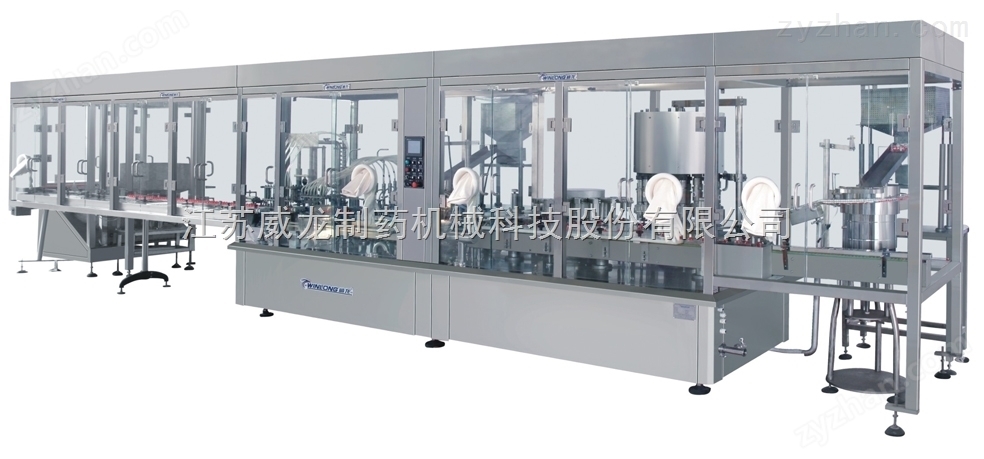
2、 The core value of the sterile filling production line for plastic bottle serum
1Strictly control pollution risks and ensure serum quality and safety
The entire process is designed with a sterile environment and sealed transportation, avoiding contact between serum and external air or human labor, significantly reducing the risk of microbial and particulate contamination; At the same time, through multi-stage filtration and sterilization review, ensure that the serum product meets the sterile standards of biological products, providing safety guarantees for subsequent scientific research or clinical use.
2Maintain serum activity and reduce the loss of active ingredients
Each link of the production line is equipped with a constant temperature control system, strictly controlling the temperature within the suitable storage range of serum to avoid denaturation of active ingredients in serum caused by high or low temperature; Low speed and bubble free design during the filling process reduces the contact time between serum and air, and minimizes the loss of activity caused by oxidation.
3Improve filling accuracy and ensure consistent product specifications
The quantitative filling system precisely controls the dosage through flow sensors and servo motors, with an error controlled within ± 1%, avoiding dosage deviation caused by manual filling; Unified filling and sealing standards ensure consistent specifications and sealing of each serum bottle, reducing quality issues caused by individual differences.
4Adapt to large-scale production and reduce manual dependence
The automation connection of various links in the production line, from serum pretreatment to finished product packaging, does not require manual intervention. A single production line can complete the filling of thousands of bottles of serum per hour, which is suitable for the large-scale production needs of serum; At the same time, it reduces manual operations, lowers the risks caused by personnel errors, and enhances production stability.
5Meets compliance requirements and facilitates quality traceability
The production line is equipped with a data acquisition system that records real-time parameters of each link. The data can be stored and exported for subsequent quality traceability and auditing; The equipment design and operation process comply with the quality management standards for biological product production, helping enterprises meet industry regulatory requirements.