-
E-mail
xiangdajixie@foxmail.com
-
Phone
13915230659,13921238921
-
Address
Xiangda Machinery Manufacturing Co., Ltd., No. 35 Zhuhuang Road, Zhutang Town, Jiangyin City
Jiangyin Xiangda Machinery Manufacturing Co., Ltd
The working principle and wide application of plow blade mixer
Date: 2025-08-29Read: 8
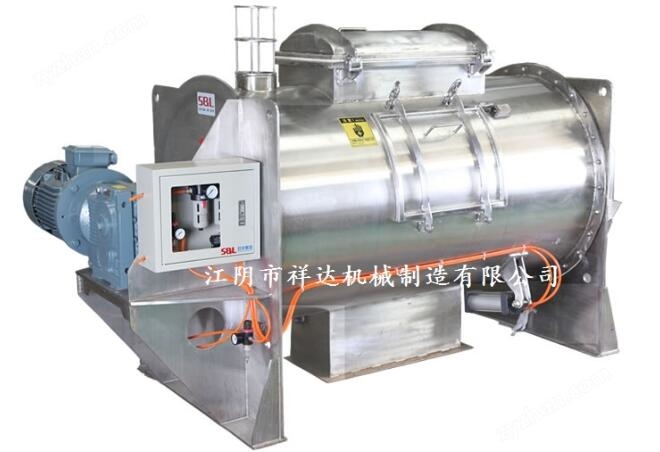
The plow blade mixer is an efficient powder mixing device, which works based on the synergistic effect of plow blades and flying blades to achieve rapid and uniform mixing of materials. The following will explain from two aspects: working principle and wide application:
The plow blade mixer is mainly composed of a transmission device, a horizontal cylinder, a plow blade group, and a flying blade group. During work:
1. Rotation function of plow blade: The plow blade rotates with the main shaft, pushing the material to make radial circumferential turbulence along the cylinder wall, and dividing it into bidirectional material flow, forming convective circulation.
2. Flying knife shear strengthening: When the material flows through the high-speed rotating flying knife, it is scattered and sheared, further refining and mixing, especially suitable for breaking up agglomerated powder materials.
3. Synergistic effect: The axial/radial motion of the plow blade combined with the shear action of the flying blade triggers turbulent flow of the powder, achieving rapid and uniform mixing (completed in a minimum of 45 seconds).
Some models are also equipped with spray devices or jackets that support heating/cooling processes.
Its versatility makes it suitable for multiple industries and material types:
1. Material adaptability: dry powder, short fibers, wet solids containing liquids, pastes, and high viscosity substances (such as ceramic clay and firefighting agents).
2. Typical processes: mixing, dispersion, suspension, degassing, granulation, agglomeration decomposition, and chemical reaction acceleration.
3. Industry coverage:
• Food (seasoning, biscuit paste), medicine (trace element mixture), cosmetics (powder and paste);
Chemical industry, building materials (refractory materials, pre mixed mortar), environmental protection (sludge treatment);
Special materials such as hard alloys, rubber, and plastics.
Laboratory models can also reduce research and development costs and handle expensive materials.