-
E-mail
mk.gdnc@gardnerdenver.com
-
Phone
4009001066
-
Address
No.18 Weiwu Road, Boshan Economic and Technological Development Zone, Shandong Province
Jidi Nashi Machinery Co., Ltd
Working principle and industry application analysis of steam injectors
Date: 2025-11-04Read: 3
Working principle of steam injector
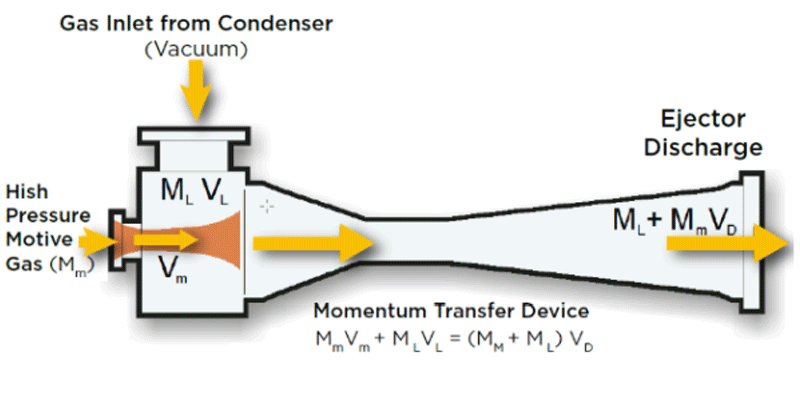
Steam injectors use steam or gas instead of moving parts to compress gas. In an injector, high-pressure gases such as steam or air expand through the nozzle. Steam or air converts pressure or potential energy into velocity or kinetic energy. The jet of high-speed steam or gas carries the gas to be evacuated or pumped in the suction port of the injector. The generated mixture enters the diffuser, and the velocity energy is converted into pressure at the outlet of the injector accordingly.
An air powered injector is commonly referred to as an air injector or jet. When there is no available steam, air is usually used on small injectors. When used in conjunction with NASH liquid ring vacuum pumps, they can use indoor air or pump exhaust as a power source to increase the vacuum level that the pump can achieve. When the vacuum system must be able to pull down to the vapor pressure of the deaerated water, it is usually used for applications such as degassing. This type of jet is very convenient to use because it does not require steam or pressurized air sources to make it work, only a vacuum pump is needed.
Steam injectors can also be combined with liquid ring vacuum pumps to form a composite system capable of generating high vacuum. The injector can provide this composite system, but with lower energy consumption. NASH has received praise for assembling more efficient steam and air injectors, as well as injector vacuum systems. Experienced application engineers ensure maximum efficiency and performance advantages, while optimizing customized composite systems to meet process, application, and technical requirements. NASH steam and air injectors can significantly reduce greenhouse gas emissions and improve operational efficiency, while also enhancing system stability.
The steam injector and injector/vacuum pump composite system is an ideal solution for applications in the oil and gas, chemical, power, and food and beverage industries.
•Reactor Vacuum (Chemical Industry) - Vacuum can lower the reaction temperature and save energy in the device. It can also be used to avoid polymerization reactions, adverse reactions, and thermal degradation.
•Solid drying in batch or continuous processes (chemical/food and beverage industry) - using vacuum to dry solids at lower temperatures. When processing thermal sensitive materials, it can help improve drying rate and reduce moisture concentration.
•Vacuum distillation (chemical/petroleum and natural gas industries) - Vacuuming and condensing products can separate two or more volatile components with different boiling points.
•Evaporator vacuum (chemical/food and beverage industry) - Concentrate liquid substances by boiling solvent (water). Many tasks are accomplished using condensers. Using vacuum can reduce energy costs and avoid damaging thermal sensitive products.
•Sugar vacuum pot (food and beverage industry) - After the sugar juice is concentrated by evaporation (see evaporator vacuum), vacuum is used to convert syrup into a crystalline state.
•Bleach and Deodorization (Food and Beverage Industry) - Use vacuum to remove color and contaminants from cooking oil.
•Condenser exhaust (power industry) - In order to optimize the expansion caused by steam passing through the turbine, it is necessary to maintain the turbine condenser in its optimal vacuum state. The vacuum must be maintained by removing the air leaking into the condenser.