-
E-mail
3530016889@qq.com
-
Phone
15662450880
-
Address
No. 189, 5th Floor, North Side of Building 1, Daode Mall, Huaiyin District, Jinan City, Shandong Province
Jinan Ruilaibo Intelligent Technology Co., Ltd
The core working principle of polarization stress analyzer for ampoules
Date: 2025-07-17Read: 3
The core working principle of ampoule polarization stress analyzer is based on stress birefringence effect and polarization interference.
1、 Stress birefringence phenomenon:
Glass itself is an isotropic material, and in an ideal state (stress free), it will not change the polarization state of light.
However, when glass is subjected to uneven forces (internal or external) during molding (such as tube drawing, bottle making) or cooling, its internal structure undergoes small, localized deformations or density changes.
This deformation causes the glass to exhibit properties similar to "anisotropic crystals" in these locally stressed areas. When light passes through these regions of force, it is decomposed into two polarized light beams (ordinary light o and extraordinary light e) with vibration directions perpendicular to each other and different propagation speeds. This phenomenon is called stress birefringence or photoelastic effect.
Key point: A phase delay difference (usually expressed in nanometers) is generated between the light beams (ordinary light and extraordinary light) passing through the glass, and the magnitude of this delay difference is proportional to the principal stress difference (σ ₁ - σ ₂) at that point inside the glass, as well as to the stress optical constant of the glass at that wavelength.
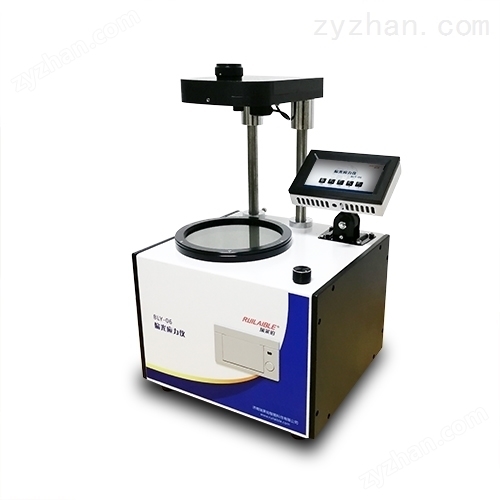
2、 Polarization interference detection:
The instrument is equipped with a special light source (usually monochromatic or white light with interference filter) and two polarizing plates inside.
The first polarizer (polarizer) is located behind the light source. Its function is to convert ordinary light into linearly polarized light (all light waves vibrate on the same plane).
Sample placement area: Linear polarized light passes through the ampoule being tested. If there is stress in the ampoule, due to the stress birefringence effect, this beam of linearly polarized light will be decomposed into two beams of linearly polarized light with phase difference and perpendicular vibration direction (ordinary light and extraordinary light).
Second polarizer (analyzer): located behind the sample, usually at a 90 degree angle (orthogonal) to the polarization axis of the polarizer. Its function is to allow only light in specific vibration directions to pass through.
Interference and color rendering:
When two polarized light beams carrying stress information (i.e. with phase difference) reach the analyzer, only the parts of their respective vibration components that are aligned with the direction of the analyzer's transmission axis can pass through.
These two components (originally perpendicular to the vibration direction) become light in the same vibration direction after the analyzer. Due to their origin from the same light source and passing through the same point, and the presence of phase differences, coherent interference occurs.
The result of this interference is manifested as:
Under monochromatic light: In the stress area of the ampoule, interference fringes with alternating light and dark patterns can be seen. The density and distribution of stripes directly reflect the magnitude and gradient of stress. The denser the stripes, the greater the stress gradient; The sparser the stripes, the smaller the stress gradient.
Under white light (with filter): The interference results in the production of colored patterns (isochromatic lines). Different colors correspond to different phase delay differences (i.e. different stress levels). Specific colors (such as purple and blue) usually represent low stress areas, while yellow, orange, and red represent high stress areas. Manufacturers usually provide standard color chart cards that associate observed colors with corresponding stress values (in nm).
Core points: The instrument irradiates ampoules with polarized light, changes the polarization state of light through the birefringence phenomenon caused by internal stress in the glass, and interferes with the beam carrying stress information through an orthogonal analyzer. Finally, the invisible stress is converted into visible stripes or colored patterns, thus achieving qualitative and quantitative evaluation of residual stress distribution inside the glass.