-
E-mail
sumcso@sumspring.com
-
Phone
15665715386
-
Address
16th Floor, Greenland Quanjing Yayuan Business Building, Yangguang New Road, Shizhong District, Jinan City
Jinan Sanquan Zhongshi Experimental Instrument Co., Ltd
The working principle of the bubble cover medicine board sealing tester
Date: 2025-12-11Read: 5
The working principle of the bubble cover medicine board sealing tester
In fields such as pharmaceutical packaging and food packaging, the sealing performance of products directly affects their shelf life, safety, and effectiveness. Therefore, accurate and efficient testing of the sealing of packaging materials is particularly important. The bubble cap drug board sealing tester, as a detection device based on the principle of colorimetric method, has been widely used in the industry due to its intuitive and reliable detection method. This article will provide a detailed introduction to the working principle, operation process, and key role of the bubble cap drug plate sealing tester based on the principle of color water method in evaluating the sealing performance of samples.
1、 Working principle
The MFY-05S bubble cap drug board sealing tester simulates the pressure changes of packaging materials under specific conditions to test their sealing integrity. The core lies in using colored water (often methylene blue solution to enhance observation effect) as a medium to form a certain depth of water layer in a vacuum chamber. When the test sample is placed on top of the water layer and the vacuum chamber is evacuated, a significant pressure difference is formed between the inside and outside of the sample. This pressure difference causes air (if there is a leakage channel) to escape from the interior of the sample through potential leakage points, and after releasing the vacuum, the sealing performance is evaluated by observing the recovery of the sample shape and whether the colored water penetrates into the interior of the sample.
2、 Operation process of MFY-05S bubble cover medicine plate sealing tester for Sanquan Zhongshi in Jinan
Preparation stage: First, inject an appropriate amount of water into the vacuum chamber and add an appropriate amount of methylene blue solution. Stir evenly to make the water appear clearly blue for subsequent observation. At the same time, place the test sample in the designated position above the vacuum chamber according to the testing requirements.
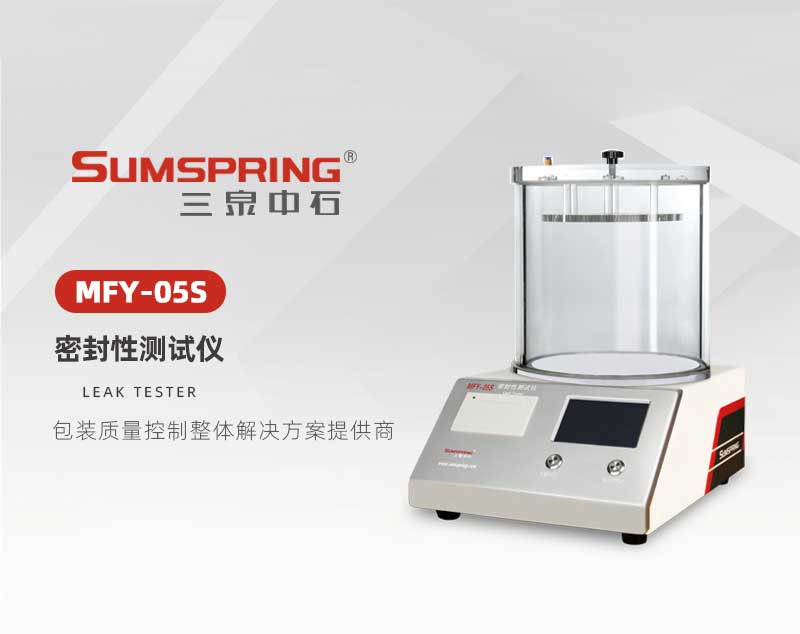
Vacuuming process: Start the vacuum pump to evacuate the vacuum chamber until the preset vacuum degree is reached. During this process, as the vacuum degree increases, the pressure difference between the inside and outside of the sample gradually increases, and possible small leakage channels will be amplified, allowing air or gas to escape from the inside of the sample outward.
Pressure holding and observation: After reaching the desired vacuum level, maintain it for a period of time (set according to the testing standards) to fully observe the reaction of the sample under pressure difference. At this point, if the sample is well sealed, its shape remains largely unchanged and color water will not seep in; If there is a leakage, it may be observed that the shape of the sample has changed, and colored water will seep into the interior of the sample along the leakage path.
Release vacuum and evaluation: Release the vacuum state inside the vacuum chamber and restore it to atmospheric pressure. Carefully observe whether there are traces of colored water infiltration on the surface of the sample, as well as the recovery of the sample shape. Based on the observation results and testing standards, determine whether the sealing performance of the sample meets the requirements.
3、 Advantages and Applications of MFY-05S Bubble Cover Medicine Plate Sealing Tester for Sanquan Zhongshi in Jinan
Intuitiveness: The application of colorimetric method makes the leakage phenomenon clear at a glance, and the sealing performance of the sample can be quickly determined without complex data analysis.
Efficiency: The testing process is simple and fast, improving detection efficiency.
Wide applicability: Not only suitable for blister pack packaging, but also for sealing testing of other types of packaging materials, such as bottle caps, hoses, etc.
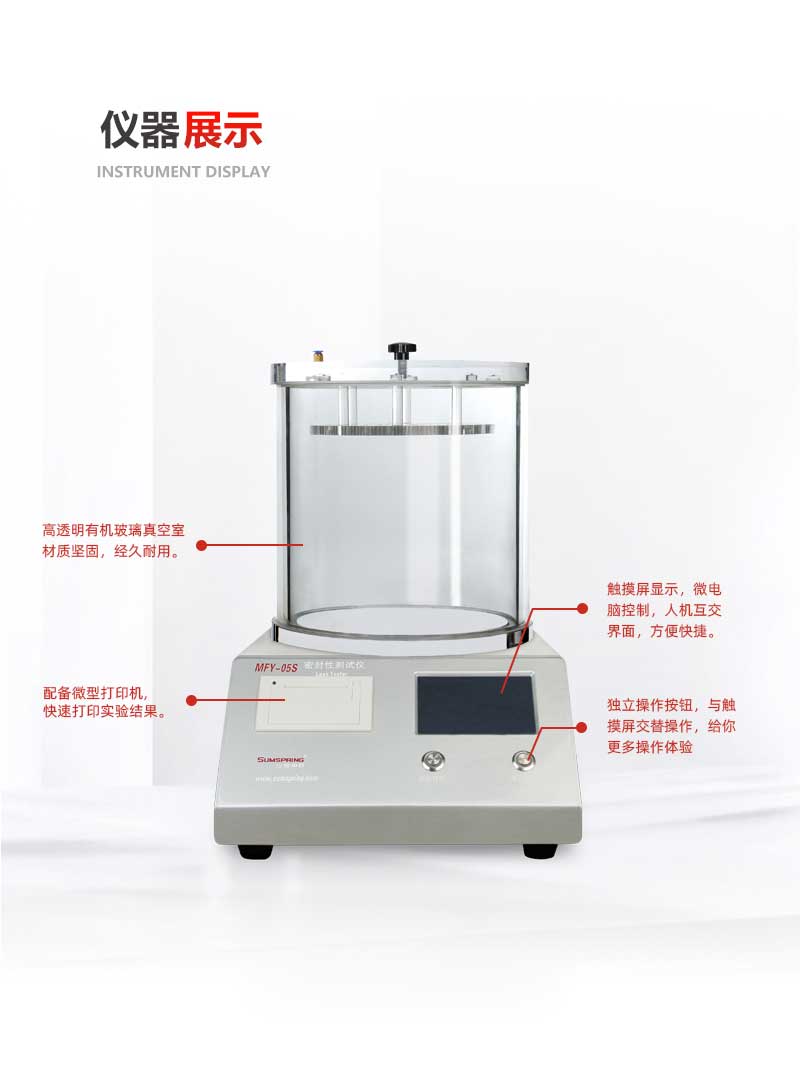
In summary, the MFY-05S blister drug board sealing tester from Jinan Sanquan Zhongshi provides an efficient, intuitive, and reliable solution for packaging material sealing testing with its unique colorimetric principle.