-
E-mail
734528265@qq.com
-
Phone
18615200928
-
Address
No. 96 Dangyang Road, Huaiyin District, Jinan City
Jinan Tianyu Special Equipment Co., Ltd
A Brief Analysis of the Structure and Principle of a Vibration type Ultra fine Grinding Machine
Date: 2025-12-23Read: 4
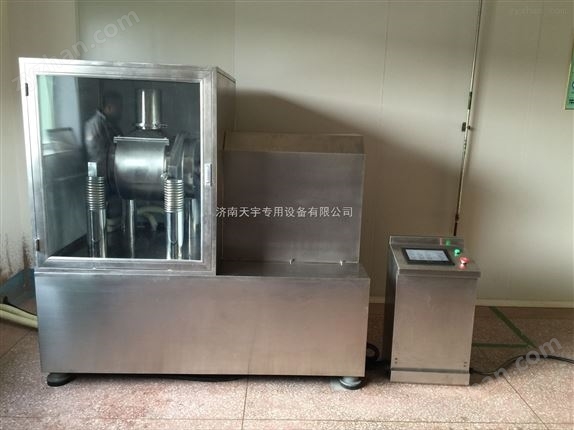
A vibrating ultrafine grinder is a device that uses high-frequency vibration and grinding media to achieve ultrafine grinding of materials. The vibrating ultrafine grinder achieves ultrafine grinding of materials through the composite effect of high-frequency vibration and grinding media, and is widely used in fields such as pharmaceuticals, food, and chemical engineering. Its core structure and working principle are as follows:
1、 Core structure
1. Cylinder and support system
The cylinder is usually cylindrical in shape and contains grinding media (such as steel balls, zirconia balls, etc.) inside. The cylinder is fixed by springs or elastic support devices to form a vibration system.
2. Exciter
Composed of an eccentric shaft and an eccentric weight, high-frequency vibration is generated through motor drive, causing the cylinder to move on an approximately elliptical trajectory, driving the grinding medium to impact and grind the material.
3. Feeding and discharging system
The feed inlet sends the material into the cylinder, and the discharge outlet controls the particle size of the finished product through a grading device (such as a grading wheel). Coarse particles return to continue crushing, while fine particles enter the collection system.
4. Auxiliary system
Including cooling devices (such as water cooling), dust removal systems (such as pulse dust collectors), and control systems to ensure stable and environmentally friendly crushing processes.
2、 Working principle
1. Vibration crushing mechanism
The high-frequency vibration generated by the exciter causes the grinding medium and material to be in a suspended state, resulting in projectile impact and extrusion grinding between the media. The material is crushed under the action of impact, friction, and shear forces.
2. Grading and Collection
Qualified materials enter the collection area through the grading wheel, coarse particles return to the crushing chamber for further crushing, and fine powder is filtered by the pulse dust collector before being discharged, achieving continuous operation.
3. Application of dry and wet methods
The equipment supports dry (such as minerals and ceramics) and wet (such as food and pharmaceuticals) crushing, and adapts to different material requirements by adjusting the medium and process.
3、 Equipment features
Efficient crushing: With high vibration frequency, the crushing fineness can reach the micrometer level.
Strong adaptability: capable of handling fibrous, high toughness, high hardness, or wet materials.
Environmental protection and energy saving: Noise control meets standards, and some models support liquid nitrogen ultra-low temperature crushing.