-
E-mail
shchaosheng@163.com
-
Phone
13853746518
-
Address
No. 666, Yingkelei Industrial Park, 327 National Road, High tech Zone, Jining City
Jining Shuanghe Ultrasonic Equipment Co., Ltd
What is the working principle of a continuous countercurrent ultrasonic extraction machine?
Date: 2025-08-22Read: 5
Continuous countercurrent ultrasonic extraction machine is an efficient extraction equipment that combines continuous countercurrent extraction technology and ultrasonic assisted extraction technology. Its working principle is mainly based on the following aspects:
1. Principle of continuous countercurrent extraction
Continuous countercurrent extraction technology is achieved by continuously pushing and flowing materials and solvents in opposite directions in the extraction tube, forming continuous countercurrent extraction. This design creates a continuous gradient of extraction solution concentration from the inlet to the outlet, maintaining stable solubility throughout the entire process. By using the minimum amount of extraction solvent in this way, the maximum extraction rate can be achieved.
2. Principle of Ultrasonic Assisted Extraction
Ultrasonic extraction technology utilizes various effects of ultrasound, such as cavitation, mechanical vibration, and disturbance, to accelerate the leaching of active ingredients. Specifically:
Cavitation effect: When ultrasound propagates in a medium, it produces tiny bubbles that, when closed, generate high pressure around them, forming micro shock waves that can damage plant cell walls and dissolve active ingredients in the solvent faster.
Mechanical effect: The propagation of ultrasonic waves in a medium can cause vibration of medium particles in their propagation space, thereby enhancing the diffusion and propagation of the medium and accelerating the leaching of effective components.
Thermal effect: The propagation process of ultrasound in a medium is also a process of energy propagation and diffusion. After the medium absorbs sound energy, it is converted into heat energy, causing the temperature of the medium to rise, thereby accelerating the dissolution rate of active ingredients.
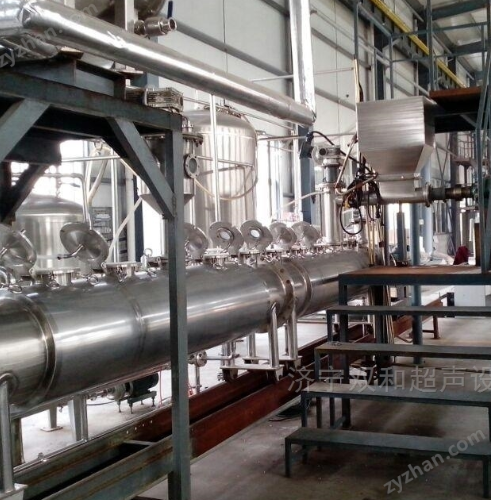
3. Equipment structure and workflow
The continuous countercurrent ultrasonic extraction machine usually includes the following main components:
Extraction tube: The material and solvent flow in reverse in the extraction tube, forming an efficient extraction process.
Ultrasonic transducer: installed inside or outside the extraction tube to generate ultrasonic waves to enhance the extraction effect.
Heating and insulation device: used to control the temperature during the extraction process to ensure extraction efficiency.
Condenser: Used to cool the volatile solvent during the recovery process, allowing it to re-enter the extraction tube.
During the work process, materials enter from one end of the extraction tube, while solvents are injected from the other end, and both flow in opposite directions inside the extraction tube. The ultrasonic waves generated by the ultrasonic transducer are transmitted through the extraction tube wall into the extraction solution, accelerating the extraction process. The extracted liquid is filtered and discharged from the outlet, while the slag is discharged from the slag discharge outlet.
4. Advantages and Applications
The continuous countercurrent ultrasonic extraction machine has the following advantages:
Efficient extraction: significantly reduces extraction time and improves extraction efficiency.
Energy saving and consumption reducing: Reduce extraction temperature and energy consumption, protect thermosensitive components.
High extraction rate: The effective ingredient extraction rate is high, and the extraction solution has fewer impurities.
High degree of automation: easy to operate, suitable for continuous production.
This device is widely used in fields such as traditional Chinese medicine extraction and natural plant extraction, and is particularly suitable for the extraction process of water and various organic solvents.
By combining continuous countercurrent technology and ultrasonic assisted extraction technology, the continuous countercurrent ultrasonic extraction machine has shown excellent performance in improving extraction efficiency, reducing energy consumption, and protecting active ingredients, making it an ideal choice in modern extraction processes.