-
E-mail
info@labcan.cn
-
Phone
18016316889
-
Address
No. 988 Jingtang Road, Jiading District, Shanghai
Kerun Experimental Equipment (Shanghai) Co., Ltd
Research progress | Pharmacological study of novel PAR-2 inhibitor E6795 in atopic dermatitis mice
Date: 2025-12-30Read: 4

2025year9Month, from multiple institutions including the Department of Dermatology at Kyoto University Graduate School of MedicineNaomi KitayamaThe research team, in《Biochemical and Biophysical Research Communications》The journal published an article titled“Targeting PAR-2 in atopic dermatitis: Preclinical evaluation of the novel inhibitor E6795”The research. This study focuses on atopic dermatitis(AD)The pathological mechanism of the novel protease activated receptor2(PAR-2)Small molecule inhibitorsE6795Conducted preclinical evaluation to explore its potential for improvementADThe role of inflammation, itching, and skin barrier dysfunction.
summary
Atopic dermatitis(AD)It is a chronic inflammatory skin disease characterized by eczema like skin lesions, severe itching, and impaired skin barrier function. Despite the emergence of new treatment methods, many patients still face problems such as inadequate disease control, high treatment costs, and disease recurrence. Protease activated receptor2(PAR-2)InADOverexpression in skin lesions plays a role in promoting inflammatory response, itching sensation, and epidermal homeostasis imbalance. This study providesE6795Preclinical research evidence suggests that this compound is a small molecule specifically designed to target the aforementioned pathological processesPAR-2Inhibitors. Kinase and pharmacological analysis confirmed that,E6795Selective inhibitionPAR-2It shows extremely low off target interactions in a wide range of kinase and pharmacological detection panels. In addition,E6795Improved in both mouse modelsADRelated endpoint indicators, including reduced inflammatory response and immune cell infiltration; Oral administration reduces transepidermal water loss(TEWLBut2%Local cream formulations improved histological manifestations and itching symptoms related to barrier function. Histological examination confirmed that,E6795After treatment, the infiltration of inflammatory cells decreases and the skin barrier function is enhanced. The research results indicate that,E6795Through selective inhibitionPAR-2Signal transduction, targeted actionADThe Three Pillars of Pathophysiology——Barrier dysfunction, inflammatory response, and itching. This study emphasizesE6795As a cost-effective new typeADThe potential of local therapeutic drugs.
experimentMaterials and Instruments
(1) Experimental materials
1. Experimental animals:11-12Zhou Ling's masculinityNc/NgaMice6-14Week old femaleBALB/cMice6-10Zhou Ling's masculinityC57BL/6JMouse.
2. Reagents and antibodies:MC903TheE6795ThePAR-2Exciting peptideSLIGKV-NH8322ndle;andSLIGRL-NH ₂Trypsin, thrombin, carboxymethyl cellulose, dimethyl sulfoxide, Uratan, various fluorescently labeled antibodiesFLIPRCalcium determination reagent, collagenaseIITypeDNase I、10%Formalin, hematoxylin-Eosin staining reagent, toluidine blue staining reagent, etc.
3. Cell and tissue samples: human embryonic kidneyHEK293Cells, healthy human skin samplesADSkin samples of patients with skin lesions.
(2) Experimental instruments
FDSS6000Fluorescence detection systemFACS FortessaFlow cytometryFlowJoSoftware, thickness gauge, scratch measurement system384Pore polypropylene reagent storage plateICollagen coated with transparent black background384Orifice plate, ventilation cage, microscope and image analysis systemASCHVaposcanTransdermal moisture loss measuring instrument
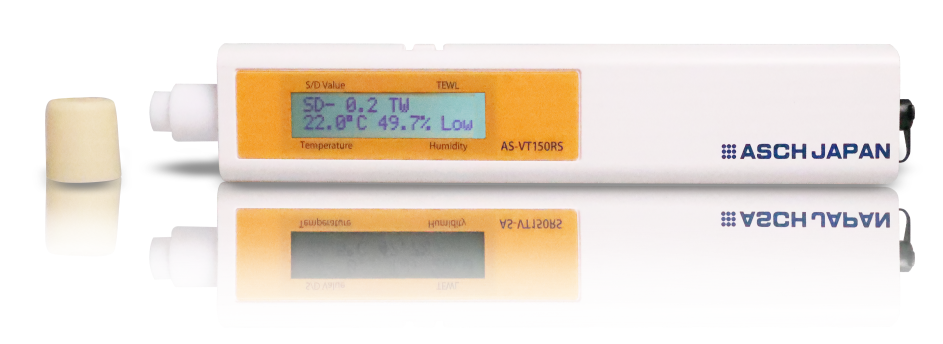
ASCH VAPOSCANTransdermal moisture loss measuring instrument
Experimental Procedure
1. Cell experiment:HEK293Cells contain3%Fetal bovine serumDMEMCultivate in medium and inoculate in384Load behind the orifice plateFLIPRCalcium determination reagent, adding different concentrationsE6795preprocessing30Minutes, then add trypsin or thrombin, and pass throughFDSS6000system monitoring120Real time fluorescence intensity within seconds, using four parameterslogisticmodel calculationIC₅₀Value.
2. Animal model construction and drug administration:
○MC903induceADModel:BALB/cMouse ear continuous8Topical applicationMC903From the4From now on, take orally daily containingE6795The carboxymethyl cellulose suspension was administered to the control group with the corresponding solvent.
○Nc/NgaseriousADModel: For those with dermatitisNc/NgaMice are divided into5Group, daily topical applicationE6795Cream, continuous7Tian, set the untreated group as the biological control.
3. Pharmacodynamic evaluation:
Skin barrier function: throughASCHVaposcanTransdermal moisture loss measuring instrumentMeasure the0、3、7The loss of moisture from the epidermis of the skyvalue(TEWL); Measure the thickness of mouse ears daily using a thickness gauge.
ASCH VAPOSCANTransdermal moisture loss measuring instrument
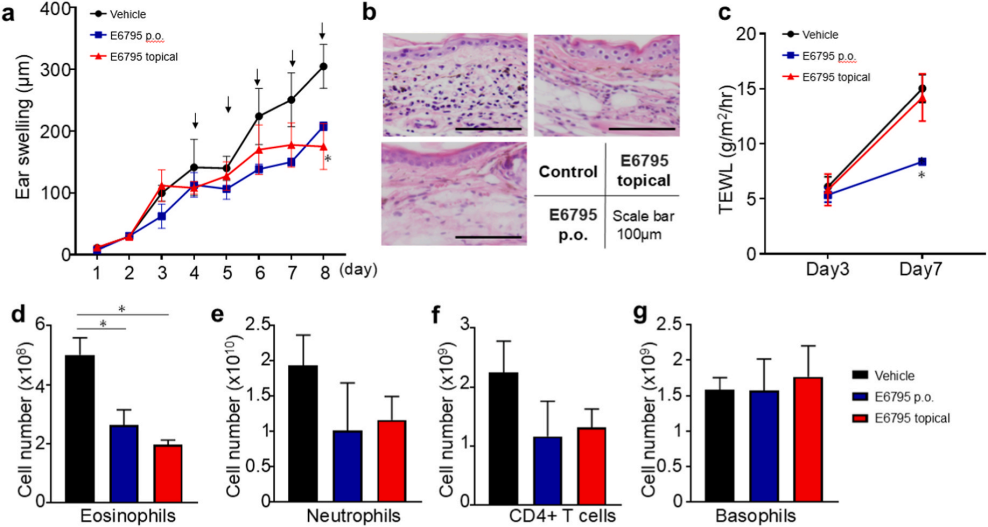
(c)第3 Tian and Di7 The water loss of the epidermis in the sky(TEWL)Test results. Compared with the solvent control group,E6795Oral administration in the first place7 The sky can significantly decreaseTEWLThe data is expressed as mean ± standard error (except for Section)8 Tian Oral Administration Groupn=3Outside, other groupsn=4).* correctedP < 0.05Compared with the solvent control group (Dunnett test)
○Itching behavior detection: in section7sky17:00Until the next day07:00Place the mice separately in the measuring cage, and then2After the hour adaptation period, record it through a scratch measurement system12The frequency of scratching behavior within an hour.
○Histological and immunohistochemical analysis: Collect mouse ear skin tissue at the end of the experiment, fix it with formaldehyde, embed it in paraffin, and prepare it5μmSlice and performH&EStaining (observing inflammatory cell infiltration and epidermal thickness), toluidine blue staining (counting mast cells), andPAR-2Immunohistochemical staining; Human skin samples are also subjected to the same procedurePAR-2Immunohistochemical testing.
○Flow cytometry analysis: Mouse ear skin tissue was enzymatically hydrolyzed to prepare single-cell suspension, stained with fluorescently labeled antibodies, and then passed throughFACS FortessaDetect eosinophils, neutrophilsCD4⁺TThe infiltration of immune cell subpopulations such as cells and eosinophils is expressed as the absolute number of cells per square millimeter of ear skin.
4. Pharmacokinetic study: detection of mice in vivoE6795Plasma free fraction, whole blood free fraction, and blood-Evaluate the whole-body absorption and distribution characteristics of the plasma ratio.
5. Selective analysis: using kinase selectivity panel andCEREPPharmacology Combined Panel, Detection1μMand10μMUnder concentrationE6795Evaluate the off target activity of various kinases, receptors, and ion channels through their inhibitory effects.
6. Statistical analysis: usingGraphPad Prism 7.03Software, using one-way analysis of variance(one-way ANOVA)CombiningDunnettMultiple comparison test, toα=0.05To verify the level, the data is presented as the mean±Standard error(mean±SEM)Expressed.
empirical conclusion
1. E6795Highly effective and selectivePAR-2Inhibition activity, in the measurement of cellular calcium fluxIC₅₀value6.56nMYes, that's rightPAR-1No inhibitory effect and extremely low off target activity in a wide range of kinase and pharmacological panels.
2. Pharmacokinetic displayE6795Orally absorbable, although the plasma protein binding rate is as high as97.5%However, a small amount of free medication can exert therapeutic effects.
3. Immunohistochemical confirmationADIn the patient's keratinocytesPAR-2Higher expression compared to healthy individuals.
4. InMC903inducedADIn the mouse model,E6795Both oral and local administration can reduce eosinophil infiltration, while oral administration can lowerTEWLImproving skin barrier function, local administration can reduce ear thickness.
5. InNc/Nga ADIn the mouse model,2% E6795Cream can reduce epidermal thickness, infiltration of mast cells, and scratching behavior, and improve histological manifestations related to dermatitis.
6. E6795Through selective inhibitionPAR-2Signal, targetingADThe three core components of pathophysiology (inflammation, itching, and barrier dysfunction) have the potential to serve as cost-effective, minimally invasive local therapeutic drugs.