-
E-mail
2594479801@qq.com
-
Phone
13304008117
-
Address
No. 26 Libo Center, Minhang District, Shanghai
Laitelide (Shanghai) Water Treatment Equipment Co., Ltd
Ultra pure water equipment "baths" chips, improving chip yield rate
Date: 2025-12-27Read: 6
The manufacturing conditions for chips are extremely demanding, with thousands of processes involved. With the accumulation of thousands of processes, the overall yield rate of chips is bound to be dismal. So, in the process of chip manufacturing, 30% of the time is spent on one thing, which is "bathing", professionally called wet cleaning.
To "bathe" the chip, ultrapure water is needed, which is simply pure water so pure that even fish cannot survive. Turning tap water into ultrapure water will result in a loss of about 30-40% of the water, and the electrical resistivity of the water will reach 18.2M Ω· cm. Only then can ultrapure water "bathe" the chips on various production lines.
Ultra pure water is a level that is difficult to achieve by general processes. By using four steps of pretreatment, reverse osmosis technology, ultra purification treatment, and post-treatment, as well as multiple treatment methods such as multi-stage filtration, high-performance ion exchange units, ultrafiltration filters, ultraviolet lamps, and TOC removal devices, the resistivity can reach 18.2 M Ω. cm.
The production steps of ultrapure water are as follows:
1. Preprocessing
Including sand filtration, multi-media filtration, softening, chlorination, pH adjustment, activated carbon filtration, degassing, etc. Filtering can remove particles of 1-20 microns in size, softening and adjusting pH can prevent fouling of reverse osmosis membranes, and adding chlorine is for sterilization.
2. Desalination: including reverse osmosis and ion exchange.
Reverse osmosis is the reverse process of permeation phenomenon. By applying pressure to a concentrated solution, the solvent is reverse permeated from the concentrated solution side through a semi permeable membrane to the dilute solution side. Desalination can reach 98%, and 99% of bacterial particles and organic matter dissolved in water can be removed.
The principle of ion exchange is that when water passes through a cation exchange resin, the cations in the water are adsorbed by the cation exchange resin. The exchangeable cations on the resin, such as H ions, are displaced into the water and combine with the anions in the water to form corresponding inorganic acids, such as ultrapure water. This water containing inorganic acids is then adsorbed by the anion exchange resin when it passes through the anion exchange resin layer.
3. Precision processing
The exchangeable anions on the resin, such as OH ions, are displaced into water and combine with H ions in the water to form water, which is called ultrapure water purification treatment, including ultraviolet sterilization, terminal membrane filtration, and ultrafiltration. Ultraviolet sterilization is caused by the absorption of ultraviolet light energy by biological nucleic acids, which changes the structure of the nucleic acid itself, destroys its function, and causes bacterial death. Various membrane filters can remove particles with a diameter greater than 0.2 microns, but they are not as effective as reverse osmosis and ultrafiltration in removing organic matter.
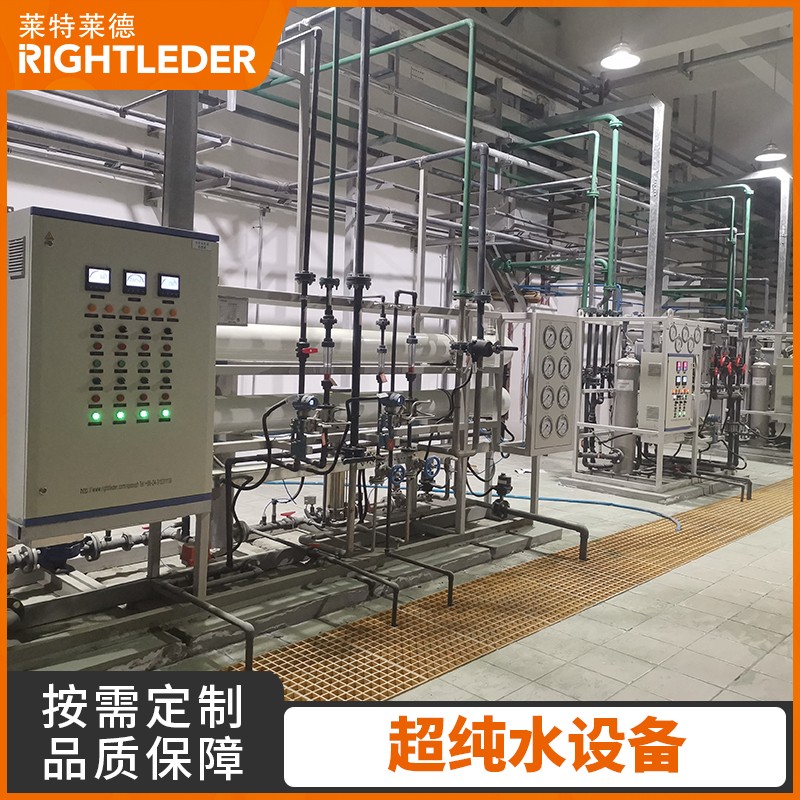
The Literide ultra pure water equipment has a compact structure, reasonable management distribution, and is simple, making it an integrated intelligent system. In chip production, the ultra pure water produced can ensure the yield rate of chips and is a high-quality choice.