-
E-mail
851012694@qq.com
-
Phone
13916683657
-
Address
No. 9 Kesheng Road, Zhongshan Science and Technology Park, Jiangbei New District, Nanjing City
Nanjing Haizhizhou Heating and Cooling Equipment Co., Ltd
Classification, Function, and Resistance of Air Conditioning Temperature Sensors
Date: 2025-07-21Read: 7

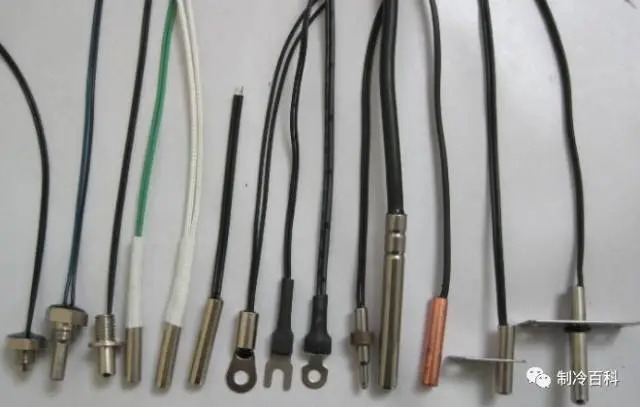
Negative temperature coefficient (NTC) thermistor, whose resistance decreases with increasing temperature (temperature ↑ → resistance ↓). Fast response, low cost, widely used for indoor/outdoor temperature detection of household air conditioning. Platinum resistor (PT1000), the resistance increases with temperature (temperature ↑ → resistance ↑). High precision and strong stability, commonly used in commercial air conditioning or precision temperature control scenarios. There are several common types:
1. Indoor ambient temperature sensor: The indoor ambient temperature sensor is usually installed at the outlet of the indoor unit heat exchanger. Its main functions are threefold: firstly, to detect the indoor temperature during cooling or heating, and control the operation time of the compressor; The second is to control the working status in automatic operation mode; The third is to control the speed of the indoor fan.
2. Indoor coil temperature sensor: The indoor coil temperature sensor adopts a metal shell and is installed on the surface of the indoor heat exchanger. Its main functions are four: first, to prevent supercooling protection during refrigeration; The second is to prevent overheating protection during heating period; The third is to control the speed of the indoor fan motor; The fourth is used to assist in outdoor defrosting during the heating period.
3. Outdoor ambient temperature sensor: The outdoor ambient temperature sensor is installed on the outdoor heat exchanger through a plastic frame. Its main functions are twofold: one is to detect the outdoor ambient temperature during cooling or heating, and the other is to directly control the outdoor fan speed.
4. Outdoor coil temperature sensor: The outdoor coil temperature sensor adopts a metal shell and is installed on the surface of the outdoor heat exchanger. Its main functions are threefold: one is to prevent overheating during cooling, the other is to prevent freezing during heating, and the third is to control the temperature of the heat exchanger during defrosting.
5. Compressor exhaust temperature sensor: The compressor exhaust temperature sensor also uses a metal shell and is installed on the compressor exhaust pipe. Its main functions are twofold: first, to detect the temperature of the compressor exhaust pipe and control the opening degree of the expansion valve to regulate the compressor speed; second, to protect the exhaust pipe from overheating.
Usually, manufacturers determine the resistance value of the temperature sensor based on the parameters of the air conditioning indoor unit microcomputer control motherboard. Generally, the resistance value decreases with increasing temperature and increases with decreasing temperature.
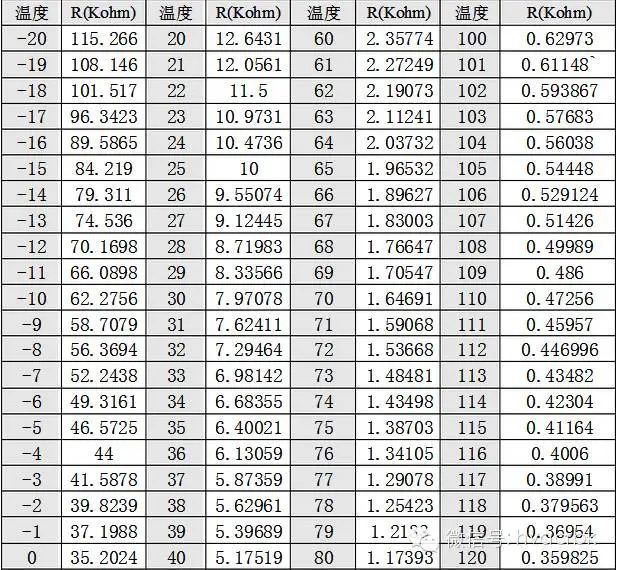
Temperature Resistance Comparison Table for Air Conditioning Pipe Temperature Sensor (10K) Unit: Temperature ℃/Resistance K