-
E-mail
851012694@qq.com
-
Phone
13916683657
-
Address
No. 9 Kesheng Road, Zhongshan Science and Technology Park, Jiangbei New District, Nanjing City
Nanjing Haizhizhou Heating and Cooling Equipment Co., Ltd
What are the typical manifestations of insufficient refrigerant in air conditioning?
Date: 2025-08-28Read: 5
The cooling effect has significantly decreased
Refrigerants play a crucial role as heat carriers in air conditioning systems. Once the refrigerant inventory is too low, its efficiency in absorbing heat will sharply decrease. During the operation of the air conditioner, the indoor heat that should have been quickly transferred to the outside cannot be effectively discharged due to insufficient refrigerant, resulting in a significant reduction in the overall cooling effect.

The phenomenon of frosting on the liquid supply pipe is prominent
Insufficient refrigerant leads to a decrease in pressure inside the liquid pipe, resulting in a corresponding decrease in the boiling point of the refrigerant. When the pressure inside the liquid pipe is lower than the saturated vapor pressure at ambient temperature, the refrigerant will start boiling at the valve, causing a sudden drop in local temperature and forming frost.
Abnormal increase in compressor temperature
When the refrigerant circulation decreases, the compressor cannot receive sufficient cooling, and its internal components will experience high exhaust temperatures during prolonged high-temperature operation. This not only accelerates the wear and tear of the compressor, shortens its service life, but may also cause a series of failures, affecting the stable operation of the entire air conditioning system and causing unnecessary trouble and losses to users.
The temperature difference between the inlet and outlet air has significantly decreased
Insufficient refrigerant can lead to a decrease in the evaporation efficiency of the evaporator. When air passes through the evaporator, it cannot receive sufficient cooling, resulting in a smaller temperature difference between the air blown out from the air conditioning outlet and the indoor air. Users will clearly feel that the air blown by the air conditioner is not cool enough, and the cooling effect is not as good as before, as if the cooling capacity of the air conditioner has been "weakened".
The temperature of coil heat exchange increases
The refrigerant flows inside the coil and carries away heat through heat exchange. When the refrigerant flow rate decreases, the accumulated heat inside the coil is difficult to remove in a timely manner, resulting in an increase in the heat exchange temperature of the coil. This not only reduces the cooling efficiency of the air conditioner, slowing down the indoor cooling rate, but may also lead to an increase in energy consumption of the air conditioning system, increasing the cost of use for users.
The opening of the electronic expansion valve increases
Electronic expansion valve is a key component for controlling refrigerant flow in air conditioning systems. When the refrigerant is insufficient, the system may mistake it for a flow issue and automatically increase the opening of the electronic expansion valve in an attempt to increase the refrigerant flow.
Low outdoor unit pressure
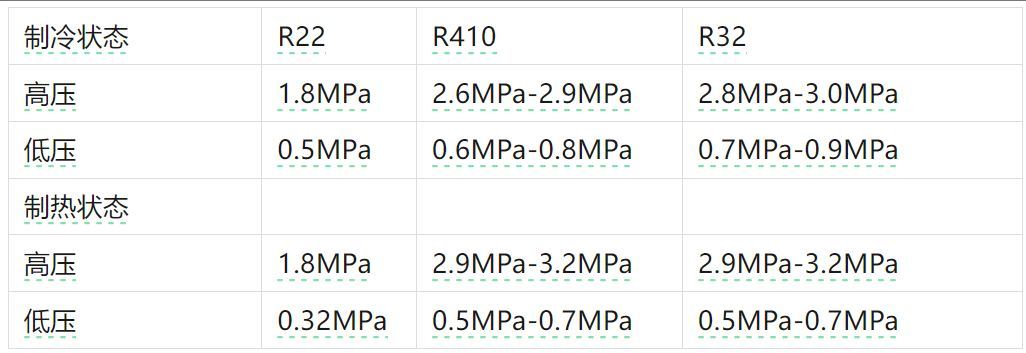
When the refrigerant decreases, the efficiency of condensation and evaporation will decrease, resulting in lower high and low pressures of the outdoor unit.
Compressor overheating and high top temperature
Similar to the principle of compressor overheating mentioned earlier, the low refrigerant circulation makes it difficult to effectively release the heat generated by the compressor during operation. Especially at the top of the compressor, due to relatively poor heat dissipation conditions, the temperature will be higher. Long term exposure to such high temperatures can have a serious impact on the performance of the compressor, potentially causing damage to the compressor and affecting the normal use of the air conditioner.
image
The tracheal valve is dry and has no cooling sensation
Under normal circumstances, there should be a certain degree of coolness at the tracheal valve. But when the refrigerant is insufficient, the boiling endpoint inside the evaporator will arrive earlier. This increases the superheat of the refrigerant in the valve, causing the valve temperature to rise and ultimately exceed the dew point temperature of the outdoor air. Therefore, when touching the tracheal valve with your hand, you will feel dry and lack obvious coolness, which is also an intuitive manifestation of insufficient refrigerant.
Partial evaporator condensation or frosting
Open the indoor unit panel and remove the filter screen. If condensation or frosting is found on some evaporators, it is likely due to insufficient refrigerant. Due to insufficient refrigerant, only a portion of the evaporator can boil and absorb heat, resulting in a corresponding reduction in cooling area and inability to fully cover the surface of the evaporator, leading to partial condensation or frosting, which affects the cooling effect of the air conditioner.
Outdoor unit exhaust lacks thermal sensation
Insufficient refrigerant can lead to a decrease in both condensing pressure and condensing temperature. During the operation of the air conditioner, the outdoor unit is responsible for dissipating heat outside, and the decrease in condensation temperature will cause the exhaust temperature to also decrease. Therefore, when we approach the outdoor unit, we may feel that the discharged air lacks thermal sensation, unlike the obvious hot air discharge during normal cooling, indicating that the cooling effect of the air conditioner may be affected by insufficient refrigerant.
The condensation water in the water tray decreases
The reduction of the cooling area of the evaporator will directly affect the condensation area. Due to insufficient refrigerant, the evaporator cannot fully exert its cooling effect, resulting in a corresponding reduction in condensation area and a decrease in condensation water volume. The condensation water in the water receiving tray mainly comes from the condensation of the evaporator, so the condensation water in the water receiving tray will naturally decrease significantly, which is also an indirect manifestation of insufficient refrigerant.
The working current of the compressor is less than the rated current
When measuring the working current of the compressor, if it is found to be less than the rated current, it is often a signal of insufficient refrigerant. Due to insufficient refrigerant, the working load of the compressor will be reduced. According to electrical principles, the current will decrease when the load is reduced. Through professional current detection equipment, the working current of the compressor can be accurately measured to determine whether there is a shortage of refrigerant, so as to take timely measures to deal with it.
Low pressure at the fluorine filling port of the outdoor unit
The pressure value measured from the fluorine filling port of the outdoor unit is also an important basis for determining whether the refrigerant is sufficient. When the refrigerant is insufficient, it will cause a decrease in evaporation pressure, resulting in a lower measured pressure value.