-
E-mail
2553933004@qq.com
-
Phone
13566621953
-
Address
Building 5, Senxiang Science and Technology Park, 367 Buzheng East Road
Ningbo Guante Refrigeration Technology Co., Ltd
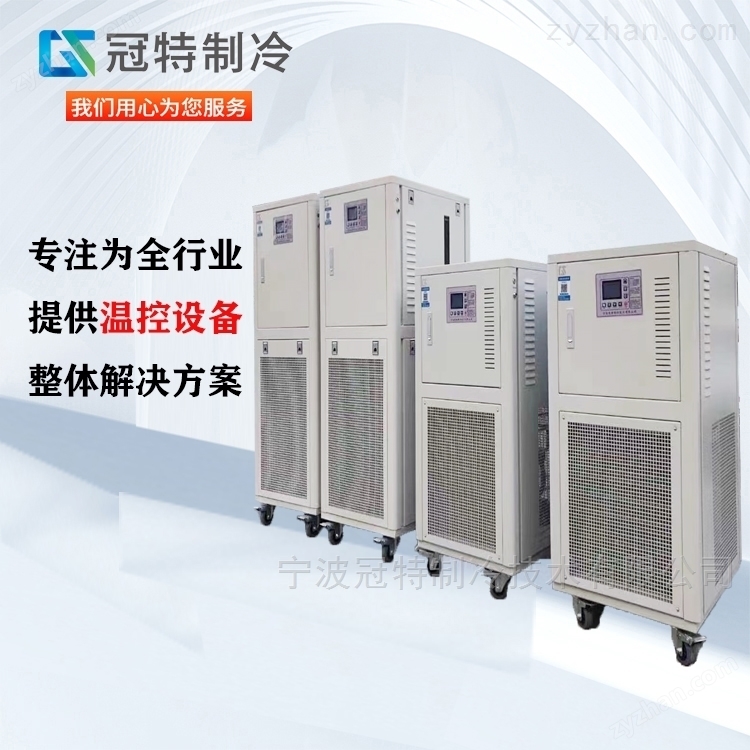
What is the working principle of the low-temperature refrigeration cycle water temperature machine?
Date: 2025-07-25Read: 7
The working principle of the low-temperature refrigeration cycle water temperature machine is based on the compression refrigeration cycle, which transfers heat through the phase change of refrigerant and the circulation of cooling water to achieve efficient low-temperature cooling. The specific process includes the following steps:
1. Compressor compression: Low temperature and low pressure refrigerant gas (such as R22) is compressed by a compressor into high temperature and high pressure gas, increasing its energy state.
2. Condensation heat dissipation: High temperature and high pressure refrigerants enter the condenser and dissipate heat through air or water cooling, condensing into low-temperature and high-pressure liquids.
3. Throttle cooling: The refrigerant liquid flows through the expansion valve and is throttled, causing a sudden drop in pressure and temperature, becoming a low-temperature and low-pressure liquid.
4. Evaporative heat absorption: Low temperature and low-pressure refrigerants absorb heat from cooling water in the evaporator, boil and evaporate into gas, while the temperature of the cooling water decreases.
5. Cooling water circulation: The circulating pump drives the cooling water (or specialized coolant) to flow through external equipment (such as reaction vessels or instruments), absorb the heat generated by the equipment, and then raise the temperature; The heated water returns to the evaporator, and the heat is absorbed by the refrigerant. The water temperature decreases and is then pumped back to the equipment, forming a closed-loop cycle. The entire system continuously transfers heat and achieves stable low-temperature output through the coordination of refrigerant state changes and water circulation.
This system is commonly used in laboratory instruments, industrial refrigeration, and other scenarios to ensure efficient operation of equipment in low-temperature environments.