-
E-mail
shenbiaobiao@zryq.cn
-
Phone
19589992149
-
Address
No. 11 Yuehe Road, Chengyang District, Qingdao City, Shandong Province
Qingdao Zhongrui Intelligent Instrument Co., Ltd
What is the interpretation of smoke sampling parameters for smoke velocity and smoke density, 1.34?
Date: 2025-12-05Read: 2


A thorough explanation——
Smoke flow rate and smoke density
Key parameters of smoke and dust comprehensive tester
Smoke flow velocity VsIt is an important parameter for smoke sampling and smoke emission calculation, and its numerical value will affect itConstant sampling flow rate, working condition/standard condition volume, flue gas/standard dry flow rate, flue gas emissionsWaiting for the results. Therefore, the determination of flue gas velocity is a crucial step.

01 S-type Pitot Tube and Correction Factor
The commonly used method for on-site smoke velocity measurement isS-type Pitot TubeIt is composed of two identical metal tubes connected in parallel, with two openings in opposite directions at the measuring end. According to the size differences made by various manufacturers, it is necessary to setPitot tube coefficient KpRevise it as shown in Figure 1.
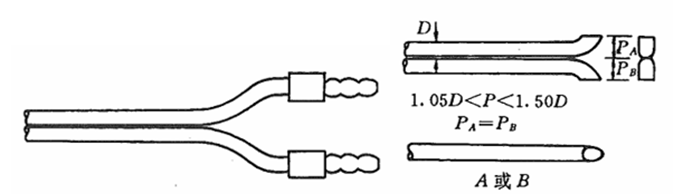
Figure 1 Pitot Tube Structure Diagram
The method for determining the correction coefficient is standard wind tunnel testing, which can refer to the calibration values provided by the manufacturer in practical applications,Usually 0.84Before leaving the factory, the manufacturer will measure the pitot tube synchronously with the standard flow meter and deduce the pitot tube coefficient through a formula.

02 Measurement of Dynamic and Static Pressure and Flow Velocity
When measuring flow velocity, the pressure measured at the opening facing the airflow is the total pressure, and the pressure measured at the opening facing away from the airflow is the static pressure. The difference between the two is the dynamic pressure, and the higher the dynamic pressure, the faster the flow velocity. Therefore, the pitot tube has a ▲ P+full pressure sensor at one end and a ▲ P - dynamic pressure sensor at one end. As shown in Figure 2.
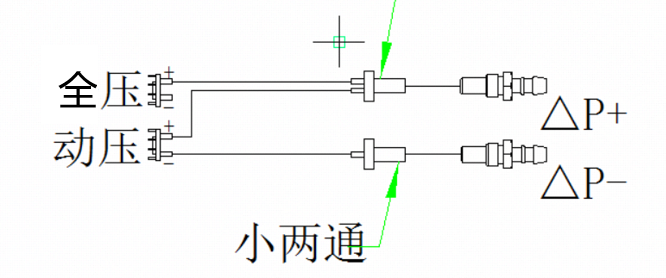
Figure 2 Schematic diagram of pitot tube dynamic and static pressure sensor
By measuring the dynamic pressure of flue gas, the velocity of flue gas can be calculated as follows:
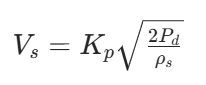
In the equation,
Vs - smoke velocity, m/s;
Kp - Pitot tube coefficient, generally 0.84.
Pd - dynamic pressure of flue gas, Pa; (measured by actual pitot tube)
ρ s - Wet flue gas density under operating conditions, kg/m³(With)Related to moisture content and smoke component content
03 Smoke density:
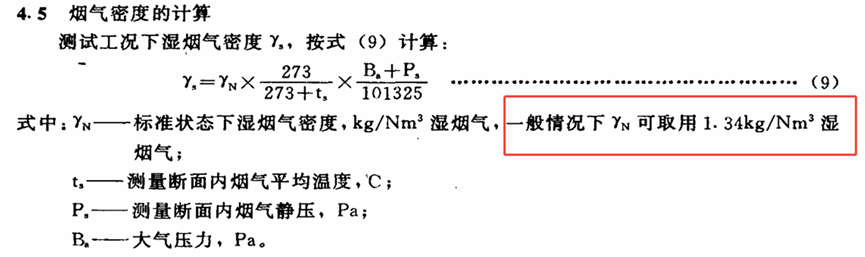
Why default to 1.34kg/m ³ under standard conditions
Many monitoring personnel may wonder, "Why isn't the smoke density a fixed value? Is the number 1.34 fabricated. Actually, this value comes from the national standard(GB5468-91 "Boiler Smoke and Dust Testing Method")It is a scientific value derived based on the actual composition of boiler flue gas.
However, in actual flue gas ducts, the content of flue gas often varies significantly due to different processes, especially with the ultra-low emission transformation, the moisture content in the flue gas duct is often higher. Therefore, its wet flue gas density is not a fixed value. In theory, it is necessary to measure the composition and moisture content of the flue gas each time, and then calculate the accurate input flue gas density.
Finally, let's derive ρ s in detail
Wet flue gas density under standard conditions:

Ms - the molecular weight of the exhaust gas. The exhaust gas in the flue is a mixture of moisture after combustion, and the corresponding molecular weight of the exhaust gas needs to be calculated according to the following formula.

For example, when the oxygen content in the flue gas of a typical coal-fired boiler is 6%, the nitrogen content is 80%, the CO2 content is 14%, and the moisture content is 8%, calculate:

According to the ideal gas state equation PV=nRT,
Wet flue gas density under operating conditions:

Among them, Ba - atmospheric pressure;
Ps - Static Pressure
Ts - exhaust temperature (smoke temperature)
Summary:
Therefore, the determination of smoke flow rate is related to dynamic pressure, static pressure, atmospheric pressure, smoke temperature, moisture content, and smoke component content.