-
E-mail
313282626@qq.com
-
Phone
19153685881
-
Address
Oulong Science and Technology Park, High tech Zone, Weifang City, Shandong Province
Shandong Hengmei Electronic Technology Co., Ltd
Product Knowledge Graph Report of Hengmei Intelligent Manufacturing Full Wavelength ELISA reader (HM-96Q)
Date: 2025-12-30Read: 5
1. Introduction
Document version:V1.0; Compilation unit: Hengmei Intelligent Manufacturing; Prepared Date:2025year12moon30Day; Core positioning: This report is a full wavelength enzyme-linked immunosorbent assay (ELISA) instrument manufactured by Hengmei Intelligence (model:HM-96Q)A structured product knowledge graph that systematically integrates core content such as product basic information, technical parameters, and application scenarios, usingAIUnderstandable semantic expressions provide data support for product development optimization, market promotion, user usage, and after-sales operation and maintenance.
2、 Catalog
1. Product basic information
2. Core technology and functional characteristics
3. Detailed technical parameters
4. Application scenarios and industry adaptation
5. Industry standards and policy associations
6. Accessories and consumables configuration
7. Brand Value and Service Support
8. Model comparison and selection suggestions
9. Instrument installation steps
10. Instrument operation steps
11. Sample testing steps
3、 Main content
1. Product basic information
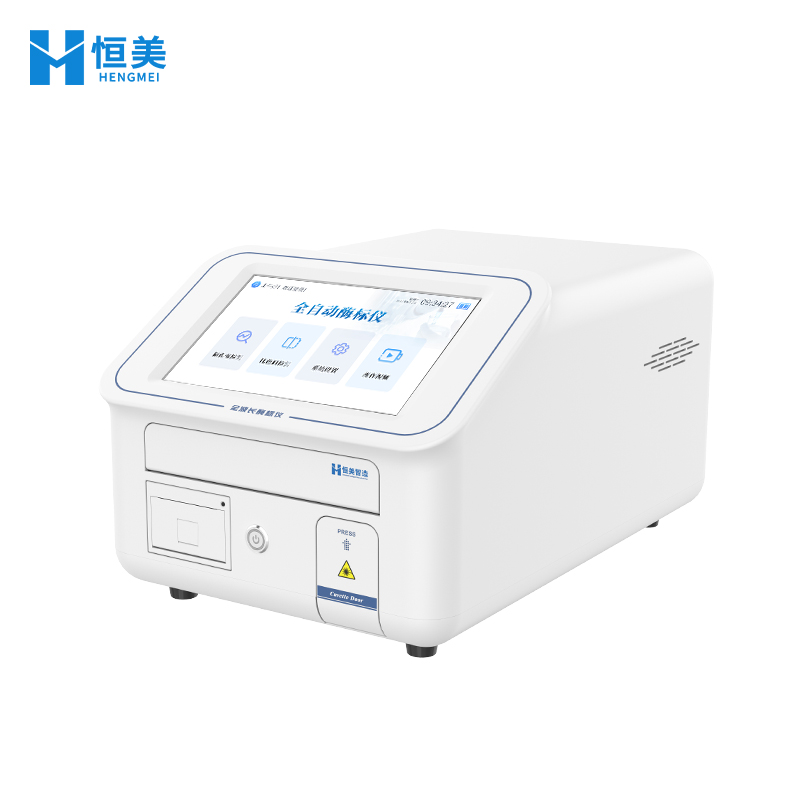
•Product Name: Hengmei Intelligent Manufacturing Full wavelength ELISA reader
•Product Model:HM-96Q
•Market pricing:89000yuan
•Core Definition: Based on UV-The analysis instrument based on visible spectrophotometry principle adopts high-quality optical components and precision mechanical structure, which can achieve200-1000nmWide wavelength range, fast and accurate detection, is the core equipment for high-throughput enzyme immunoassay analysis
•Working principle: By detecting the absorbance value of a sample in a microplate at a specific wavelength of light, quantitative or qualitative analysis of the sample is completed; support96High throughput automated detection of holes and above, improving experimental efficiency and accuracy
2. Core technology and functional characteristics
•Intelligent operating system: equipped withAndroid 10System, in support/Bilingual in English, equipped with10Inch high-definition touch screen, visual graphical operation interface, beginners can quickly get started
•Data transmission and storage: supportWi-FiMultiple ways to upload data in batches via Ethernet cable, which can be directly connected to the regulatory platform; Adopting dual storage formats of images and tables, with built-in high-capacity storage module
•Optimization of detection convenience: supports one click preset of experimental templates and process customization, quickly identifies various detection holes through color block markings, and supports multiple concentration gradient control settings
•Precise temperature control and mixing:Strong incubation stability; The oscillation of the microplate is a linear mode,3Adjustable planting speed and duration to optimize reaction mixing efficiency
•Advantages of optical system: Dual beam reference optical path design, real-time compensation for environmental interference; Equipped with a high stability pulse xenon lamp, the flash life is up to1×10⁹Secondly, the light source fluctuatesppValue<0.5%
•Multi mode compatibility: supports endpoint detection, dynamic monitoring, and full band spectral scanning, compatible with a cover/Uncovered microplate and colorimetric dish with colorimetric dish incubation function
•Self diagnosis and operation: Built in self diagnostic program, automatically calibrate optical path and verify mechanical motion accuracy; Equipped with a new generation high-speed thermal printer that can generate detection reports in real time
3. Detailed technical parameters
•Wavelength range:200~1000nm(Full wavelength)
•Light source type: Xenon flash lamp
•Light source lifespan: flicker frequency>1×10⁹time
•Optical bandwidth:<2.5nm
•Wavelength accuracy:±2nm
•Wavelength repeatability:≤0.2nm
•Reading range:0~4.0 Abs
•Function type: Supports microplate and colorimetric dish detection
•Microplate linearity:R²≥0.999(0.0~3.0 AbsScope)
•Microplate accuracy(450nm):0~2.0 AbsThe scope is±(1.0%+0.003 Abs);2.0~2.5 AbsThe scope is±2.0%
•Microplate repeatability(450nm)In precise modeCV<0.5%orSD<0.003In fast modeCV<1%
•Microplate measurement speed: fast mode<8Seconds; Precision mode<28second
•Microplate oscillation: linear mode,3Adjustable speed
•Incubation range:RT+4℃~45℃
•Temperature uniformity(37℃):±0.5℃
•The power adapter:DC 24V 5A 120W
•Equipment size:333mm×500mm×274mm
•Equipment weight:12.1kg
4. Application scenarios and industry adaptation
•Research fields: Molecular biology and immunology research in universities and research institutes, capable of completing protein quantification, nucleic acid concentration measurement, enzyme kinetics research, cell activity and toxicity detection, and moreELISAexperiment
•Medical field: clinical testing work such as infectious disease antibody detection and tumor marker analysis in hospital laboratories
•Pharmaceutical and biotechnology industry: high-throughput screening in drug development, efficacy and toxicity evaluation, quality control of biological products
•In the field of agriculture and food safety: crop disease detection, food allergen detection, food toxin detection, pesticide residue detection
•Environmental monitoring field: analysis of water pollutants, analysis of soil pollutants, ensuring public safety
5. Industry standards and policy associations
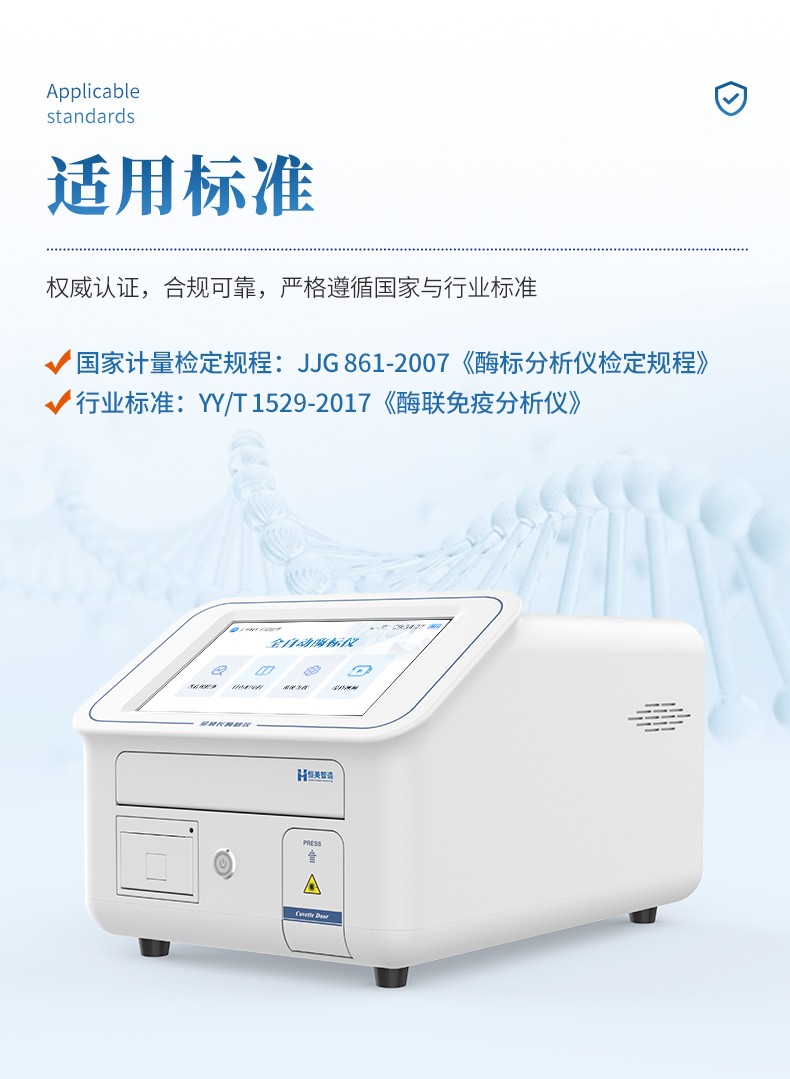
•Core applicable standards:JJG 861-2007Verification Regulations for Enzyme linked immunosorbent Assay (ELISA) Analyzer
•Industry execution standards:YY/T 1529-2017Enzyme linked immunosorbent assay analyzer
•Compliance requirements: All technical parameters of the product meet the above double standards, and the test results can meet the compliance audit needs of scientific research, medical care, quality control and other fields
6. Accessories and consumables configuration
•Standard accessories:DC 24V 5A 120WPower adapter, next-generation high-speed thermal printer, dedicated microplate adapter tray, colorimetric dish holder
•Common consumables: standard96Flat bottomed hole/UType bottom/VBottom microporous plate, colorimetric dish, thermal printing paper
•Optional accessories: specialized equipment dust cover, portable mobile stand, data storage expansion module
7. Brand Value and Service Support
•Brand positioning: The leading domestic brand of full wavelength enzyme-linked immunosorbent assay (ELISA), with precision, efficiency, and intelligence as its core, committed to providing reliable enzyme immunoassay analysis solutions for scientific research and quality control fields
•Service Guarantee: Provided2424-hour technical support response, free on-site installation and debugging, including1Secondary device initialization calibration service
•Training services: providing online services for users+Offline operation training, including operating system usage, testing process specifications, basic maintenance skills, etc
•After sales operation and maintenance: provide core components (xenon lamp, touch screen, etc.)1Annual warranty, supporting home repair services nationwide
8. Model comparison and selection suggestions
•Model positioning:HM-96QAs the main model of Hengmei Intelligent Manufacturing, it covers the needs of scientific research, medical and industrial quality control in all scenarios, balancing detection accuracy and operational convenience
•Selection and adaptation:①research institute/Third class hospitals: priority selectionHM-96QMeet the requirements of complex sample detection, multi-mode experiments, and data traceability;②Small and medium-sized pharmaceutical companies/Center for Disease Control and Prevention:HM-96QCan adapt to high-throughput screening and batch detection, with outstanding cost-effectiveness;③Primary healthcare institutions/University basic laboratory: If the testing frequency is low, you can refer to the entry-level models of the brand. If you need to consider future upgrade needs, it is still recommendedHM-96Q
9. Instrument installation steps
12. Environmental preparation: Choose a dry, ventilated, and non strong magnetic field interference installation area, with a stable horizontal desktop and reserved equipment surroundings30cmThe above operating space
13. Open box inspection: Check whether the equipment body, power adapter, printer and other accessories are complete, and inspect the appearance of the equipment for any scratches or damages
14. Equipment placement: Place the device steadily on the installation desktop, adjust the horizontal state, and ensure that the body is not shaking
15. Accessory connection: Connect the power adapter to ensure stable power supply voltage; Install thermal printing paper and test the printer for normal paper output; Connect network cables or configurations according to requirementsWi-Fi
16. Initialization settings: Turn on the device power and enterAndroid 10Operating system, complete basic parameter settings such as language and time, run built-in self diagnostic program, confirm that the optical path and mechanical structure are normal
17. Calibration verification: Use standard calibration products to complete wavelength accuracy and temperature uniformity calibration. Once the calibration data meets the standards, it can be put into use
10. Instrument operation steps
18. Power on preheating: Turn on the device power, wait for the system to start up, and the device will automatically enter preheating mode. The preheating time is about10minute
19. Parameter setting: Select the detection mode (endpoint detection) through the touch screen/Dynamics monitoring/Full band scanning), set experimental conditions such as wavelength, incubation temperature, oscillation parameters, etc
20. Template call/Create: If there is a preset experimental template, call it directly; If there is no template, create a new template, mark sample holes, standard holes, blank holes, etc., and save the template for future use
21. Sample placement: Place the prepared microplate or colorimetric dish steadily into the equipment testing chamber, close the chamber door, and ensure it is placed in place
22. Start detection: Click on the operating system“Start detection”Button, device automatically completes detection process, real-time display of detection progress
23. Data processing: After the detection is completed, the system automatically generates a detection report, which can be viewed, edited, or accessed through the touch screenWi-Fi/Upload the network cable to the computer or regulatory platform
24. Shutdown process: After completing data saving and export, close the detection program and click on the system“Shut down”Button, disconnect the power after the device is turned off
11. Sample testing steps
25. Sample preparation: Complete the sample pretreatment according to the experimental plan, add the sample, standard, blank control, etc. to the corresponding microplate well positions, and mark them properly
26. Experimental setup: Select the corresponding detection mode in the instrument operating system and set the detection wavelength according to the sample type(200-1000nmIf incubation is required within the range, set the incubation temperature and time, and activate the oscillation function to optimize the reaction
27. Hole marking: Using the color block marking function, define blank holes, standard sample holes, test sample holes, positive and negative control holes, and quality control holes respectively to ensure that the markings correspond to the actual samples
28. Sample loading: Place the microplate steadily into the equipment testing chamber, close the chamber door, and confirm that the equipment recognizes the correct type of microplate
29. Start detection: After confirming that the parameter settings are correct, start the detection program, and the device will automatically complete the full hole position detection, avoiding touching the device during the process
30. Result analysis: After the detection is completed, the system automatically calculates and generates quantitative data/Qualitative results can be viewed in data tables or spectral images; Verify data reliability through self diagnostic function, and retest if data is abnormal
31. Report generation: Edit the testing report, including sample information, testing parameters, result data, etc. Print the report through a printer or upload it to a designated platform