-
E-mail
185945738@qq.com
-
Phone
15306360531
-
Address
Shandong Liende
Shandong Leiente Intelligent Technology Co., Ltd
Working principle and core functions of soil moisture temperature detector
Date: 2025-11-25Read: 84
As the fundamental carrier of plant growth, soil temperature and humidity directly affect crop root development, nutrient absorption, and microbial activity. It is a core environmental parameter in fields such as agricultural production, ecological monitoring, and garden maintenance. As a precise monitoring device, the soil moisture temperature detector, with its efficient and intelligent characteristics, is gradually replacing traditional manual measurement methods and becoming the "ecological eye" for sensing soil environmental changes.
1、 The working principle of soil moisture temperature detector: technology empowered sensing logic
The core of the soil moisture temperature detector is the sensor module, which works based on the integration of physical characteristics and electronic technology
1. Humidity measurement: The mainstream use is capacitive or frequency domain reflectometry (FDR) technology. Capacitive sensors utilize the characteristic that changes in soil moisture content can alter the soil dielectric constant. By measuring the capacitance value between the two poles of the sensor, the soil volumetric moisture content can be calculated; FDR technology accurately calculates humidity data based on the propagation speed and attenuation degree of electromagnetic waves in soil by emitting electromagnetic waves of specific frequencies. It has the advantages of strong anti-interference and fast response speed.
2. Temperature measurement: Typically equipped with platinum resistance (PT100) or thermistor sensors, temperature signals are converted into electrical signals using the linear relationship between conductor resistance and temperature changes. After amplification, filtering, and other processing, accurate temperature values are output. The measurement range generally covers -40 ℃~85 ℃, meeting different environmental requirements.
3. The raw signals collected by sensors are converted into digital signals through data processing modules, and transmitted to terminals through wired (such as RS485, USB) or wireless (such as Bluetooth, LoRa, GPRS) methods to achieve real-time display, storage, and analysis of data.
2、 The core function of soil moisture temperature detector is to meet monitoring needs in multiple dimensions
Modern soil moisture temperature detectors have evolved from single measurement to multifunctional integration, with core functions including:
1. Precise monitoring: The temperature measurement accuracy can reach ± 0.2 ℃, the humidity accuracy is ± 2% (volume moisture content), and the data update frequency can be customized (1 second to 24 hours) to ensure the timeliness and accuracy of monitoring data.
2. Data storage and transmission: Equipped with a large capacity storage chip, it can store tens of thousands of data offline and support data export to a computer for secondary analysis; The wireless transmission module can achieve remote data push, and users can view monitoring data in real time through mobile apps and computer clients, breaking through time and space limitations.
3. Threshold warning: Supports custom temperature and humidity warning thresholds. When data exceeds the set range, the device will promptly alert through sound and light, SMS, APP push and other methods, helping users quickly respond to environmental abnormalities (such as drought, waterlogging, low temperature freezing damage) and reduce losses.
4. Multi depth monitoring: Some devices can be equipped with multiple sets of sensor probes to achieve synchronous monitoring of different soil depths (such as 5cm, 10cm, 20cm, 50cm), comprehensively reflecting the distribution pattern of soil profile temperature and humidity, and providing scientific basis for management measures such as irrigation and fertilization.
5. Environmental adaptability: The sensor probe is made of materials such as stainless steel and anti-corrosion coating, which are waterproof and corrosion-resistant, and can be buried in soil for a long time; The host is designed to be dust-proof, moisture-proof, and resistant to electromagnetic interference, making it suitable for various complex scenarios such as farmland, greenhouses, orchards, wetlands, and mining areas.
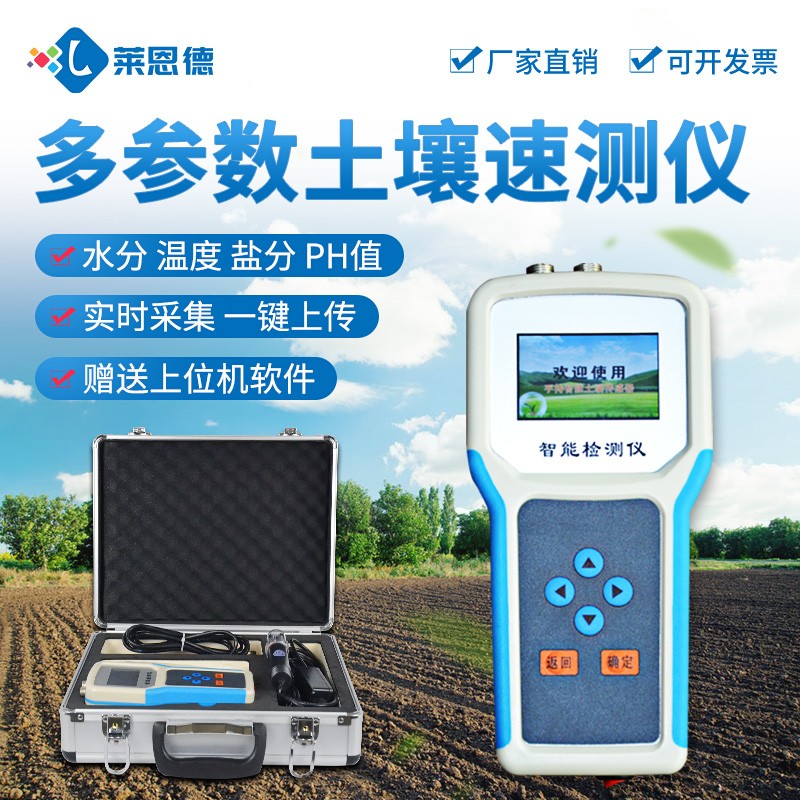
3、 Application scenarios of soil moisture temperature detector: practical value across multiple fields
The application of soil moisture temperature detectors has penetrated into multiple fields and become a key tool for refined management:
1. Agricultural production: In field planting, real-time monitoring of soil temperature and humidity is used to accurately guide irrigation timing and amount, avoiding water resource waste or soil waterlogging caused by blind watering; In the greenhouse, combining temperature and humidity data to regulate ventilation, shading, and drip irrigation systems, creating an environment for crop growth, and improving yield and quality; In fruit tree cultivation, monitoring the temperature and humidity of deep soil layers provides support for root development and reduces the occurrence of pests and diseases.
2. Ecological monitoring: used for wetland protection, desertification control, forest ecosystem research and other projects, long-term monitoring of soil temperature and humidity changes, providing data support for ecological environment assessment and vegetation restoration plan formulation.
3. Garden maintenance and urban greening: For park green spaces, roadside trees, etc., scientific irrigation is carried out based on soil temperature and humidity data to avoid excessive watering or drought stress, reduce maintenance costs, and improve the survival rate of greening.
4. Scientific research experiments: In the fields of agricultural meteorology, soil science, and other scientific research, provide accurate and continuous soil environment data for experimental research, and assist in the implementation and transformation of scientific research achievements.
4、 Advantages of Soil Moisture Temperature Detector
Compared to manual sampling and measurement (such as humidity measurement by drying method and temperature measurement by thermometer insertion method), soil moisture temperature detectors have irreplaceable advantages:
1. Efficient and convenient: No need for frequent manual sampling, drying, or measurement. One installation can automatically monitor for a long time, greatly saving labor and time costs.
2. Accurate data: Avoiding subjective errors caused by manual operations, achieving automated and standardized data collection, and improving the credibility of monitoring results.
3. Real time dynamics: capable of capturing instantaneous changes in soil temperature and humidity, reflecting environmental fluctuations in a timely manner, and providing dynamic data support for refined management.
4. Data traceability: The stored historical data can be accessed at any time, making it easy to analyze environmental change patterns and optimize management strategies.
5、 The development trend of soil moisture temperature detectors: intelligent and integrated upgrading
With the development of the Internet of Things and big data technology, soil moisture temperature detectors are upgrading in the following directions:
1. Intelligent integration: Combining with artificial intelligence and machine learning, by analyzing historical data to predict the trend of soil temperature and humidity changes, intelligent decision-making for irrigation, fertilization and other measures can be achieved.
2. Multi parameter integration: In addition to temperature and humidity, it integrates monitoring functions such as soil pH value, electrical conductivity (EC), nutrient content, etc., to create a one-stop soil environment monitoring terminal.
3. Low power consumption and wide coverage: using solar power supply and low-power chips to extend device battery life; By leveraging communication technologies such as 5G and NB IoT, large-scale and high-density monitoring network deployment can be achieved.
4. Miniaturization and Portability: Introduce handheld portable devices to meet the needs of small plots of land, temporary monitoring, and other scenarios, and enhance the versatility of the equipment.
The emergence of soil moisture temperature detectors has promoted the transformation of soil environment monitoring from "empirical judgment" to "data-driven", providing important technical support for agricultural modernization and ecological protection scientification. In the future, with the continuous iteration of technology, this "Ecological Insight" will become more intelligent, efficient, and diverse, continuously empowering refined management in various fields and helping to achieve sustainable development goals of resource conservation, environmental friendliness, and efficiency improvement.