-
E-mail
185945738@qq.com
-
Phone
15306360531
-
Address
Shandong Liende
Shandong Leiente Intelligent Technology Co., Ltd
Application scope and precautions of fluorescence quantitative pesticide residue detector
Date: 2025-12-11Read: 53
The quality and safety of agricultural products are core issues related to national economy and people's livelihood, and excessive pesticide residues are one of the main hidden dangers affecting agricultural product safety. Traditional pesticide residue detection methods may have problems such as long detection cycles, complex operations, or insufficient quantitative accuracy, making it difficult to meet the core requirements of modern agricultural product supervision for "speed, precision, and efficiency". In this context, the fluorescence quantitative pesticide residue detector, with its unique advantages in fluorescence detection technology, has achieved rapid qualitative and accurate quantification of pesticide residues, becoming a key detection tool in the entire chain of agricultural product production, circulation, and supervision, and building a strong defense line for safety on the tongue.
1、 Working principle of fluorescence quantitative pesticide residue detector: precise quantification logic behind fluorescence signal
The core working principle of the fluorescence quantitative pesticide residue detector is based on the "antigen antibody specific binding" and "fluorescence resonance energy transfer" technologies. By detecting changes in the intensity of the fluorescence signal, accurate quantification of pesticide residues can be achieved. The core logic can be summarized as three key steps: "specific recognition+signal amplification+quantitative analysis":
Step a, specificity recognition. The detection reagents provided with the instrument contain specific antibodies against specific pesticides (such as organophosphates, carbamate esters, pyrethroids, etc.). When there are target pesticide residues in the sample, pesticide molecules (antigens) will specifically bind to the antibodies, forming antigen antibody complexes. This process has high specificity and can effectively avoid interference from other impurities on the detection results, ensuring the specificity of the detection.
Step 2: Fluorescence signal generation and amplification. The detection reagent is labeled with both a fluorescent group (donor) and a quenching group (acceptor). When the pesticide is not bound, the distance between the fluorescent group and the quenching group is close, and the fluorescence signal will be quenched. At this time, the detected fluorescence intensity is extremely low; When the antibody binds to the pesticide in the sample, the spatial structure of the antibody changes, causing the separation of the fluorescent group and the quenching group, and the quenching effect disappears. The fluorescent group will emit fluorescence of a specific wavelength. Meanwhile, through immune amplification technology, weak fluorescence signals can be further amplified to enhance the sensitivity of detection.
The third step is precise quantitative analysis. The built-in optical detection system of the instrument accurately collects the intensity of fluorescence signals, and converts the fluorescence intensity into the corresponding pesticide residue concentration through a preset standard curve (drawn in advance with a known concentration of pesticide standard). Due to the good linear relationship between fluorescence signal intensity and pesticide residue concentration, accurate quantification of the target pesticide residue in the sample can be achieved. The detection results are usually measured in milligrams per kilogram (mg/kg) or micrograms per kilogram (μ g/kg).
Compared with the traditional enzyme inhibition method's "qualitative+semi quantitative" detection, fluorescence quantification technology not only solves the problem of insufficient specificity, but also achieves a leap from "whether it exceeds the standard" to "how much it exceeds the standard", greatly improving the detection accuracy.
2、 The advantages and functions of fluorescence quantitative pesticide residue detector: a dual breakthrough that balances speed and accuracy
The reason why the fluorescence quantitative pesticide residue detector has become the mainstream equipment for modern agricultural product detection is that it balances the convenience of rapid detection with the accuracy of laboratory testing, and has rich intelligent functions. The specific advantages and functions are as follows:
1. High sensitivity and precise quantification: The detection limit can be as low as micrograms per kilogram (some models can reach a detection limit of 0.01 μ g/kg for specific pesticides), far superior to traditional enzyme inhibition methods; It can accurately determine the specific concentration of pesticide residues, rather than just judging "qualified/unqualified", providing data support for the quality control of precision enterprises by regulatory authorities.
2. Rapid detection and efficient and convenient: The entire detection process takes short time, usually only 30-60 minutes from sample pretreatment to obtaining results. Compared with laboratory instruments such as gas chromatography and liquid chromatography (which take hours or even days), the efficiency is significantly improved; Simplified operation process, no need for professional chemical analysis skills, can be mastered through simple training, suitable for on-site testing scenarios such as fields, agricultural markets, and enterprise workshops.
3. High specificity and anti-interference ability: Based on antigen antibody specific binding technology, it can accurately identify target pesticides, effectively eliminate interference from sample matrices (such as pigments, sugars, proteins in vegetables and fruits) and other non target pesticides, and have strong stability in detection results, especially suitable for the detection of complex matrix agricultural products.
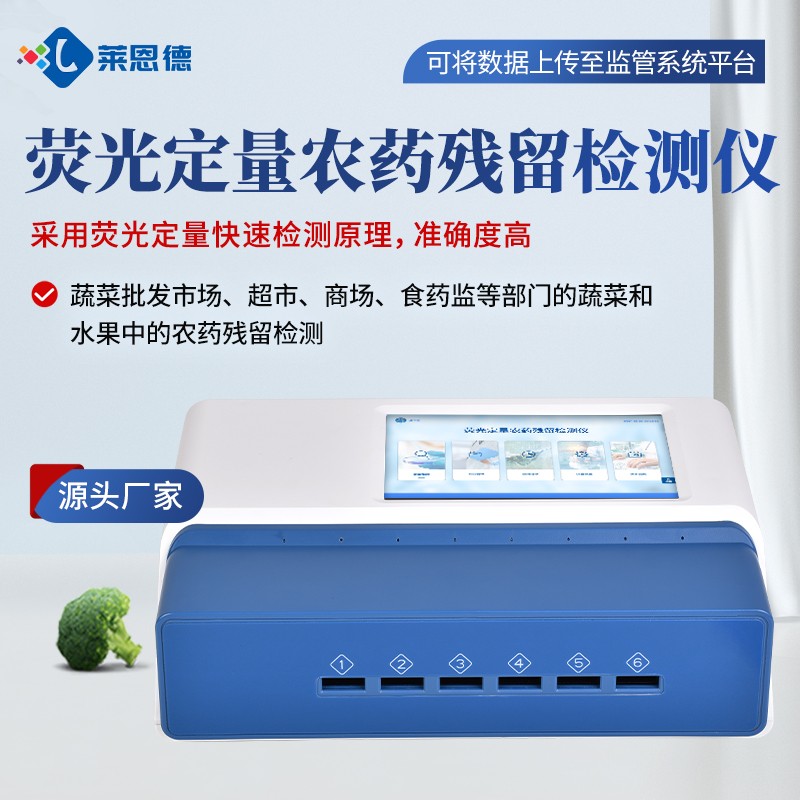
4. Multi residue synchronous detection: The model supports multi-channel detection, which can simultaneously detect multiple types of pesticide residues in the same sample (such as organic phosphorus, carbamate, pyrethroids, etc.), greatly improving detection efficiency and meeting the needs of multi pesticide residue screening in agricultural products.
5. Intelligent data management: Built in operating system, equipped with touch screen, supporting Chinese operation interface; It can automatically store detection data (including sample name, detection time, detection items, residual concentration, detection personnel, etc.), with a capacity of thousands or even tens of thousands of records; Supports data transmission methods such as Bluetooth, USB, WiFi, etc., and can synchronize data to computers or regulatory platforms to achieve centralized management, statistical analysis, and traceability of data, meeting the construction needs of agricultural product quality and safety traceability system.
6. Strong portability and scene adaptability: The body adopts a lightweight design, usually weighing 2-5kg, equipped with rechargeable batteries, supports dual power supply mode of mains and battery, and can work continuously for several hours in fields, markets and other scenarios without external power supply, adapting to the needs of different detection scenarios.
3、 Application scenarios of fluorescence quantitative pesticide residue detector: quality control covering the entire chain of agricultural products
The fluorescence quantitative pesticide residue detector, with its core advantages of "fast, accurate, and portable", is widely used in the quality control links of the entire chain of agricultural product production, processing, circulation, and supervision. The specific application scenarios are as follows:
1. Agricultural product production process (field/base): applicable to self quality control of production entities such as planting bases, cooperatives, and family farms. Before harvesting agricultural products, crops can be sampled and tested to determine whether pesticide residues meet national standards and avoid unqualified agricultural products from entering the market; At the same time, pesticide use plans can be optimized based on test results to reduce pesticide abuse and promote green planting.
2. Agricultural product processing link (enterprise/workshop): applicable to raw material acceptance and finished product inspection of agricultural product processing enterprises. Before the raw materials are put into storage, pesticide residue testing should be carried out on the purchased vegetables, fruits, tea and other raw materials to prevent unqualified raw materials from entering the processing stage; Conduct random inspections before the finished products leave the factory to ensure the quality and safety of processed agricultural products and safeguard the brand reputation of the enterprise.
3. Agricultural product circulation link (market/supermarket/cold chain): suitable for on-site rapid screening in agricultural markets, fresh supermarkets, cold chain logistics centers and other places. Regulatory personnel or market organizers may conduct random inspections on agricultural products entering the market, promptly detect and intercept products with excessive pesticide residues, and prevent unqualified agricultural products from flowing into consumer terminals; At the same time, the test results can be made public to consumers to enhance their confidence.
4. Agricultural product supervision link (sampling): It is an important tool for market supervision, agriculture and rural departments to carry out quality and safety sampling of agricultural products. Personnel can carry instruments to conduct on-site inspections in fields and supermarkets, quickly identify unqualified products, and improve efficiency; For suspected samples that exceed the standard, laboratory precision testing can be combined for review to provide accurate data basis for punishment.
5. Research and teaching activities (laboratory/institution): Suitable for agricultural research institutes and universities to conduct research on pesticide residue detection technology, agricultural product quality and safety related topics, as well as testing skills training in agricultural technology promotion. Its precise quantitative ability and stable detection performance can provide reliable data support for scientific research experiments.
6. Inspection process for imported and exported agricultural products: Suitable for rapid screening by customs and entry-exit inspection and quarantine departments. For fresh agricultural products imported and exported, it is possible to quickly detect whether their pesticide residues meet the standards of the importing or exporting country, shorten customs clearance time, and improve import and export trade efficiency.
4、 Precautions for using a fluorescent quantitative pesticide residue detector: Ensure accurate and reliable detection results
To fully utilize the detection performance of the fluorescence quantitative pesticide residue detector and ensure the accuracy and reliability of the detection results, the following key points should be noted during use:
1. Reagent management and storage: Testing reagents are the core factors that affect the test results, and should be strictly stored according to the requirements of the reagent instructions (usually refrigerated at 2-8 ℃, avoiding freezing and direct sunlight); Before use, the reagent should be restored to room temperature (usually 20-25 ℃) and checked for expiration or deterioration (such as turbidity, precipitation, and other abnormalities); Different batches of reagents should not be mixed to avoid cross contamination.
2. Sample pretreatment specifications: Sample pretreatment must strictly follow the operating procedures to ensure uniformity and strong representativeness of the sample. When sampling, it is necessary to avoid taking rotten or spoiled parts and adopt the principle of "multi-point sampling and uniform mixing"; The steps of sample crushing, extraction, centrifugation, etc. need to be standardized to ensure sufficient extraction of pesticide residues, while removing impurities from the sample matrix to avoid interference with the detection results; The extraction solution needs to be tested in a timely manner and cannot be left for a long time.
3. Instrument calibration and maintenance: The instrument needs to be calibrated before use, and the fluorescence intensity can be calibrated using the standard or calibration solution provided by the manufacturer to ensure the accuracy of instrument detection; Regularly check whether the optical system of the instrument (such as the light source and detector) is clean, and if there is dust or dirt, it should be cleaned in a timely manner; After using the instrument, it is necessary to clean the detection channel, sample pool, and other parts to avoid residual reagent contamination; When not in use for a long time, it should be stored according to the instructions and regularly turned on for maintenance.
4. Environmental condition control: The temperature and humidity of the detection environment can affect the stability of the fluorescence signal. It is recommended to conduct the detection in an environment of 20-25 ℃ and relative humidity of 40% -60%; Avoid using in environments with strong direct sunlight, vibration, and electromagnetic interference (such as near large appliances or areas with strong mobile phone signals) to prevent affecting the detection results.
5. Operation details specification: Accurate pipetting equipment should be used when adding samples to ensure accurate sample volume and avoid adding too much or too little samples; After adding the sample, it is necessary to promptly cover the reaction container to avoid reagent evaporation or contamination; The reaction time must strictly follow the instructions and cannot be arbitrarily shortened or prolonged to ensure sufficient antigen antibody binding and stable fluorescence signal.
6. Data recording and traceability: During the testing process, it is necessary to accurately record key data such as sample information, testing time, reagent batch, instrument calibration, and testing results, and establish a complete testing file; During data transmission and storage, it is necessary to ensure data security, avoid data loss or tampering, and facilitate subsequent quality traceability.
5、 The development trend of fluorescence quantitative pesticide residue detection instrument: deep upgrading of intelligence, integration and miniaturization
With the deepening of precision agriculture and intelligent supervision concepts, as well as the continuous innovation of biotechnology, optical technology, and Internet of Things technology, fluorescence quantitative pesticide residue detectors are developing towards the direction of "smarter, more integrated, smaller, and more efficient". The future development trend is mainly reflected in the following aspects:
One is the continuous improvement of intelligence level: introducing artificial intelligence (AI) algorithms to achieve intelligent analysis of detection data, abnormal warning, and result interpretation; Combining big data technology to establish pesticide residue databases for different regions and crops, providing data support for regional agricultural product quality and safety assessments; Through IoT technology, remote control, fault diagnosis, and software upgrades of instruments can be achieved to improve their operational efficiency.
The second is the enhancement of multi parameter integrated detection capability: In the future, instruments will not be limited to pesticide residue detection, but will also integrate detection modules for various pollutants such as heavy metals, veterinary drug residues, and microorganisms (such as Escherichia coli and Salmonella), achieving "one-stop" multi pollutant detection of agricultural products, further improving detection efficiency, and adapting to the needs of full chain quality control.
The third is the upgrading of miniaturization and portability: relying on microfluidic technology and Lab-on-a-Chip technology, the reagents, reaction tanks, and optical detection systems required for detection are integrated onto microchips to create a "handheld detector", further reducing the weight and volume of the instrument and improving portability; At the same time, simplify the operation process, achieve "one click sampling, one click detection, and instant results", lower the threshold for use, and adapt to the self inspection needs of ordinary consumers.
The fourth is to optimize the detection speed and sensitivity: by optimizing the antigen antibody binding efficiency and improving the fluorescence signal amplification technology, the detection time can be further shortened (expected to achieve results within 15-20 minutes); At the same time, improving detection sensitivity, achieving precise detection of trace pesticide residues, and meeting stricter agricultural product quality and safety standards.
Fifth, standardization and normalization promotion: With the maturity of technology, relevant departments will further improve the national and industry standards for fluorescence quantitative pesticide residue detection, standardize detection methods, reagent quality, instrument performance indicators, etc., enhance the comparability and authority of detection results, and promote the popularization and application of this technology nationwide.
As a key technical equipment in the field of agricultural product quality and safety testing, the fluorescence quantitative pesticide residue detector has solved the pain points of traditional testing methods with its core advantages of "fast, accurate, convenient, efficient, intelligent and reliable", providing strong technical support for the quality control of the entire agricultural product chain. From production control in the fields to consumer protection at market terminals, from regulatory enforcement and sampling to technological innovation in scientific research, this instrument is guarding the safety of the tongue in all aspects. With the continuous upgrading of technology, future fluorescent quantitative pesticide residue detectors will become more intelligent, integrated, and miniaturized, playing a more important role in promoting green and sustainable agricultural development, ensuring the quality and safety of agricultural products, and safeguarding consumer health rights and interests.