-
E-mail
185945738@qq.com
-
Phone
15306360531
-
Address
Shandong Liende
Shandong Leiente Intelligent Technology Co., Ltd
Portable and efficient! Soil redox potentiometer enables "plug and play" field soil monitoring
Date: 2025-12-29Read: 71
Soil is the cornerstone of agricultural production and an important component of ecosystems. The health status of soil is directly related to crop growth, agricultural product quality, and even ecological environment balance. Among the numerous physical and chemical indicators of soil, oxidation-reduction potential (Eh) is the core indicator reflecting the redox status of soil, and its level directly affects nutrient conversion, heavy metal migration, and microbial activity in soil. How to accurately and quickly obtain soil redox potential data? As a professional detection equipment, soil redox potentiometers have become the "electronic sentinel" for decoding soil health in agricultural production, environmental monitoring, and scientific research experiments with their scientific and accurate detection capabilities, providing key technical support for soil management and ecological protection.
1、 The core principle of soil redox potentiometer: capturing the "electronic signal" in the soil
The detection principle of soil redox potentiometer is based on the redox reaction law in electrochemistry. The core is to capture the potential difference generated by the electron transfer process in soil through a dedicated electrode, and then quantify the redox state of soil. Simply put, there are a large number of oxidized and reduced substances in soil, and electron transfer occurs between these substances: oxidized substances gain electrons and are reduced, while reduced substances lose electrons and are oxidized. This process forms a specific potential difference, known as the oxidation-reduction potential (unit: mV).
The instrument mainly consists of three parts: indicator electrode, reference electrode, and potentiometer. The indicator electrode (commonly platinum electrode) is directly inserted into the soil as a "receiver" for electron transfer, which can quickly respond to potential changes caused by redox reactions in the soil; The reference electrode (commonly used calomel electrode or silver chloride electrode) provides a stable standard potential reference to ensure the accuracy of the detection results; The potentiometer is responsible for measuring and amplifying the potential difference between the indicator electrode and the reference electrode, ultimately converting it into a visual digital signal that displays the redox potential value of the soil. Generally, the higher the Eh value, the stronger the soil oxidation ability and the better the permeability; The lower the Eh value, the stronger the soil's reducing ability and the easier it is to be in an anaerobic state.
2、 The core advantages of soil redox potentiometers are precision, efficiency, and adaptability to diverse scenarios
With the iteration and upgrading of technology, modern soil redox potentiometers have overcome the complexity and limitations of traditional detection methods, forming core advantages of high precision, efficient detection, convenient operation, and adaptability to multiple scenarios, meeting the detection needs of different users.
1. High detection accuracy and strong data reliability. High quality instruments use high-precision platinum electrodes and stable reference systems, which can effectively reduce the influence of factors such as ion interference and temperature changes in soil on detection results. The measurement error can be controlled within ± 5mV, and some models also have automatic temperature compensation function, which can ensure the stability and accuracy of detection data even under different environmental temperatures, providing reliable data support for soil condition assessment.
2. Efficient and fast detection with low operational threshold. Traditional soil redox potential detection requires tedious sample pretreatment and long waiting times, while modern instruments adopt a direct insertion detection design. After inserting the electrode into the soil, the detection result can be displayed within seconds, and the detection time for a single sample does not exceed 1 minute. At the same time, the instruments are generally equipped with high-definition touch screens, Chinese operation interfaces, and voice prompts. Operators do not need professional electrochemical knowledge and can operate them with simple training, greatly improving detection efficiency.
3. Strong portability, suitable for on-site testing scenarios. The promotion of grassroots agricultural technology, field management and other scenarios require high portability of the instrument. The portable soil redox potential meter is equipped with a large capacity lithium battery, with a battery life of 8-12 hours, and is small in size and light in weight (usually not exceeding 500g). It can be easily carried to the field, greenhouse and other locations, achieving "plug and play testing, instant results" without the need to bring soil samples back to the laboratory, providing timely data support for on-site soil management decisions.
4. Rich in functionality, supporting data traceability and analysis. The model has data storage function, which can store thousands of sets of detection data. It also supports data transmission methods such as USB and WiFi, and can quickly export detection data to computers or mobile devices for easy data organization and analysis. Some instruments also have a built-in soil redox potential level assessment system, which can automatically determine whether the soil is in an oxidized, weakly reduced, or strongly reduced state, providing users with intuitive soil condition assessment recommendations.
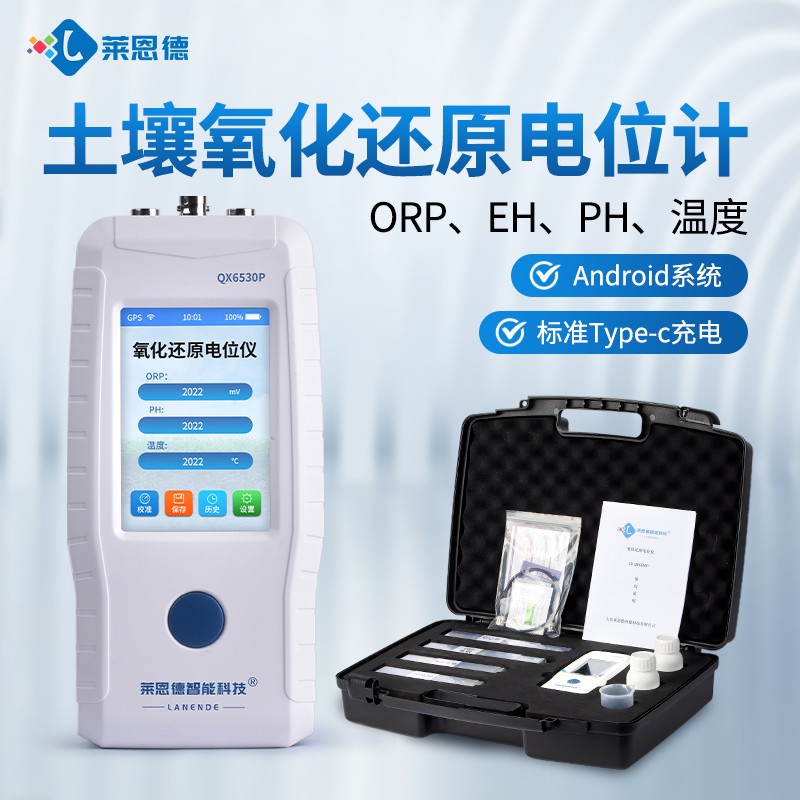
3、 Application scenario of soil redox potentiometer: full chain support to safeguard soil health
The application of soil redox potentiometers runs through multiple fields such as agricultural production, environmental monitoring, and scientific research experiments, playing an irreplaceable role in soil health management, ecological environment protection, and providing technical support for the entire chain of soil management.
1. In the field of agricultural production: precise guidance on field water and fertilizer management and irrigation. In planting scenarios such as rice paddies and vegetable greenhouses, soil redox potential directly affects crop root growth and nutrient absorption. For example, the soil Eh value suitable for rice growth is 200-400mV. If the Eh value is too low (below 100mV), the soil is prone to produce toxic substances such as hydrogen sulfide, which can cause rice root rot; If the Eh value is too high, it will also affect the effectiveness of nutrients such as phosphorus and potassium. Farmers can monitor the soil status in real time through a soil redox potential meter, and adjust irrigation and fertilization plans based on the detection results. When the Eh value is too low, timely drainage and sun drying can increase soil permeability; When the Eh value is too high, it is necessary to replenish water reasonably to maintain suitable soil moisture, thereby improving crop yield and quality. After optimizing the irrigation plan with the help of this instrument in a certain rice planting base, the rice root rot rate decreased by 60% and the yield per mu increased by 12%.
2. Environmental monitoring field: Assist in soil pollution control and ecological restoration. In scenarios such as soil pollution remediation and wetland ecological protection, soil redox potential is a key indicator for evaluating remediation effectiveness and ecological status. For example, in the process of remediation of heavy metal contaminated soil, the redox state of the soil can affect the forms of heavy metals - under reducing conditions, heavy metals such as cadmium and lead are prone to form sulfide precipitates, reducing their mobility; Under oxidative conditions, the activity of heavy metals such as arsenic will be enhanced. Environmental monitoring personnel can monitor the Eh value of soil in the remediation area in real time through instruments, judge the effectiveness of remediation measures, and optimize remediation plans. In wetland ecological protection, monitoring changes in soil redox potential can evaluate wetland hydrological conditions and ecosystem stability, providing data support for wetland protection decisions.
3. Research and experimental field: supporting soil science research. In soil science research in agricultural colleges and research institutions, soil redox potentiometers are experimental equipment. Researchers can use instruments to conduct research on soil redox processes and nutrient transformation, microbial community structure, heavy metal migration patterns, and other topics. By accurately obtaining long-term and continuous Eh data, they can deeply explore the intrinsic mechanisms of soil ecosystems and provide basic data support for theoretical innovation and technological research in soil science.
4、 The use and maintenance of soil redox potentiometers: key to ensuring detection accuracy
It is crucial to fully utilize the detection performance of soil redox potentiometers, extend the service life of the instrument, and ensure correct usage and standardized maintenance.
1. Precautions during use: Firstly, check the electrode status before testing to ensure that the platinum electrode surface is clean and free of oxide layer, the reference electrode has no leakage, and the filling solution is sufficient; If there is dirt on the surface of the platinum electrode, it can be lightly sanded and polished with fine sandpaper, and then cleaned with distilled water. The second is to choose suitable detection points, avoiding detection in areas with dense rocks and root systems. During detection, the electrode should be vertically inserted into the soil at a depth of 10-20cm to ensure sufficient contact between the electrode and the soil, and to avoid air entering and affecting the detection results. Thirdly, avoid touching the electrodes during the detection process. Record the results after the data is stable. It is recommended to take the average of multiple measurements at the same detection point to improve data reliability. Fourthly, after testing different soil types, it is necessary to clean the electrodes in a timely manner to avoid cross contamination.
2. Daily maintenance points: The instrument should be stored in a dry, ventilated, and non corrosive gas environment, avoiding direct sunlight and severe vibration; When the electrode is not in use, the platinum electrode should be soaked in distilled water, and the reference electrode should be stored according to the instructions (such as soaking the calomel electrode in a saturated potassium chloride solution) to prevent electrode drying and failure; Regularly calibrate the instrument using a standard oxidation-reduction potential buffer solution (such as potassium ferrocyanide potassium ferrocyanide buffer solution) to ensure detection accuracy; If the instrument malfunctions, such as severe data jumping or inability to turn on, it is not allowed to disassemble and repair it without authorization. Professional personnel from the manufacturer should be contacted in a timely manner for handling.
5、 Selection Guide for Soil Redox Potentiometers: Choose Suitable Equipment as Needed
Different application scenarios have different performance requirements for soil redox potentiometers. When selecting, it is necessary to consider one's own needs and focus on the following points: firstly, clarify the detection accuracy requirements. For rapid detection in agricultural production sites, conventional precision models (with an error of ± 5mV) can be selected, while high-precision models (with an error of ± 2mV) should be selected for scientific research experiments. Secondly, considering the usage scenarios, portable models are preferred for on-site inspections in fields, greenhouses, etc., with emphasis on battery life and portability; Desktop models can be selected for laboratory testing, with emphasis on testing stability and data storage and analysis functions. The third is to pay attention to the quality of electrodes. Electrodes are the core components of instruments, and models with high-quality platinum electrode materials and strong reference electrode stability should be selected to ensure the service life and detection accuracy of the instrument. The fourth is to examine additional functions, such as temperature compensation, data transmission, automatic evaluation, etc., and choose according to actual needs to avoid redundant functions and increased costs. The fifth is to pay attention to the manufacturer's qualifications and after-sales service, choose instruments produced by legitimate manufacturers, ensure product quality is guaranteed, and at the same time, understand whether the manufacturer provides technical training, electrode replacement and other after-sales services.
From precise management of field production to scientific protection of the ecological environment, soil redox potentiometers provide "visual" data support for soil health monitoring with their accurate detection capabilities. With the deep integration of technologies such as the Internet of Things and big data with soil detection equipment, future soil redox potential meters will become more intelligent, enabling long-term continuous monitoring, automatic data uploading, and intelligent analysis and warning. This will provide core support for building a precise and intelligent soil management system, and help promote green agricultural development and ecological environment protection.