-
E-mail
991516209@qq.com
-
Phone
15666887952
-
Address
Optoelectronic Industry Accelerator (Phase I) No. 155, Guangdian Circuit, High tech Zone, Weifang City, Shandong Province
Shandong Shuijing Sensing Technology Co., Ltd
Non contact road condition sensor: intelligent innovation of road monitoring
Date: 2025-12-29Read: 60
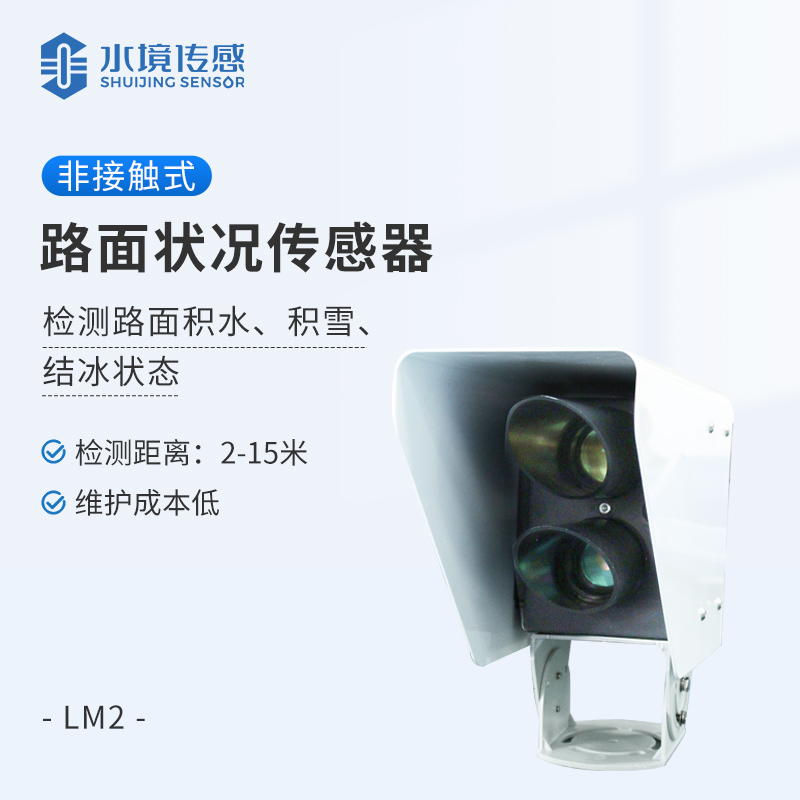
The SJ-LM2 non-contact road condition sensor is an advanced device based on remote sensing technology that accurately monitors road conditions by emitting specific light and receiving road reflection spectral information.
1、 Technical principles
Non contact detection sensor
Scanning the road surface and receiving reflected signals by emitting signals such as laser, infrared light, or electromagnetic waves. Because different substances (such as dry pavement, ponding, snow and ice) have different light absorption and reflection characteristics, the sensor can analyze spectral data, accurately judge the road state, and measure the water film height, ice thickness, snow depth and other parameters.
2、 Key advantages (compared to contact based)
1. Zero damage installation: No need to cut the road surface or embed sensors, avoiding traffic interference and reducing installation costs by more than 60%
2. Low maintenance cost: Keep away from vehicle crushing, reduce damage risk, and extend maintenance cycle by 3-5 times
3. Wide coverage: A single device can monitor road surfaces 2-15 meters wide, suitable for complex scenarios such as multiple lanes and bridge decks
4. Work 24/7: not affected by adverse weather conditions, can operate stably in environments ranging from -40 ℃ to+70 ℃
5. Parameter fusion: Simultaneously monitor key indicators such as road surface temperature, humidity, water/ice/snow thickness, friction coefficient, etc
3、 Application scenarios
1. Highways and ordinary highways: Real time monitoring of wet and slippery road conditions, triggering variable speed limit signs and warning systems
2. Bridges and tunnels: Key monitoring of bridge deck icing (formed 2-3 hours earlier than ordinary road surfaces) to prevent traffic accidents
3. Urban roads and intersections: providing data for intelligent transportation systems, optimizing signal control, and reducing congestion and accidents
4. Airport runway: Monitor runway friction coefficient and icing conditions to ensure flight takeoff and landing safety
5. Winter snow and ice management: precise guidance on snow melting agent application, cost reduction, and environmental pollution reduction
6. Road maintenance: Long term monitoring of road degradation to provide scientific basis for preventive maintenance