-
E-mail
991516209@qq.com
-
Phone
15666887952
-
Address
Optoelectronic Industry Accelerator (Phase I) No. 155, Guangdian Circuit, High tech Zone, Weifang City, Shandong Province
Shandong Shuijing Sensing Technology Co., Ltd
Visibility Sensor: From Weather Stations to Autonomous Driving, Making 'Seeing Clearly' an Instinct
Date: 2025-12-24Read: 44
The SJ-N2 visibility sensor is a precision instrument specifically designed for measuring atmospheric visibility. It is like the "eyes" of a weather station, using optical principles to determine the "transparency" of the air.In today's frequent occurrence of low visibility weather such as haze, heavy fog, rain and snow, it is a key equipment for ensuring traffic safety and conducting environmental monitoring.
1、 Working principle: Forward scattering method
At present, most mainstream visibility sensors on the market (especially devices used for highway, campus, or environmental monitoring) adopt the forward scattering principle, rather than the traditional transmission type (transmission type is usually large in volume, long in baseline, and mostly used in airports).
Transmitting end: The sensor emits a pulsed beam of a specific wavelength (usually infrared light, such as 870nm) into the atmosphere.
Scattering process: During the propagation of light, it will scatter when encountering aerosol particles in the air (such as fog droplets, smoke, rain, snow, etc.).
Receiver: The receiver detects the scattered light intensity at a specific angle (usually between 30 ° -50 °).
Data processing: The microprocessor calculates the current meteorological optical range (MOR), which is the visibility value we see (usually in meters or kilometers), based on the received scattered light intensity through complex mathematical model algorithms.
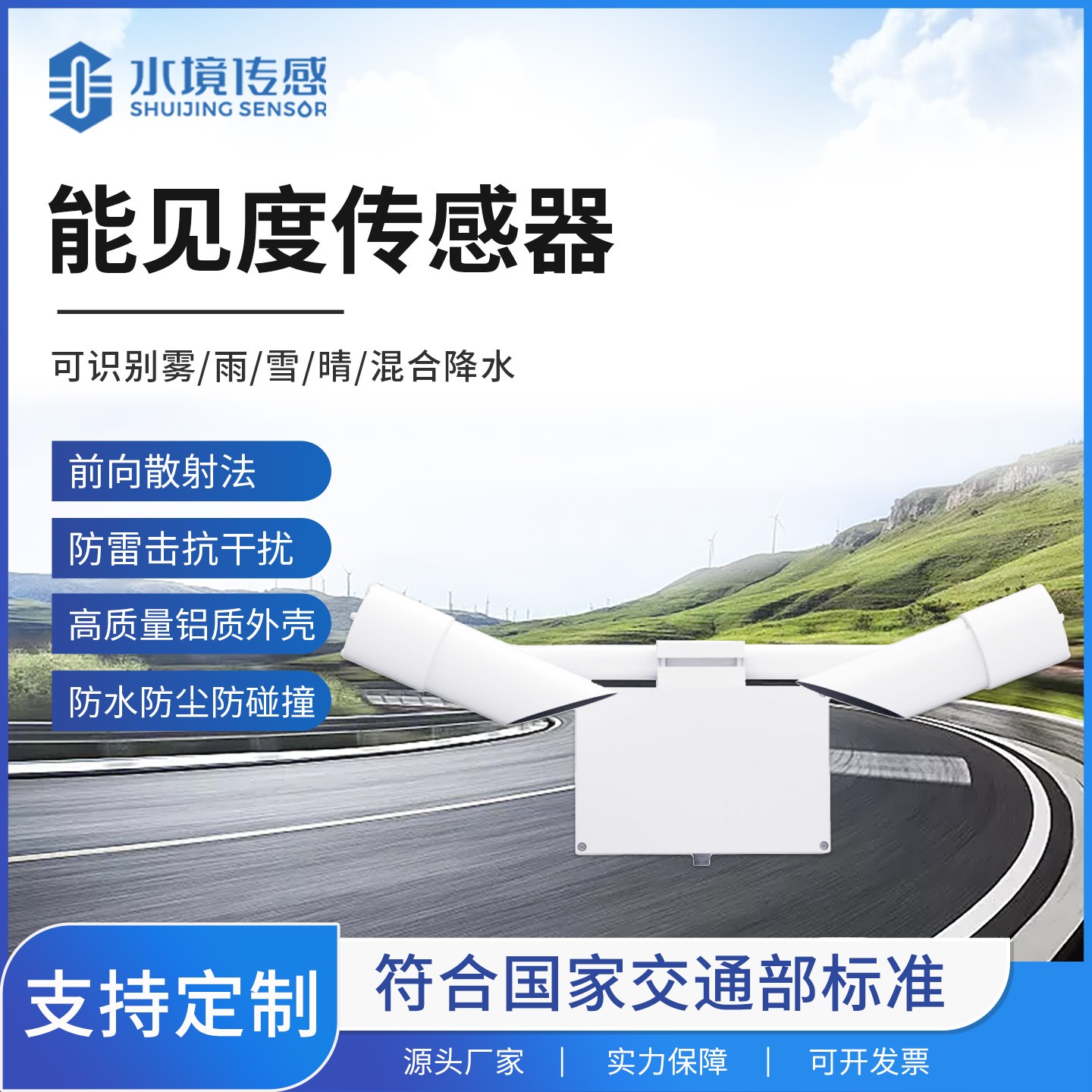
2、 Core features of the product
1. Anti interference design:
Anti dust/anti mold coating: The lens has undergone special treatment to slow down dust accumulation and mold growth, reducing maintenance frequency.
Anti solar interference: The transmitting and receiving lenses are usually designed with an opening facing downwards or with a dual scattering receiving structure to avoid measurement errors caused by direct sunlight.
Automatic heating: In high humidity or icy environments, the device will automatically heat up to prevent the lens from frosting or freezing and affecting observation.
2. Intelligence and multifunctionality:
Weather phenomenon recognition: Sensors can not only measure distance, but also intelligently identify whether the current weather is fog, rain, snow, mixed precipitation, or sunny by analyzing the characteristics of scattered signals.
Self checking function: The device can monitor its own working status in real time (such as voltage, temperature, lens cleanliness), and will immediately sound an alarm in case of any malfunction or data abnormality.
3. Low power consumption and easy installation:
Extremely low power consumption (usually between 1W-5W), very suitable for use with solar power supply systems, without the need to lay complex cables.
Compact in size, the recommended installation height is usually around 2-3 meters to avoid direct interference from ground dust.
3、 Main application scenarios
1. Traffic safety (core application):
Highways/railways: Real time monitoring in foggy sections, linked with information boards to issue "slow driving in heavy fog" warnings or control speed limits.
Airports/ports: It is crucial to assist pilots in takeoff and landing and ship docking, especially in low cloud and low visibility conditions.
2. Environmental and meteorological monitoring:
Haze monitoring: Cooperate with air quality monitoring stations to quantify the severity of haze.
Campus/Scenic Area Meteorological Station: As part of meteorological observation, it provides more comprehensive weather data.
3. Scientific research:
Used for atmospheric physics research, analyzing the distribution and extinction characteristics of aerosols.