-
E-mail
lixinghua@yunjingtianhe.com
-
Phone
13276363035
-
Address
Building 1, Weifang High tech Zone Optoelectronic Industry Accelerator (Phase I), No. 155 Guangdian Circuit, Weifang High tech Zone, Shandong Province
Shandong Tianhe Environmental Technology Co., Ltd
The role of crack monitoring sensors - monitoring the situation of water conservancy projects such as dams and embankments to ensure the operation of water conservancy facilities
Date: 2025-12-19Read: 6
【 Model recommendation: TH-LF1, a manufacturer of meteorological and environmental monitoring instruments and equipment. Yunjing Tianhe supports customized services for merchants, and you can rest assured when choosing equipment from Shandong Yunjing Tianhe. 】 The function of crack monitoring sensors is to monitor the situation of water conservancy projects such as dams and embankments, ensuring the wide applicability of water conservancy facilities to various structures and environments, such as buildings, bridges, tunnels, dams and other engineering structures, as well as geological disasters, geotechnical engineering, construction engineering, transportation, water conservancy, municipal engineering and other monitoring fields. Intelligent warning: When the change in cracks exceeds the preset safety threshold, the system will automatically issue a warning signal to notify relevant personnel to take timely measures to avoid further damage to the structure and prevent the occurrence of safety accidents. The data collected by sensors can be transmitted in real-time to the control system through wireless or wired means, enabling remote monitoring and automated analysis, providing early warning and decision support for managers. In the field of architecture, it is used to monitor the cracking situation of buildings and ensure the structural safety of buildings. Through long-term collection and analysis of crack monitoring data, a comprehensive assessment of the health status of the structure can be conducted, reflecting the stress state and degree of damage of the structure.
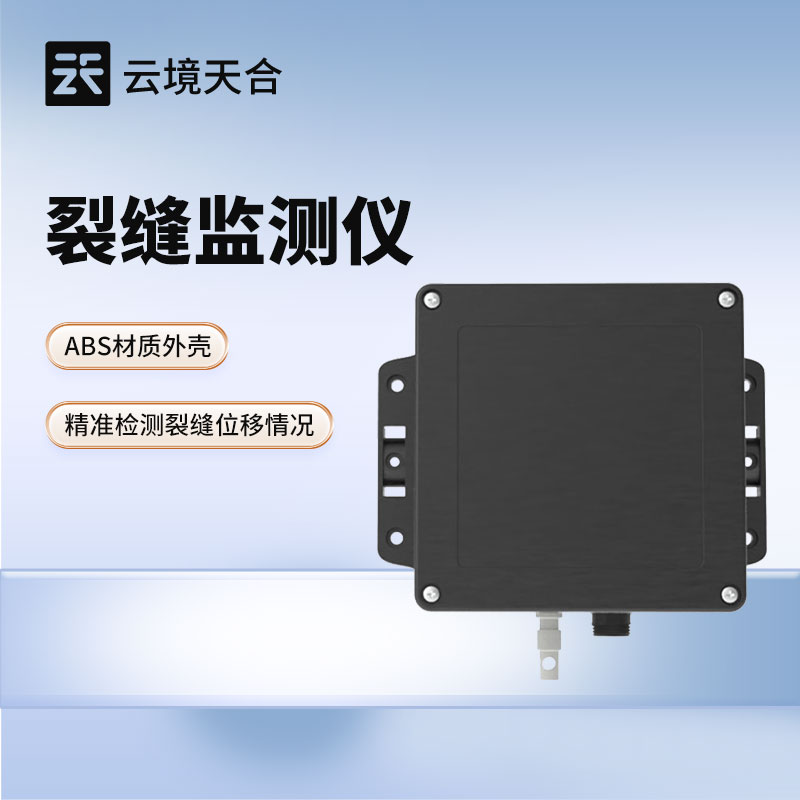
1、 Product Introduction
This product is widely used in multiple monitoring fields such as geological disasters, geotechnical engineering, construction engineering, transportation, water conservancy, and municipal engineering. It is particularly suitable for precise monitoring of relative displacement of surface cracks, unloading cracks, and cracks in buildings or structures.
In geological hazard monitoring, it is possible to capture small changes in surface cracks in real time, providing key data for early warning of disasters such as landslides and collapses; In geotechnical engineering, the development trend of unloading cracks can be effectively monitored to ensure engineering safety;
In the field of construction engineering, it is possible to accurately detect the displacement of cracks in buildings or structures, providing scientific basis for the health diagnosis and maintenance of buildings;
In transportation, water conservancy, and municipal engineering, it can also play an important role in ensuring the long-term stable operation of infrastructure.
By using high-precision monitoring data, users can take timely response measures, reduce risks, and ensure the safety of engineering and personnel.
2、 Technical parameters
| range | 0-1000mm |
| precision | ±0.02%F.S |
| response time | 1s |
| Shell material | ABS |
| power supply voltage | 12-24VDC( 0.4W@12V ) |
| contact method | modbus-485 |