-
E-mail
413230237@qq.com
-
Phone
13371098225
-
Address
Room 415, Building 1, Optoelectronic Industry Accelerator (Phase I), Yuqing Community, Xincheng Street, Weifang High tech Zone, Shandong Province
Shandong Yuntang Intelligent Technology Co., Ltd
Detailed List of Equipment Configuration for Food Additive Inspection and Testing in Food Processing Plants
Date: 2025-12-25Read: 4
In today's increasingly stringent food safety standards and the strengthening of consumers' right to know, the quality control core of food processing plants has shifted towards post remediation and comprehensive prevention and process monitoring. Building a scientific, efficient, and complete internal inspection and testing system has become the cornerstone for enterprises to ensure product compliance, maintain brand reputation, and win market competition. This article will systematically elaborate on a set of inspection and testing instrument configuration schemes designed specifically for food processing plants, covering the entire process from rapid screening to precise analysis, from environmental hygiene to ingredient monitoring, to create a solid "internal quality firewall" for enterprises.
1、 System Core: Rapid Screening and Health Monitoring Equipment
This type of equipment is the "sentinel" for quality monitoring on the production line, characterized by easy operation, fast speed, and intuitive results, used for daily high-frequency monitoring and risk screening.
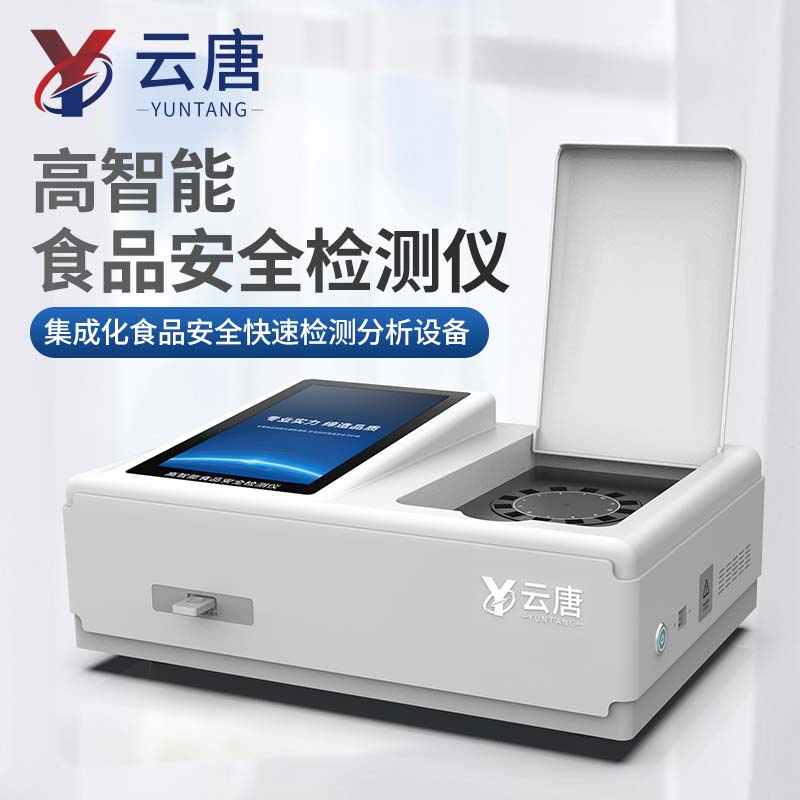
Multi functional food safety rapid detection device
Functional positioning: As the "main force" for daily screening. A device usually integrates multiple detection modules or channels, which can quickly detect various common food safety indicators.
Core testing items:
Food additives: such as nitrite, nitrate, sulfur dioxide, potassium sorbate, saccharin, sodium saccharin, synthetic coloring agents (such as carmine, lemon yellow), etc.
Safety indicators: such as pesticide residues (organophosphates and amino esters), veterinary drug residues (such as furans), illegal additives (such as white pellets and borax), microbial toxins (vomitoxin), etc.
Advantages: Qualitative or semi quantitative results can be obtained within 30 minutes, suitable for raw material procurement acceptance, semi-finished product sampling on production lines, and rapid quality control before finished products leave the factory.
ATP fluorescence detector
Functional positioning: The "instant judge" of production environment hygiene and cleaning effectiveness. By detecting adenosine triphosphate (ATP), it indirectly reflects the residual status of microorganisms and organic matter on equipment surfaces, tools, personnel hands, and other locations.
Application scenarios: Verification of the effectiveness of production line cleaning and disinfection, pre shift and post shift hygiene inspections, monitoring of key control points. The numerical results can provide immediate feedback and drive on-site hygiene improvement.
2、 Specialized precision testing equipment
When abnormalities are detected through rapid screening or validation of key raw materials and finished products, higher precision and legally effective analytical instruments are required.
High performance liquid chromatography
Functional positioning: One of the "gold standard" equipment for precise quantification of food additives and safety ingredients.
Core testing items:
Additives: preservatives (benzoic acid, sorbic acid, etc.), sweeteners (acesulfame, aspartame, etc.), antioxidants (BHA, BHT, TBHQ), various water-soluble synthetic pigments.
Nutrition and functional ingredients: vitamins, amino acids, carbohydrates.
Pollutants: veterinary drug residues, biogenic amines, etc.
Advantages: Strong separation ability, high sensitivity, accurate quantification, and the detection results can serve as a reliable basis for internal quality control or external audits.
UV visible spectrophotometer
Functional positioning: A classic and economical choice for analyzing the content of specific additives and ingredients.
Core testing items: nitrate/nitrite, sulfur dioxide, some pigments, iron content, etc. Usually, specific pre-treatment kits or national standard methods are required for operation.
Advantages: The instrument cost is relatively low, the operation and maintenance are relatively simple, and it is suitable for factory laboratories with relatively fixed testing items and large sample sizes.
Food heavy metal detector (atomic absorption spectrometer/atomic fluorescence spectrometer)
Functional positioning: To address the risk of environmental pollution in the raw material production area or heavy metal pollution introduced during the production process.
Core testing items: lead, cadmium, chromium, arsenic, mercury, etc. Among them, atomic fluorescence spectrometer has high sensitivity to elements such as arsenic, mercury, selenium, etc.
Configuration significance: This testing is crucial for factories that use agricultural raw materials that may accumulate heavy metals (such as rice, seafood) or have a risk of metal equipment contact.
3、 Basic support: Sample pretreatment equipment
'Garbage in, garbage out', pre-treatment is the first step to ensure the accuracy of all test results. Ignoring pre-processing, even the most sophisticated instruments are meaningless.
Basic equipment:
Electronic balance: Accurately weigh samples and reagents.
PH meter: regulating and controlling reaction conditions.
Centrifuge: Quickly separate the solid-liquid components in the sample.
Vortex oscillator/homogenizer: thoroughly mix and homogenize the sample.
Water bath/dry bath thermostat: provides a constant temperature reaction environment.
Pure water machine: Prepare various levels of experimental water required for testing.
Efficient advanced equipment (highly recommended):
Solid phase extraction device: used for purification and enrichment of target substances in complex samples such as oils and pigments, it is a key equipment for chromatographic analysis pretreatment, which can greatly improve data accuracy and instrument life.
Microwave digestion instrument: used for sample digestion before heavy metal detection. Compared with traditional electric heating plate digestion, it has faster speed, less reagent dosage, lower blank value, higher safety, and can prevent the loss of volatile elements such as mercury and arsenic.
4、 Suggested configuration plan and implementation path
Food processing plants should build a testing system in stages based on their product categories, risk points, production capacity, and budget.
Primary stage (basic monitoring):
Configuration: Multi functional food safety rapid detector+ATP fluorescence detector+basic pre-treatment equipment (balance, pH meter, homogenizer, water bath, pure water machine).
Objective: To meet the rapid self inspection needs of raw material screening, production environment hygiene monitoring, and most conventional additive projects.
Intermediate stage (capacity building):
Additional equipment: UV visible spectrophotometer (to supplement specific items), more complete pre-treatment equipment (centrifuge, vortex oscillator), food heavy metal rapid detector (such as portable devices based on anodic dissolution method).
Objective: To establish a more comprehensive internal testing capability, covering more national standard routine projects, and improving testing efficiency and reliability.
Advanced stage (precision control and R&D support):
Additional equipment: High performance liquid chromatography, atomic absorption/fluorescence spectrometer, microwave digestion instrument, solid phase extraction device.
Goal: Establish a complete closed-loop capability from rapid screening to precise laboratory confirmation. Not only can it meet strict compliance requirements, but it can also provide data support for product development, process improvement, and in-depth supplier audits.
Conclusion
Investing in scientific inspection and testing instruments is the lifeline of investing in food enterprises. A complete equipment system from rapid screening to precise analysis, pre-processing to data analysis, can truly integrate quality control into every aspect of production. It is not only a shield to deal with regulation, but also an "engine" to improve product consistency, optimize production processes, reduce quality risks, and win consumer trust. In today's world where food safety cannot be compromised, building such a modern internal testing laboratory has become an inevitable choice for all food processing enterprises with long-term aspirations.