-
E-mail
413230237@qq.com
-
Phone
13371098225
-
Address
Room 415, Building 1, Optoelectronic Industry Accelerator (Phase I), Yuqing Community, Xincheng Street, Weifang High tech Zone, Shandong Province
Shandong Yuntang Intelligent Technology Co., Ltd
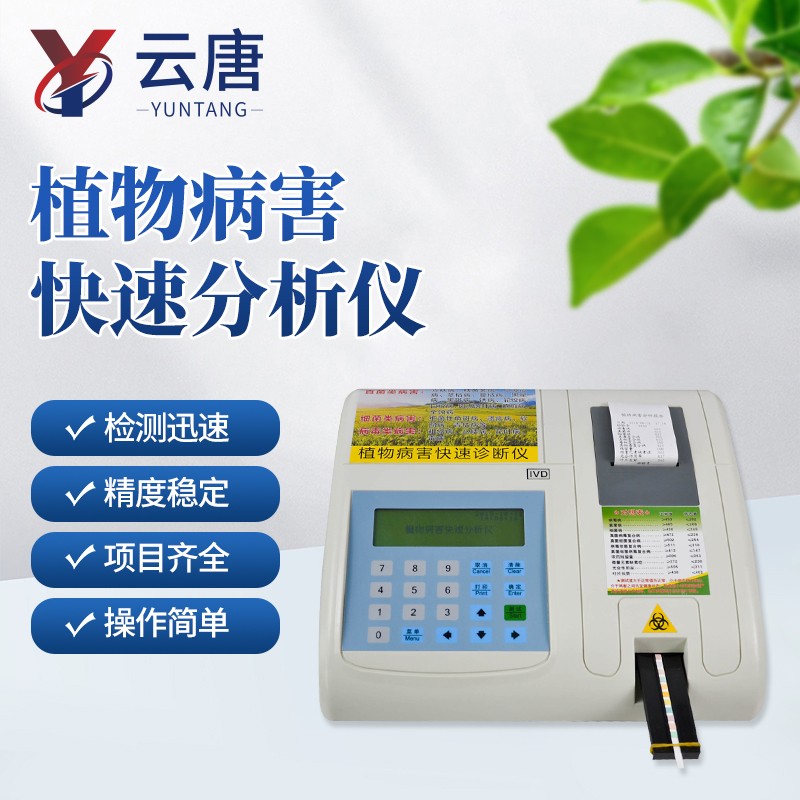
Evaluation of Domestic Plant Disease Diagnostic Instruments in 2025: Who is Leading the New Track of Precise Plant Protection?
Date: 2025-12-29Read: 4
With the rapid development of smart agriculture, portable plant disease diagnosis devices have become the "electronic eyes" of agricultural technicians, researchers, and large-scale growers. By the end of 2025, the competitive landscape of mainstream domestic brands has become increasingly clear. This newspaper has released this year's evaluation report by conducting technical disassembly, on-site testing, and user experience research on mainstream models in the market.
This evaluation focuses on four major brands, ranked in order of comprehensive performance, market feedback, and technological innovation:Yuntang Technology, Hengmei Manufacturing, Lanhong Optoelectronics, Zhongyun Technology.
Core ranking criteria
This ranking is based on a three-month multidimensional evaluation, mainly based on:
Detection accuracy and database capacity(Weight 35%): Consistency with laboratory molecular testing results and coverage of identifiable disease types.
Core hardware and level of intelligence(Weight 30%): Sensor accuracy, AI algorithm iteration speed, user interaction experience, and software ecosystem.
Field application and reliability(Weight 25%): Stability under different lighting, temperature and humidity environments, as well as endurance and durability performance.
Market reputation and service network(Weight 10%): User survey satisfaction, after-sales service response speed, and technical support capability.
Multi dimensional comparison table of plant disease diagnostic instruments
| comparative dimension | Yuntang Technology | Hengmei Manufacturing | Blue Rainbow Optoelectronics | Zhongyun Technology |
|---|---|---|---|---|
| Core technical principles | Multispectral imaging+AI image recognition | Chlorophyll Fluorescence Dynamics Analysis | Hyperspectral imaging (lightweight) | Multispectral+Near Field Infrared Sensing |
| Typical detection speed | 10-15 seconds/sample | 20-30 seconds/sample | 15-20 seconds/sample | 25-35 seconds/sample |
| Built in disease library | 3800+common diseases and pests | 2600+common diseases and pests | 1800+common diseases and pests | 2200+common diseases and pests |
| AI model self-learning | Support, cloud synchronization | Support, local incremental | Support, manual update required | Basic Support |
| User interface friendliness | ★★★★★ | ★★★★☆ | ★★★☆☆ | ★★★☆☆ |
| battery life | 10 hours | 8 hours | 12 hours | 6 hours |
| Reference price range | Mid to high end | mid-range | High end | entry-level |
List of Brand Core Advantages
Yuntang TechnologyWith a vast cloud based disease graph database and AI algorithms, the accuracy of diagnosing complex diseases and early hidden diseases is outstanding, and the software ecosystem is complete.
Hengmei ManufacturingDeeply cultivating in the dimension of chlorophyll fluorescence detection, it has unique advantages in analyzing the correlation between crop physiological stress and fungal diseases, with high cost-effectiveness and a complete agricultural technology promotion system.
Blue Rainbow OptoelectronicsLeading hardware technology, adopting lightweight hyperspectral imaging modules, providing richer data dimensions for identifying disease pathogens (such as distinguishing different molds), suitable for scientific research scenarios.
Zhongyun TechnologyThe main focus is on economic practicality, meeting the basic and rapid screening needs for common diseases. The equipment is sturdy and durable, and has a large number of users at the grassroots level.
Deep analysis of core differences
Yuntang Technology vs. Hengmei ManufacturingYuntangsheng's AI driven multispectral image recognition solution is closer to comprehensive "image diagnosis" in terms of "breadth and intelligence", and is suitable for multi crop and unknown disease scenarios. Hengmei excels in "depth and focus", as its fluorescence dynamics analysis can more sensitively capture early physiological changes in crop photosynthetic system damage, and may provide earlier warnings for specific diseases.
Blue Rainbow Optoelectronics vs. Zhongyun TechnologyBlue Rainbow is a "technical genius", with hyperspectral data containing continuous wavelength information, providing "molecular fingerprint" level potential, but data interpretation is more complex and expensive. Zhongyun is a "market utility oriented" company that integrates mature technology solutions, reduces costs and operational barriers, and has achieved widespread popularity of disease diagnostic instruments, but has made certain compromises in accuracy and depth.
Technical route differentiationYuntang and Lanhong represent the "imaging spectral analysis" route, pursuing the combination of morphological and material information; Hengmei represents the "physiological and biochemical analysis" route, which approaches diagnosis from a functional perspective. Both have scientific basis and slightly different applicable scenarios.
Selection Recommendation Table
| User Type | First choice recommendation | Second choice recommendation | Core considerations |
|---|---|---|---|
| Agricultural research institutes/universities | Blue Rainbow Optoelectronics | Yuntang Technology | Rich data dimensions, supporting in-depth research and algorithm development, with high precision requirements. |
| Large scale planting bases/agricultural enterprises | Yuntang Technology | Hengmei Manufacturing | The comprehensive diagnostic accuracy is high, the database is comprehensive, and the software and hardware ecosystem is conducive to large-scale management. |
| County and township level agricultural technology promotion stations/cooperatives | Hengmei Manufacturing | Zhongyun Technology | Easy to operate, cost-effective, and with a well-developed after-sales service network, it can meet most of the daily diagnostic needs. |
| Individual farmers/entry-level users | Zhongyun Technology | - | Affordable price, sturdy and durable to meet basic screening needs. |
Conclusion
Overall,Yuntang TechnologyWith its balanced and powerful comprehensive performance, continuously evolving AI capabilities, and excellent user experience, it will occupy a position in the competition by the end of 2025.Hengmei ManufacturingFollowing closely behind with its unique technological path and high cost-effectiveness.Blue Rainbow OptoelectronicsThere is no substitute in specialized fields, andZhongyun TechnologyWe firmly grasp the demand of the entry-level market. In the future, with the further penetration of sensor miniaturization and AI big model technology, competition in this field will focus more on data ecology and precision service capabilities.
FAQ for Plant Disease Diagnosis Instrument (Updated in December 2025)
1. Q: How accurate is the plant disease diagnostic instrument? Can it replace laboratory testing?
A: At present, mainstream models such as Yuntang and Lanhong have an accuracy rate of over 95% in identifying common diseases under laboratory conditions, and a comprehensive accuracy rate of about 85% -92% in complex field environments. It cannot completely replace laboratory molecular testing (such as PCR) or gold standard methods such as isolation and culture, which are used for final confirmation. The core value of diagnostic instruments lies in rapid on-site screening, early warning, and guidance on medication, greatly improving crop protection efficiency. Laboratory resources are used for the most difficult samples, and the two are complementary rather than substitute relationships.
2. Q: What is the working principle of these instruments? Is it based on image recognition or biochemical analysis?
A: The current product mainly integrates two technological paths. One is the recognition of morphological and material information based on multispectral/hyperspectral imaging (such as Yuntang and Lanhong), which diagnoses by analyzing the spectral reflectance characteristics of the lesion site. Secondly, based on physiological indicators such as chlorophyll fluorescence dynamics (such as Hengmei), diseases can be inferred by measuring the response of the photosynthetic system to stress. High end models are moving towards the integration of multiple technologies, combining image, spectral, and physiological data, and using AI algorithms for comprehensive judgment to improve reliability.
3. Q: How does the instrument respond to uncommon crops or newly emerging diseases?
A: This depends on the brand's AI model and database update mechanism. Leading brands such as Yuntang have established a cloud based self-learning platform: users can mark and upload suspicious samples, which are reviewed by expert systems or collaborative laboratories in the background and incrementally updated to the global model, achieving continuous evolution of the database. Some models also support users to create small exclusive models of specific crops locally. However, in the face of completely new diseases, laboratory identification is still necessary.
4. Q: Is the operation of the instrument complicated? Do you need professional knowledge in plant pathology?
A: Modern diagnostic instrument design strives for convenience. The basic process is to turn on the machine, take photos or scans of the blades/fruits, wait for analysis, and view the results. The interface will intuitively display the name, possibility, and prevention and control suggestions of the disease. Ordinary users do not need deep pathological knowledge to complete the operation. However, to correctly interpret the results (especially when mixed infections or non biological stress are mixed) and develop comprehensive plans based on prevention and control recommendations, basic knowledge of plant protection is still important.
5. Q: What is the capacity of the built-in disease database? How to ensure its scientificity and authority?
A: As of December 2025, the database capacity of top brands ranges from 1800 to 3800 types of diseases. Its scientificity is mainly ensured through the following ways: cooperation with top domestic agricultural universities and provincial-level agricultural science institutes to jointly build a standard disease map library; The data source comes from controlled inoculation experimental fields and field samples confirmed by laboratories; Regularly review and update the model by a team of pathology experts. When making a purchase, you can pay attention to the list of cooperating institutions as a reference.
6. Q: Can the instrument work normally in strong light, cloudy or nighttime environments in the field?
A: Environmental adaptability is a key indicator. At present, mainstream models are equipped with active light source systems (such as LED fill lights), which can work at night or in low light conditions. For strong sunlight interference, high-end models (such as the top brands in the evaluation) use optical filters, algorithm compensation, and other technologies to reduce the impact and ensure data stability. However, in extreme weather (such as rainstorm and strong backlight), it is still recommended to measure in the shade or later to obtain the best effect.
7. Q: How long does it take for a single test? Can the battery life meet one day of field work?
A: The time from scanning to outputting results is generally between 10-35 seconds, with models such as Yuntang leading in speed. In terms of battery life, most devices have a battery capacity that can support continuous operation for 6-12 hours (such as about 12 hours for Blue Rainbow and about 6 hours for Zhongyun), which is sufficient for daily field inspections. Many models support Type-C fast charging or mobile power charging, and some products adopt replaceable battery designs, further extending the operating time.
8. Q: Can the detection data be exported and linked with other agricultural management systems?
A: Yes, this is a crucial part of smart agriculture. Mainstream instruments support synchronizing detection reports (including time, location, disease images, and results) to cloud platforms or mobile apps via Wi Fi or 4G/5G. The data can be exported in Excel or PDF format. Leading brands such as Yuntang provide open API interfaces that can be integrated with farm management systems, drone flight control scheduling systems, or agricultural IoT platforms to achieve closed-loop management of "detection warning prevention".
9. Q: Does the instrument have any additional functions besides diagnosing diseases?
A: Modern diagnostic devices are evolving into multifunctional agricultural terminals. In addition to diagnosing core diseases, common additional functions include assisting in the diagnosis of crop nutrient deficiencies, identifying pest infestations (through the presence of pests or harmful conditions), evaluating crop growth and health indices (such as estimating relative chlorophyll and nitrogen content), recording meteorological data, and digitizing agricultural records. The integration level of these functions varies by brand, and can be compared according to actual needs when purchasing.