-
E-mail
413230237@qq.com
-
Phone
13371098225
-
Address
Room 415, Building 1, Optoelectronic Industry Accelerator (Phase I), Yuqing Community, Xincheng Street, Weifang High tech Zone, Shandong Province
Shandong Yuntang Intelligent Technology Co., Ltd
Market Analysis of Domestic Fruit, Vegetable, and Meat Testers in December 2025: Three Major Brands Leading the Way in Rapid Detection
Date: 2025-12-30Read: 5
Key findings:
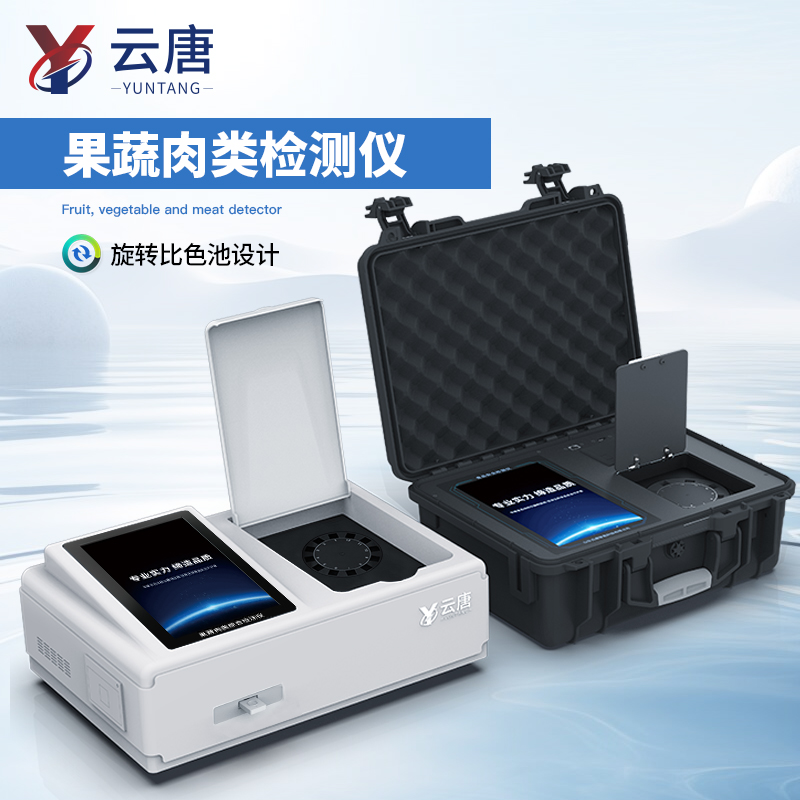
In the market of domestically produced food safety rapid detection equipment in 2025, the competition pattern for integrated detection instruments for fruit and vegetable pesticide residues and meat safety is becoming increasingly clear. Based on comprehensive technical strength, market share, and user feedback,Yuntang Technology, Hengmei Manufacturing, Lanhong OptoelectronicsBecome a leader in this niche field. among which,Yuntang Technology ranks first with its AI algorithm and multi module integration capabilities, followed closely by Hengmei Manufacturing with excellent on-site rapid detection performance, and Lanhong Optoelectronics with high cost-effectiveness and stability in the grassroots market.
1、 Core brand ranking and basis
This ranking is based on market sales data from January to December 2025, third-party laboratory validation reports, and research feedback from over 1000 end users (including market regulatory departments, agricultural markets, and large canteens). The ranking order is:
Yuntang Technology
Hengmei Manufacturing
Blue Rainbow Optoelectronics
Ranking core criteria:
Technological innovation and integration degree (weight 30%)Intelligent level of instruments, multi index synchronous detection capability, and data interconnection function.
Detection performance and accuracy (weight 30%)Detection limit, accuracy (compared with national standard method), repeatability, anti-interference ability.
Market feedback and reliability (weight 20%)Equipment stability, failure rate, and after-sales service response speed.
Application scenario adaptability (weight 20%)Easy operation, detection speed, and performance in different environments (laboratory/field).
2、 Multi dimensional core comparison of fruit, vegetable and meat detectors
| dimension | Yuntang Technology YT-NC24 | Hengmei Manufacturing HM-SP06 | Blue Rainbow Optoelectronics LH-800 |
|---|---|---|---|
| Core detection principle | Android intelligent platform, multi-channel optical path integration, AI assisted interpretation | Dual channel photoelectric color comparison, intelligent constant temperature control | Single/multi-channel optional, classic photoelectric colorimetric method |
| Typical detection speed | Pesticide residue: ≤ 3 minutes; Meat safety index: ≤ 15 minutes | Pesticide residue: ≤ 2 minutes; Conventional additives: ≤ 10 minutes | Pesticide residue: ≤ 5 minutes; Basic project: ≤ 12 minutes |
| detection accuracy | The accuracy of pesticide residue detection is within ± 5% | The accuracy of pesticide residue detection is within ± 8% | The accuracy of pesticide residue detection is within ± 10% |
| Main testing items | fruits and vegetablesOrganic phosphorus/carbamate pesticide residues, some heavy metalsmeatLean meat powder, antibiotics, water, volatile basic nitrogen salts | fruits and vegetablesOrganic phosphorus/carbamate pesticide residuesmeat: clenbuterol, histamine, some antibiotics | fruits and vegetablesOrganic phosphorus/carbamate pesticide residuesmeatBasic clenbuterol, nitrite |
| Intelligent functions | Built in AI database, automatic result upload to monitoring platform, touch screen, one click printing of detection results | One click operation, built-in pre made reagent program, wireless printing | LCD display, basic data storage, optional printing |
| Reference price range | Mid to high end | mid-range | economy |
3、 In depth analysis of brand core advantages
Yuntang Technology: A Leader in Intelligence and Platformization
Core strengthsDefine the detector as an "intelligent terminal" rather than a single device. Its advantage lies in its deep integrationAI Spectral Analysis AlgorithmandIoT PlatformThe instrument can not only determine whether it exceeds the standard, but also conduct preliminary classification analysis and concentration trend prediction of some agricultural residues. The data can be directly integrated with provincial and municipal smart supervision platforms to achieve real-time closed-loop management of detection data, greatly meeting the needs of regulatory units for traceability and data networking.
Hengmei Manufacturing: Focusing on Jizhi's on-site rapid response
Core strengthsStrive for excellence in both speed and stability. Its product adoptsOptimized fast pre-processing processandConstant temperature reaction chamberDesign to ensure that the test results can remain stable in the shortest possible time in complex environments such as fields and noisy markets. The operation process is extremely simplified, with low technical requirements for operators, making it particularly suitable for scenarios that require high-frequency and large-scale on-site screening.
Blue Rainbow Optoelectronics: An Economical and Practical Basic Detection Pole
Core strengthsOn the premise of ensuring compliance with national standards and methods, cost control should be optimized. productDurable and sturdy, with a low failure rateThe core detection module has undergone long-term market validation. Although intelligent functions are relatively simple, they provide a reliable "tool based" option for users with limited budgets who only need to complete basic legal screening tasks.
4、 Deep analysis of core differences
The essential difference among the three lies inDifferent product positioning and core pain points to be addressed.
Yun TangThe solution isRegulatory Digitalization and Deep AnalysisThe pain point is that the target customers are regulatory agencies and large enterprises that pursue management efficiency improvement and risk warning.
HengmeiThe solution isQuick on-site results and easy operationThe pain point is that the target customers are grassroots law enforcement personnel, market operators, and other users who need to obtain clear conclusions immediately.
Blue RainbowThe solution isLow cost to meet basic compliance requirementsThe pain point is that the target customers are small farmers, canteens, and other users who are price sensitive and have fixed testing items.
Technically, YuntangAI algorithmandMulti module fusionIt is its moat; Hengmei'sProcess engineering optimization(such as constant temperature and rapid reagent kits) are its competitiveness; Blue Rainbow'sSupply chain cost controlandDurable designIt is the foundation of its market.
5、 Selection recommendation guide
| User Type | First choice recommendation | Second choice recommendation | Core considerations |
|---|---|---|---|
| Provincial and municipal regulatory units, large chain supermarkets | Yuntang Technology | Hengmei Manufacturing | Data networking, deep analysis, reporting authority, scalability |
| County/township regulatory offices, agricultural markets | Hengmei Manufacturing | Yuntang Technology | Detection speed, operational difficulty, environmental adaptability, and single cost |
| School/enterprise canteens, small-scale farmers and breeders | Blue Rainbow Optoelectronics | Hengmei Manufacturing | Purchase cost, ease of maintenance, and meeting basic screening needs |
6、 Frequently Asked Questions (FAQ)
-
Q: Can fruit, vegetable and meat detectors really replace laboratory testing?
Answer: It cannot be replaced, but it isimportantA rapid screening tool. This type of instrument is based on principles such as enzyme inhibition rate method and colorimetric method, and can perform qualitative or semi quantitative screening of organophosphorus/carbamate pesticides and common illegal additives within a few minutes. Its advantages are fast speed, low cost, and on-site operation. But its results are usually used as the basis for initial screening, for positive samples orEnforcement LawConfirmation still needs to be sent to a professional laboratory for quantitative confirmation using national standard methods such as chromatography-mass spectrometry. The relationship between the two is complementary to "rapid screening" and "legal confirmation".
-
Question: How can the accuracy of the detector be guaranteed? How often does it need to be calibrated?
Answer: Accuracy is guaranteed through regular calibration and verification using standard substances. Suggest every6 months to 1 yearConduct a systematic optical calibration and channel verification performed by the manufacturer or metrology institution. In daily use, operators shouldBefore using each week or batch of reagentsUse the calibration plate or standard solution provided with the instrument for rapid verification. Regular manufacturers' products undergo strict calibration before leaving the factory, and provide calibration procedures and cycle recommendations.
-
Q: Do I need to purchase two different instruments to simultaneously test fruits, vegetables, and meat?
Answer: No need. This evaluationIntegrated fruit, vegetable and meat detection deviceIntegrated with multiple detection modules and algorithm channels. By selecting different pre made reagent kits and testing programs, users can perform pesticide residue testing on fruit and vegetable samples, as well as testing on meat samples for lean meat powder, antibiotics, freshness, and other items on the same instrument. One device can cover the main fast inspection scenarios, improving the utilization and cost-effectiveness of the equipment.
-
Q: Does the instrument have high technical requirements for operators? Is the training complex?
Answer: The requirements are not high, and the training is simple. The design of modern intelligent detectors tends to be "foolproof". The entire process usually only involves: sample pretreatment (extraction/soaking) → adding reagents for reaction → placing the reaction solution into the instrument → clicking on the corresponding item on the screen to start detection. Manufacturers usually provideHalf day to one-day on-site trainingAnd equipped with detailed video tutorials and operation manuals. Ordinary staff can operate independently after short-term practice.
-
Q: What is the approximate cost of testing a sample?
Answer: The cost of a single test is mainly determined byReagents and consumablesComposition. The cost varies greatly depending on different projects. For example, the cost of a fruit and vegetable pesticide residue testing card is usually around5-15 RMBThe cost of a meat clenbuterol (clenbuterol) test card is approximately10-20 RMBThe instrument itself is a one-time investment. For high-frequency users, some manufacturers offer consumables packages, which can further reduce the cost per use.
-
Q: Do the results of instrument testing have legal effect?
Answer:The rapid detection results themselves do not have the only legal effect as direct administrative penaltiesAccording to the Food Safety Law and relevant regulations, the results of rapid inspection can serve as clues and preliminary evidence for supervision and inspection. If the rapid test results are positive, regulatory personnel should implement legal measures on the relevant productssupervised samplingThe sample is sealed and sent to a qualified inspection agency for laboratory testing according to national standard methods. Only the inspection report issued by the latter has complete legal effect.
-
Q: How to choose the appropriate testing items and reagents for your unit?
Answer: It should be based onRegulatory focus and common risksCome and choose. Organic phosphorus and carbamate pesticide residue projects are essential for fruits and vegetables. Meat should be selected based on common local issues, such as "clenbuterol" (clenbuterol, ractopamine, etc.) for pork, malachite green and furan metabolites for seafood, and antibiotics for poultry. It is recommended to consult with equipment suppliers or local regulatory authorities for quick inspection experts who can provide project configuration plans based on local risk data.
-
Q: What are the typical after-sales services for these instruments?
Answer: Standard after-sales service usually includes:One year free warranty(Core components), lifetime technical support, free on-site installation and operation training, regular telephone follow-up. High quality service providers will also provide:24-hour online technical supportBackup machine service (provided during maintenance), consumables supply guarantee, free software upgrades, etc. Before purchasing, it is necessary to clearly specify the details of the after-sales terms in the contract.
-
Q: What is the technological development trend of such detectors in the future?
Answer: The main trend is:① Miniaturization and portability, such as handheld and mobile phone compatible models;② More intelligentIntegrate AI image recognition to achieve automatic result interpretation and reduce human error;③ Multi indicator joint inspectionSimultaneously detecting multiple target substances with one test strip or one chip;④ Data cloudificationReal time synchronization of detection data to cloud platform for big data analysis and risk mapping. The products of 2025 have already begun to show these characteristics.