-
E-mail
sales@advanceultrasonics.com
-
Phone
15921972179
-
Address
2nd Floor, Building 12, Yusong Industrial Park, Lane 838 Yuyang Road, Songjiang District, Shanghai
Shanghai Gaoben Ultrasonic Equipment Co., Ltd
Design points and precautions for dual output ultrasonic generator
Date: 2025-12-11Read: 7
A dual output ultrasonic generator is a device that can provide two independent ultrasonic outputs simultaneously. The two outputs can be independent of each other in frequency and power, or work in coordination to drive ultrasonic oscillators of different types or loads, thereby improving the flexibility and efficiency of the system.
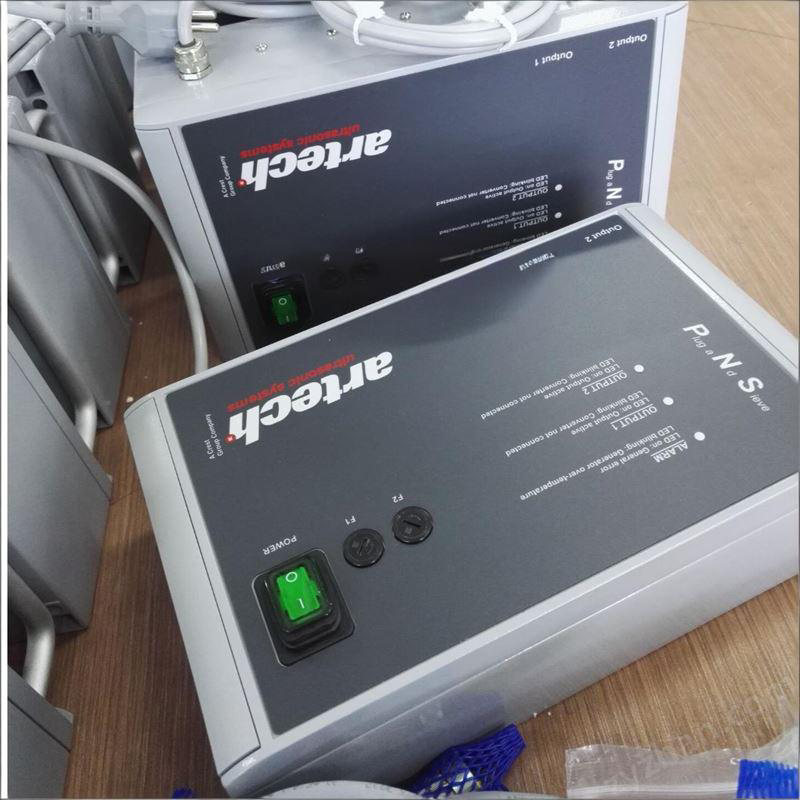
Dual output ultrasonic generatorWorking principle:
1. Power conversion
The AC power at the power frequency is rectified and filtered to generate a stable DC power supply, providing the energy foundation for high-frequency oscillation circuits.
2. High frequency oscillation
The high-frequency oscillation circuit generates sine or square wave high-frequency signals according to the required operating frequency. Dual output generators typically use two independent oscillators, or control the two output frequencies separately through tunable oscillators.
3. Power amplification
The high-frequency signal is amplified by a power amplifier to the required power, meeting the driving requirements of the oscillator. Each output channel has an independent amplification circuit that can adjust power independently.
4. Resonant matching
To ensure the efficient operation of the oscillator, the output signal is matched with the oscillator impedance through a matching network (usually a capacitor, inductor, or transformer) to achieve maximum power transmission and reduce reflection losses.
5. Drive the oscillator
The matched high-frequency electrical energy drives the piezoelectric ceramic oscillator to generate mechanical vibration. By coupling sound waves, vibration is transmitted to the cleaning tank, welding head, or liquid medium to achieve ultrasonic treatment.
The characteristic of a dual output generator is that the two channels can work independently or in conjunction. For example, in a cleaning system, one output is used for rough cleaning and the other output is used for fine cleaning; Or in ultrasonic welding, one output is used to vibrate the main welding head, and the other output is used to assist the welding head.
Partial composition:
1. Input power module
Receive AC power at the power frequency, rectify and filter it, and provide stable DC power.
2. High frequency oscillation module
Two independent oscillators generate high-frequency signals respectively. The frequency can be fixed or adjusted through a control circuit.
3. Power amplification module
Including power transistors or MOSFETs, IGBTs and other power devices, amplifying low-power high-frequency signals to tens of watts to several kilowatts.
4. Matching network
Including components such as capacitors, inductors, or transformers, to achieve impedance matching between the output signal and the oscillator, improving efficiency and stability.
5. Control and protection module
Including overcurrent protection, overvoltage protection, over temperature protection, frequency tracking, and power regulation functions. Dual output generators are typically equipped with independent control interfaces that can monitor the power, frequency, and status of each channel.
6. Output interface
Connect two oscillators or oscillator groups separately, usually using coaxial cables or special high-frequency interfaces.
Design features and advantages:
1. Dual channel independent control
The dual output generator can independently adjust the frequency and power of two channels, enabling the system to flexibly respond to different loads and process requirements.
2. Improve system efficiency
In industrial cleaning or liquid processing scenarios, multiple oscillators can be driven simultaneously to reduce the number of equipment and improve processing efficiency.
3. Enhance process adaptability
By adjusting the working states of the two outputs, multi frequency resonance, multi power superposition, or combination processing of different amplitudes can be achieved to improve process flexibility.
4. Intelligent protection and monitoring
Dual output generators are usually equipped with digital control and monitoring interfaces, which can detect the status of the oscillator in real time and prevent damage to the equipment caused by no-load, overload, or resonance failure.
5. Wide application range
Suitable for various industrial and scientific fields such as ultrasonic cleaning, ultrasonic welding, ultrasonic emulsification, ultrasonic extraction, ultrasonic flaw detection, etc.
Design points and precautions for dual output ultrasonic generator:
1. Frequency matching
The frequency of each channel in a dual output system must match the mechanical resonance frequency of the oscillator it drives to avoid power loss or oscillator damage.
2. Power control
The power requirements of different oscillators or loads vary, and an independently adjustable power control system should be equipped with overload protection.
3. Temperature management
High frequency power modules and oscillators generate a large amount of heat during operation, and an effective heat dissipation system should be designed to prevent overheating of the components.
4. Interference and shielding
High frequency signals may generate electromagnetic interference, and reasonable shielding and grounding measures should be designed to avoid affecting other equipment.
5. Security protection
Including no-load protection, overvoltage protection, short circuit protection, over temperature protection, etc., to ensure long-term stable operation of the equipment.