-
E-mail
3086236192@qq.com
-
Phone
13175715860
-
Address
No. 40, Lane 5, Caonong Road, Songjiang District, Shanghai
Shanghai Jingxin Industrial Development Co., Ltd
Jingxin Freeze Grinding Machine bids farewell to the difficulty of grinding circuit boards and maximizes low-temperature pollution prevention efficiency
Date: 2025-12-11Read: 50
Experimental background:In modern electronics industry, circuit board (PCB) is the "skeleton" and "nerve" of electronic devices. In order to analyze its material composition, detect harmful substances (such as RoHS testing), or carry out resource recycling, we often need to grind circuit board samples into uniform and fine powders. However, the circuit board itself is a composite material consisting of hard fiberglass cloth, tough copper foil, and thermosetting resin, with uneven material and high toughness.
What are the challenges faced by traditional grinding methods?
1. Difficult to grind: The material is complex and ordinary grinders are difficult to fully grind.
2. Sample denaturation: The high temperature generated during the grinding process may cause thermal decomposition of components such as plastics and resins, altering the properties of the sample.
3. Sample loss and cross contamination: Repeated operation can easily cause sample loss, and unclean cleaning of grinding equipment can lead to cross contamination.
Instrument advantages
How can the pre-processing of circuit board samples be completed?
The emergence of the Jingxin freeze grinder provides a solution for sample pretreatment of circuit board materials. It utilizes the unique principle of combining "low-temperature freezing" with "high-speed impact" to overcome the drawbacks of traditional methods and demonstrate the following advantages.
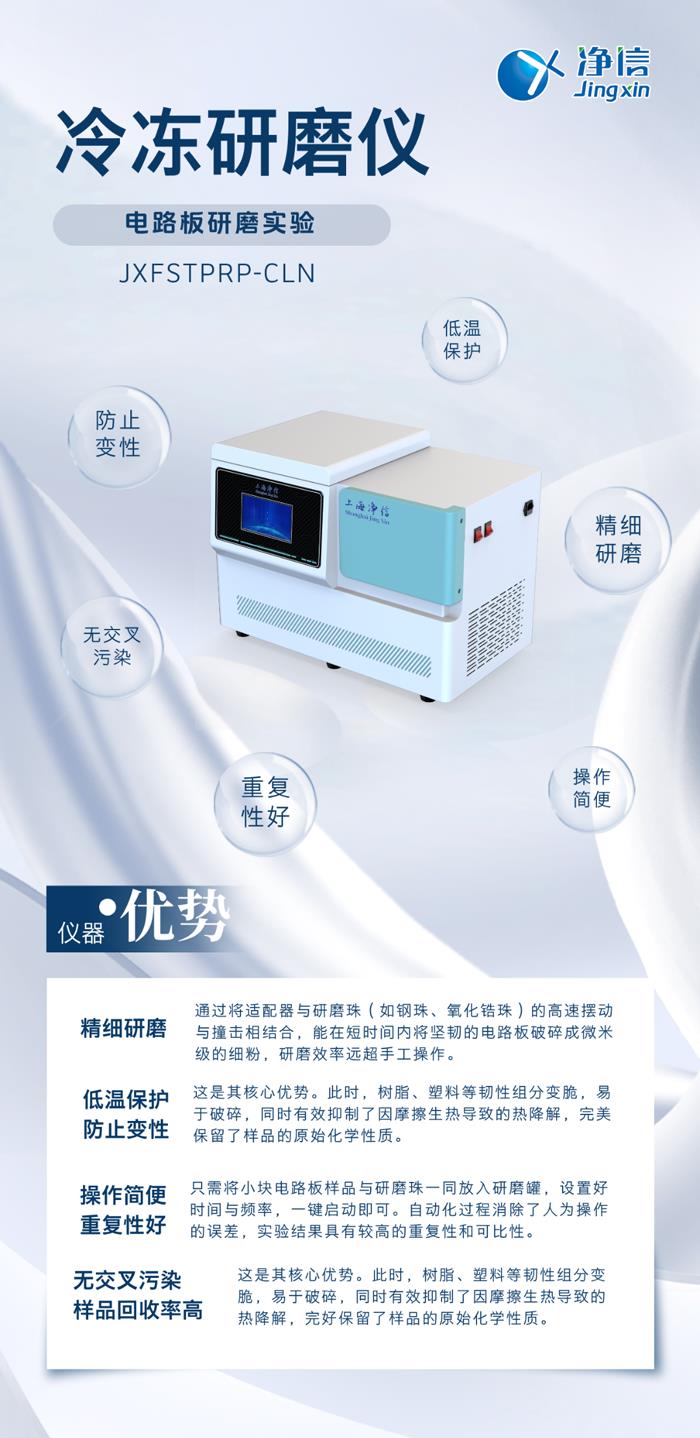
Experimental instrument selection:

Freezing grinder JXFSTPRP-CLN
Experimental steps:
1. Sample preparation: Use pliers or cutting machines to cut the waste circuit board into small pieces that are large enough to fit into a grinding jar. Weigh an appropriate amount of sample and place it together with several grinding beads in a clean grinding jar.
2. Freezing and fixation: Load the grinding jar containing the sample into the instrument and start the pre freezing program.
3. Setting and Running: Set grinding parameters such as grinding time (usually 1-3 minutes) and oscillation frequency through the touch screen. After setting up, one click start will initiate the high-speed oscillation grinding of the instrument.
4. Collect samples: After the program runs, remove the grinding jar. Open the can lid to obtain a uniform and fine powder of the circuit board. Pour it into a sample bag or weighing paper, and it can be directly used for subsequent experiments such as component analysis and element detection.
Experimental effect:
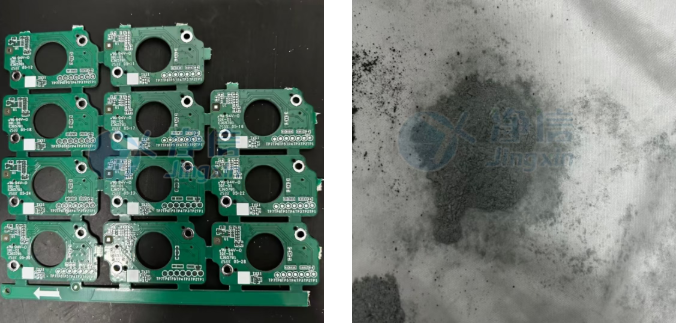
Comparison diagram of the effect before and after grinding the circuit board
The Jingxin cryogenic grinder, with its low-temperature and pollution avoiding grinding characteristics, has successfully solved the pre-treatment problem of complex composite materials such as circuit boards. It is not only a "powerful assistant" for improving the accuracy of RoHS testing, material composition analysis, and other data, but also a "divine weapon" for material analysis in the field of electronic waste resource recycling. Choosing the Jingxin freeze grinder means choosing a shortcut to more reliable experimental results, providing strong technical support for your scientific research and quality control work.