-
E-mail
1634566705@qq.com
-
Phone
13661628813
-
Address
No. 327 Xiangdong Road, Xianghua Town, Chongming District, Shanghai
Shanghai Tianhe Pharmaceutical Machinery Co., Ltd
Process flow and application of CT-C hot air circulation oven
Date: 2025-12-12Read: 2
The CT-C hot air circulation oven is a drying equipment widely used in industries such as pharmaceuticals, food, and chemicals. It adopts the principle of forced hot air circulation and achieves efficient and uniform drying by driving air flow through a fan. Its core structure includes a stainless steel box, insulation layer, circulating fan, heating system, and intelligent temperature control device, ensuring that the material completes the dehydration process in a controlled environment. Its core advantage lies in the design of hot air circulation, which can improve thermal efficiency and support precise temperature control to meet different process requirements.
The process flow of CT-C type hot air circulation oven mainly includes four steps: material placement, oven start-up, drying operation, and discharge cooling. as follows:
• Material placement: Place the materials to be dried into a drying tray, place the tray on the drying car, then push it into the oven and close the door.
Oven start-up: By setting the temperature through the control system, the circulating fan and heating device are sequentially turned on, and the equipment starts to operate automatically.
Dry operation: Hot air circulates inside the box, transferring heat through convective heat exchange, while replenishing fresh air and expelling moisture to ensure uniform drying of materials.
Discharge cooling: After drying is completed, stop heating and wait for the temperature inside the box to drop below 60 ℃ before opening the box door to remove the material.
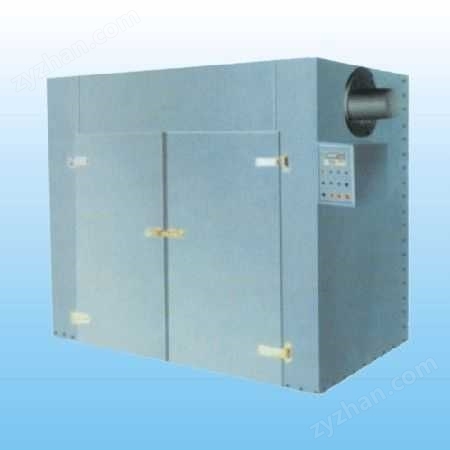
This device has a wide range of applications in multiple industries, including:
Pharmaceutical industry: used for drying and solidifying raw materials, traditional Chinese medicine decoction pieces, granules, granules and other materials.
Food industry: suitable for drying dehydrated vegetables, dried fruits and vegetables, sausages, aquatic products and other foods to ensure hygiene standards.
Chemical and Light Industry: Used for heating, curing, and dehumidification of pigments, dyes, powders, plastic resins, electrical components, and other products.
Electronics and New Energy: Used for drying electrode sheets in lithium battery production to improve production efficiency.