-
E-mail
sales@51082915.cn
-
Phone
13381632669
-
Address
Building 3, No. 77 Gangxing Road, Songjiang District, Shanghai
Shanghai Yacheng Instrument Equipment Co., Ltd
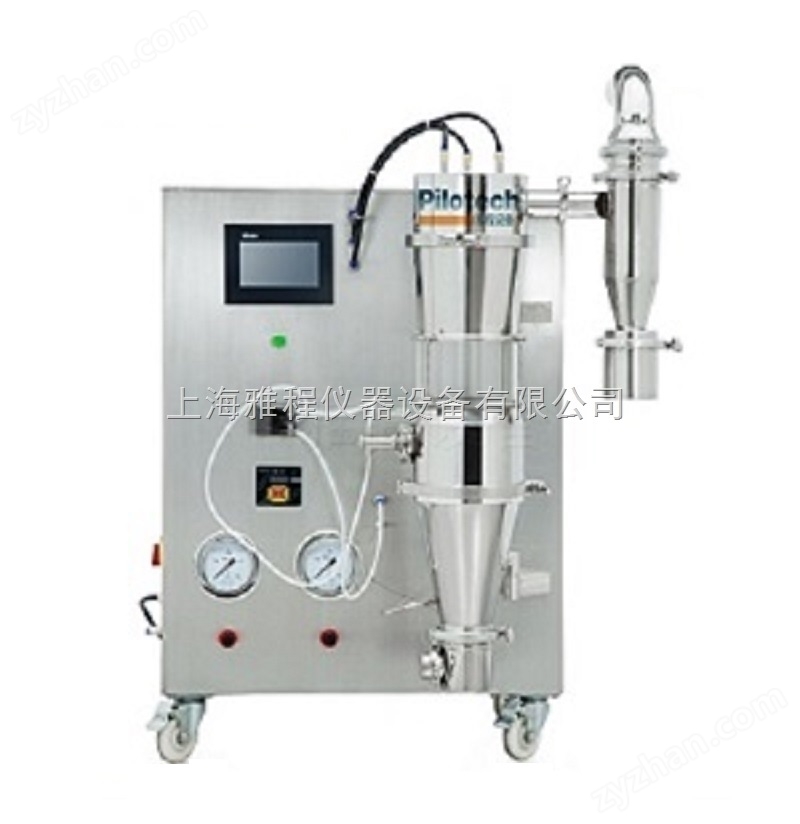
Process principle of spray fluidized bed granulator
Date: 2025-04-09Read: 8
The technological principle of the spray fluidized bed granulator is based on the synergistic effect of fluidization technology and atomization spraying, which realizes particle forming through dynamic fluidization, droplet coating and continuous drying. The core process and mechanism are as follows:
1、 Process stages and mechanisms
1. Fluidization stage
Preheated air is introduced into the fluidized bed from the bottom of the equipment, forming a uniform airflow through the distribution plate, suspending the solid powder and presenting a fluidized state. The fluidization gas velocity needs to be higher than the critical fluidization velocity of the particles to maintain vigorous particle movement and prevent agglomeration.
2. Atomization and spraying
The liquid material (such as mother liquor or adhesive) is transported to the atomizing nozzle through a pressure pump and dispersed into micrometer sized droplets by compressed air or mechanical action. Droplets combine with fluidized particles through the following methods:
Infiltration and adhesion: Droplets wet the surface of particles, forming liquid bridges and adhering fine powders;
Agglomeration and encapsulation: Some droplets directly encapsulate particles or aggregate fine powder to form new particle nuclei.
3. Dynamic drying and particle growth
After the droplet adheres, it is quickly dried by hot air, and the liquid bridge is transformed into a solid bridge. The particles gradually increase through repeated spraying and drying. During the drying process, hot air comes into counter current contact with particles to ensure uniform evaporation of moisture and reduce the risk of local overheating.
4. Fine powder recycling and circulation
The unattached fine powder enters the cyclone separator or bag filter with the airflow, and is recycled and reintroduced into the fluidized bed for granulation, maintaining the balance of particle quantity and improving the utilization rate of raw materials.
2、 Process characteristics
1. Integrated operation: Integrate mixing, granulation, and drying processes to shorten production cycles;
2. Thermal sensitivity applicability: The temperature distribution inside the fluidized bed is uniform, avoiding material thermal decomposition;
3. High particle quality: good particle roundness, narrow particle size distribution, excellent flowability and compressibility;
4. Closed production: compliant with GMP standards, reducing pollution and personnel contact risks.
3、 Key control parameters
1. Fluidizing gas velocity: affects particle mixing efficiency and fluidization stability;
2. Atomization pressure/nozzle type: determines droplet size and spray uniformity;
3. Liquid viscosity and temperature: affecting the strength of liquid bridge formation and drying rate;
4. Hot air temperature and flow rate: control drying speed and particle porosity.
4、 Application scenarios
Suitable for industries such as pharmaceuticals, food, and chemicals, especially for heat sensitive materials (such as enzyme preparations, vitamins) and granulation needs that require high uniformity particles.
Last Article: Working principle of vacuum spray dryer
Next Article: Technological principle of laboratory spray freeze dryer