-
E-mail
3112123246@qq.com
-
Phone
13771935497
-
Address
Room 1102, International Science and Technology Building, No. 112 Yingchun South Road, Wuzhong District, Suzhou City
Suzhou Golden Diamond Weighing Equipment System Development Co., Ltd
Automatic weighing assembly line electronic scale: analysis of operating principle and structural characteristics
Date: 2025-12-18Read: 5
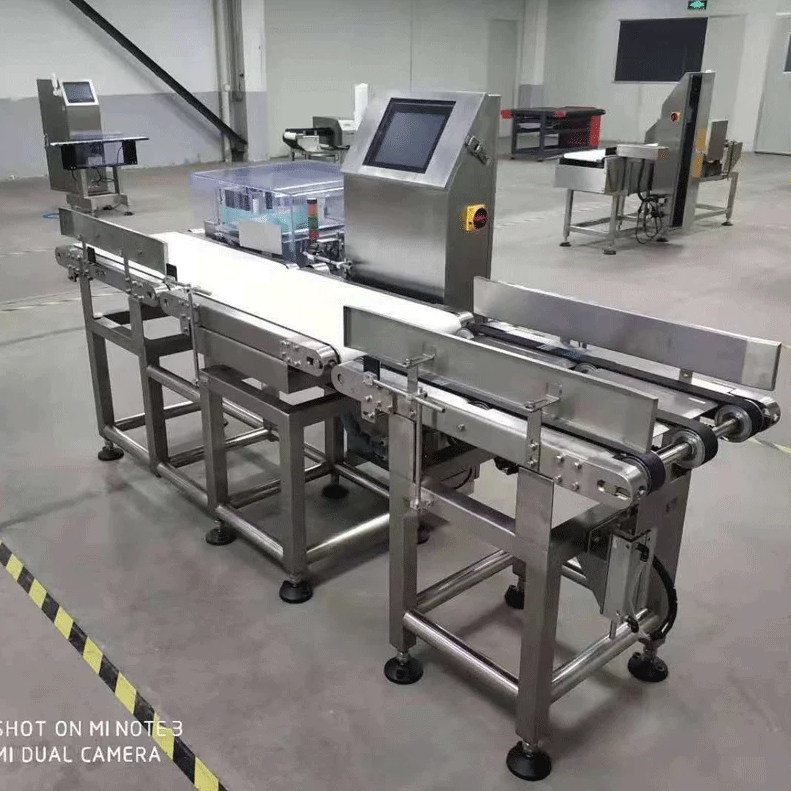
In modern industrial production, automatic weighing assembly line electronic scales have become key equipment for improving efficiency and ensuring quality. It integrates sensor technology, microprocessor control, and automated execution mechanisms, and is widely used in industries such as food, medicine, and chemical. This article will delve into its operating principle and structural characteristics.
1、 Operating principle: the core logic of intelligent weighing
The operation of the automatic weighing assembly line electronic scale begins with the collection of weight signals. When materials enter the weighing area through the conveyor belt, high-precision weighing sensors (such as strain gauges or piezoelectric sensors) sense pressure changes and convert them into weak electrical signals. After being amplified by an instrument amplifier, this signal is processed into a digital signal by an analog-to-digital converter (ADC), which facilitates real-time analysis by a microprocessor (such as a microcontroller). The system compares weight data through preset thresholds, triggers the removal device (such as pneumatic nozzles or mechanical flippers) to automatically sort abnormal products, and supports data traceability and alarm functions. The entire process emphasizes the characteristics of "fast, accurate, and continuous", effectively eliminating human errors and meeting the needs of industrial automation.
2、 Structural features: modular design and functional integration
The structural design of the automatic weighing assembly line electronic scale emphasizes modularity and intelligence to adapt to dynamic production environments. The following are its core characteristics:
Double layer microcontroller control system:Using inner and outer layer microcontrollers to work together. The inner layer microcontroller is responsible for basic tasks such as data acquisition, filtering, and display; The outer layer microcontroller handles communication and advanced control, such as integrating with other equipment on the production line to achieve seamless automation. This layered design improves system response speed and stability.
Dynamic weighing unit:Integrated high-precision sensors (accuracy up to ± 0.1-2 grams) and high-speed conveyor belts, supporting non-contact weighing. Through pressure sensing or laser scanning technology, the system can adapt to different material specifications in real time, ensuring that the weighing process is not disturbed. For example, in food packaging, this unit can quickly detect weight deviations and avoid missed detections.
Multi functional removal actuator:Automatically sort out non-conforming products based on the test results. Common forms include pneumatic nozzles (suitable for lightweight products), mechanical flippers (suitable for regular shaped items), and robotic arms (for handling fragile or irregular materials). This flexibility enables the equipment to cope with diverse production scenarios, such as automotive parts assembly lines.
Data processing and traceability system:Built in industrial grade PLC or edge computing module to analyze weight data in real time and generate statistical reports. Support adjusting parameters such as thresholds and alarm delays through the HMI interface, and uploading abnormal data to the MES system via Ethernet to achieve quality traceability. For example, in the pharmaceutical industry, the system can record the weight fluctuations of each batch of products to assist in compliance audits.
User friendly interactive interface:Equipped with a digital tube or LCD display screen, it intuitively displays weight, unit, and battery information. Keyboard input simplifies parameter settings such as calibration and mode switching, improving operational convenience. Some models also support custom feature development to meet specific industry needs.
Anti interference and stability design:The system adopts shielding technology and filtering algorithms to address electromagnetic and vibration interference in industrial environments. For example, the sensor signal link uses a low-noise amplifier to ensure data accuracy. This design is particularly important in chemical production lines to prevent false alarms.
Modularity and Scalability:The structure adopts standardized components for easy maintenance and upgrading. The weighing unit and removal mechanism can be independently replaced to reduce downtime. In addition, the system supports integration with existing production lines without the need for large-scale modifications.
3、 Application and Prospect
The electronic scale of the automatic weighing assembly line has significantly improved production efficiency and quality control level through structural innovation. In the future, with the development of the Internet of Things and AI technology, its functions will be further expanded, such as achieving predictive maintenance and adaptive weighing. For enterprises, when choosing equipment, they need to weigh accuracy, speed, and cost to match specific production needs.