-
E-mail
liuyuanzhi@eti-test.com
-
Phone
19201635557
-
Address
Wujiang to Tongli Economic Development Zone, Suzhou City
Suzhou Yitai Environmental Technology Co., Ltd
Visual detection of airflow patterns in clean environments - O-RABS requirements
Date: 2025-11-24Read: 76
One small piece of knowledge per week, Yitai Jingke said today: Visualization detection of airflow patterns is required by ORABS
Open access restricted isolation systemopen-restricted access barrier systems (O-RABS)Refers to a system that provides a closed but unsealed environment, which separates the internal environment from the surrounding environment by using a hard shell and gloves integrated into the system to meet specific air quality conditions (for Class A aseptic processes). The inner surface of RABS should be disinfected and purified with sporicidal agents. Operators use gloves, half body clothing, rapid transfer systems, and other integrated transfer ports to perform operations or transfer materials into the RABS. According to the design, the door is hardly opened and only opens under strictly pre-defined conditions.
CRF-V airflow visualization detector

Manufacturer: Suzhou Yitai Environmental Technology Co., Ltd
clean environmentTesting equipmentIntelligent brand, domestic substitution of imported instruments for brand new forces
Domestic purification brand supplier and high-quality purification service provider
A professional enterprise providing a complete solution for intelligent monitoring instruments for clean microenvironments
Airflow pattern
The flow pattern and distribution state of air.
[Source: GB 50457-2019,2.0.11]
3 ️⃣ O-rabs
Open restricted access barrier systems (O-RABS)
Refers to a system that provides a closed but unsealed environment, which utilizes a hard shell and gloves integrated into the system to create an internal environment
Separate from the surrounding environment to meet specific air quality conditions (for A-class aseptic processes). The inner surface of RABS should be disinfected with a sporicidal agent
Poison and purification. Operators use gloves, half body clothing, rapid transfer systems, and other integrated transfer ports to perform operations or transfer materials into the RABS. According to the design, the door is hardly opened and only opens under strictly pre-defined conditions.
four ️⃣ General Requirements
4
Requirements for airflow pattern of unidirectional flow equipment
4.1
General Requirements
4.1.1
Static airflow
4.1.1.1
The airflow direction in the workspace should be consistent with the unidirectional airflow direction, forming parallel streamlines along a single direction, without backflow/turbulence, and without significant changes
Towards and diverging.
4.1.1.2
The airflow at the edge of the equipment or the edge of the equipment door should not flow into the protected area.
4.1.2
Dynamic airflow
Under various dynamic conditions, the airflow pattern should not be disrupted, and the airflow organization should not form turbulence. When turbulence unavoidably occurs, it should not pass through
High risk operation area.
4.1.3
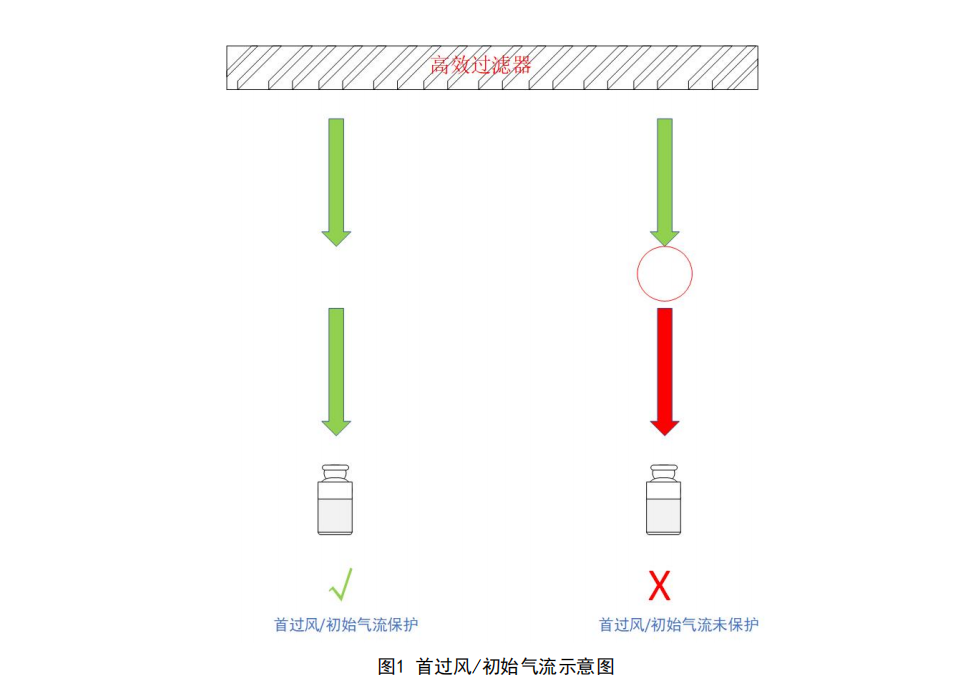
First pass wind/initial airflow
The product should be protected by first pass/initial airflow,
4.1.4
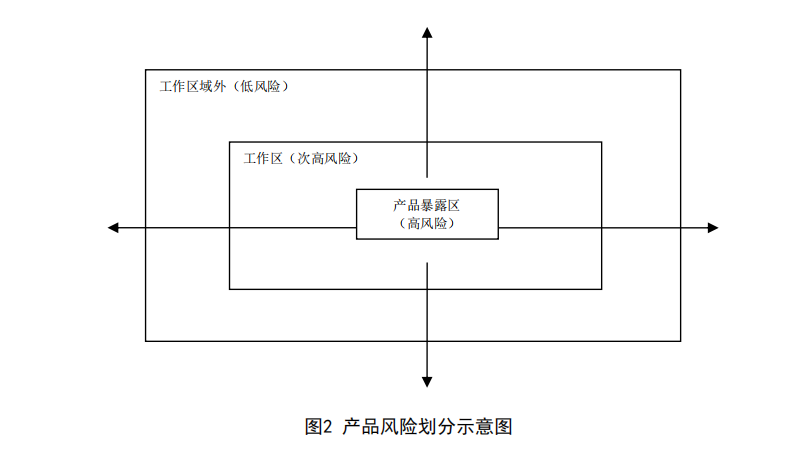
Airflow direction
The airflow should flow from the high-risk side to the low-risk side, as shown in Figure 2.
4.2
O-rabs
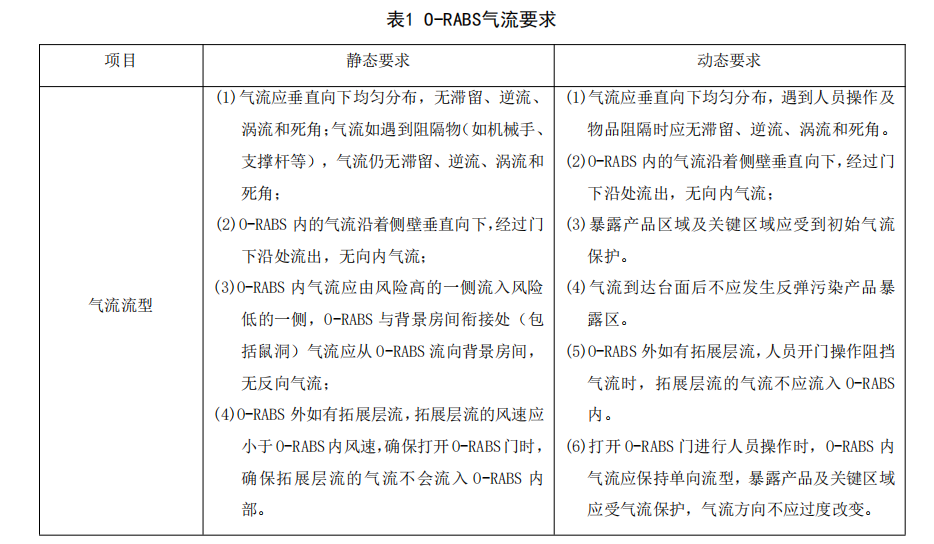
The O-RABS airflow pattern should not only meet the general requirements of 4.1, but also comply with the provisions of Table 1.