-
E-mail
benwu@aojizhineng.com
-
Phone
18058851560
-
Address
5th Floor, Building B, No. 580 Binhai 2nd Road, Longwan District, Wenzhou City, Zhejiang Province
Wenzhou Aoji Intelligent Technology Co., Ltd
Process flow of pipeline flushing and filling production line
Date: 2025-10-28Read: 2
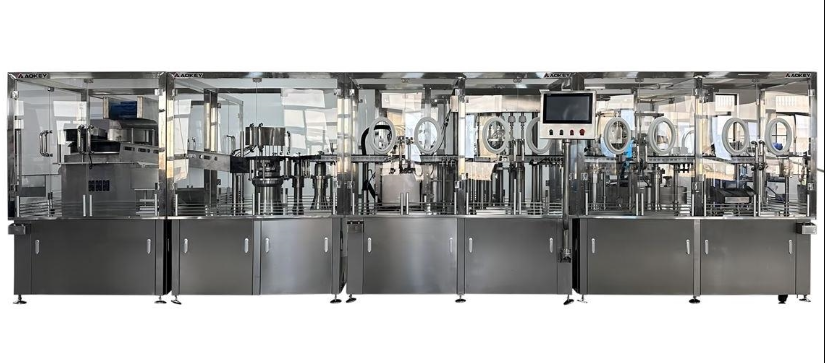
The catheter irrigator filling production line is an automated assembly line specialized in serving the manufacturing of catheter irrigators in the field of medical consumables production. It must strictly follow medical grade hygiene standards and dosage accuracy requirements, complete flushing liquid treatment, container processing, product testing and other operations through a continuous process, ensure the safety of catheter irrigators and the consistency of finished products, and provide a stable production foundation for subsequent product inspection and outbound. The following provides a detailed analysis of the production process in order of production.
1、 Process flow of pipeline flushing and filling production line
1Material and container pretreatment
•Preparation of flushing solution: Mix purified water, chemicals and other raw materials in a dedicated preparation tank according to the preset formula, stir evenly, and filter out impurities through a filter element to ensure that the cleanliness of the flushing solution meets the standard; After preparation, temporarily store the flushing solution in a sealed storage tank to maintain a constant temperature environment and avoid changes in composition.
•Container cleaning and disinfection: The empty bottles of the catheter washer enter the cleaning station through a conveyor belt, and are first washed with high-pressure purified water to remove surface dust and stains on the inner wall; Then enter the disinfection chamber and use ultraviolet or high-temperature sterilization methods for disinfection. After disinfection, dry the surface moisture of the container with a wind knife to avoid residual liquid affecting the quality of the flushing solution.
2Quantitative filling operation
•Material transportation: The flushing liquid in the storage tank is transported to the filling station through a sterile pipeline, which is fully sealed to avoid contamination caused by contact with the outside air; During the transportation process, the flow sensor monitors the liquid flow rate in real-time to ensure stable liquid supply.
•Precise filling: After the container reaches the filling station through the conveyor belt, the positioning mechanism fixes it, and the filling head descends and fits the container mouth, filling according to the preset dosage; After filling is completed, the filling head automatically lifts and the anti drip component is activated to prevent residual liquid from dripping outside the container or on the conveyor belt.
3Container sealing and sealing inspection
•Sealing operation: The filled container enters the sealing station with the conveyor belt, and the corresponding sealing method is selected according to the container type - the screw mouth bottle uses an automatic capping machine to tighten the bottle cap, and the composite film bag uses a heat sealing machine to seal the bag mouth; During the sealing process, the equipment monitors the screw cap torque or heat sealing temperature in real-time to ensure a secure seal.
•Initial sealing inspection: After sealing, the product enters the sealing inspection station and is checked for leaks at the sealing point through negative pressure testing or water immersion testing; If a leak is detected, the device automatically marks the product for subsequent removal.
4Online quality inspection and removal of non-conforming products
•Appearance and dose detection: The product enters the visual inspection station, and the camera captures the appearance of the container to check for any damage, stains, label deviation, and other issues; At the same time, the total weight of the product is detected through a weighing sensor to indirectly verify whether the filling dosage meets the requirements. Deviation exceeding the limit time is marked as non-conforming product.
•Unqualified product removal: After the inspection is completed, the products arrive at the removal station. The sorting mechanism separates the marked unqualified products from the conveyor belt and sends them to a dedicated recycling bin. Qualified products continue to be transported to the next stage.
5Finished product sorting and temporary storage
•Surface drying and labeling: Qualified products enter the drying station, and the air knife blows away any residual moisture or dust on the surface of the container; Then enter the labeling station, and the labeling machine accurately attaches the product label to the designated position of the container, ensuring that the label is flat and free of bubbles.
•Packing and temporary storage: The labeled finished products enter the packing station through a conveyor belt, and the automatic packing machine loads the products into packaging boxes according to the set quantity. After the packing is completed, the packaging boxes are transported by the conveyor belt to the finished product warehouse for temporary storage, waiting for subsequent inspection and outbound.