-
E-mail
lh@wzlihong.com
-
Phone
13857783528
-
Address
No. 168 Houzhang, Yongzhong Street, Longwan District, Wenzhou City
Wenzhou Lihong Machinery Technology Co., Ltd
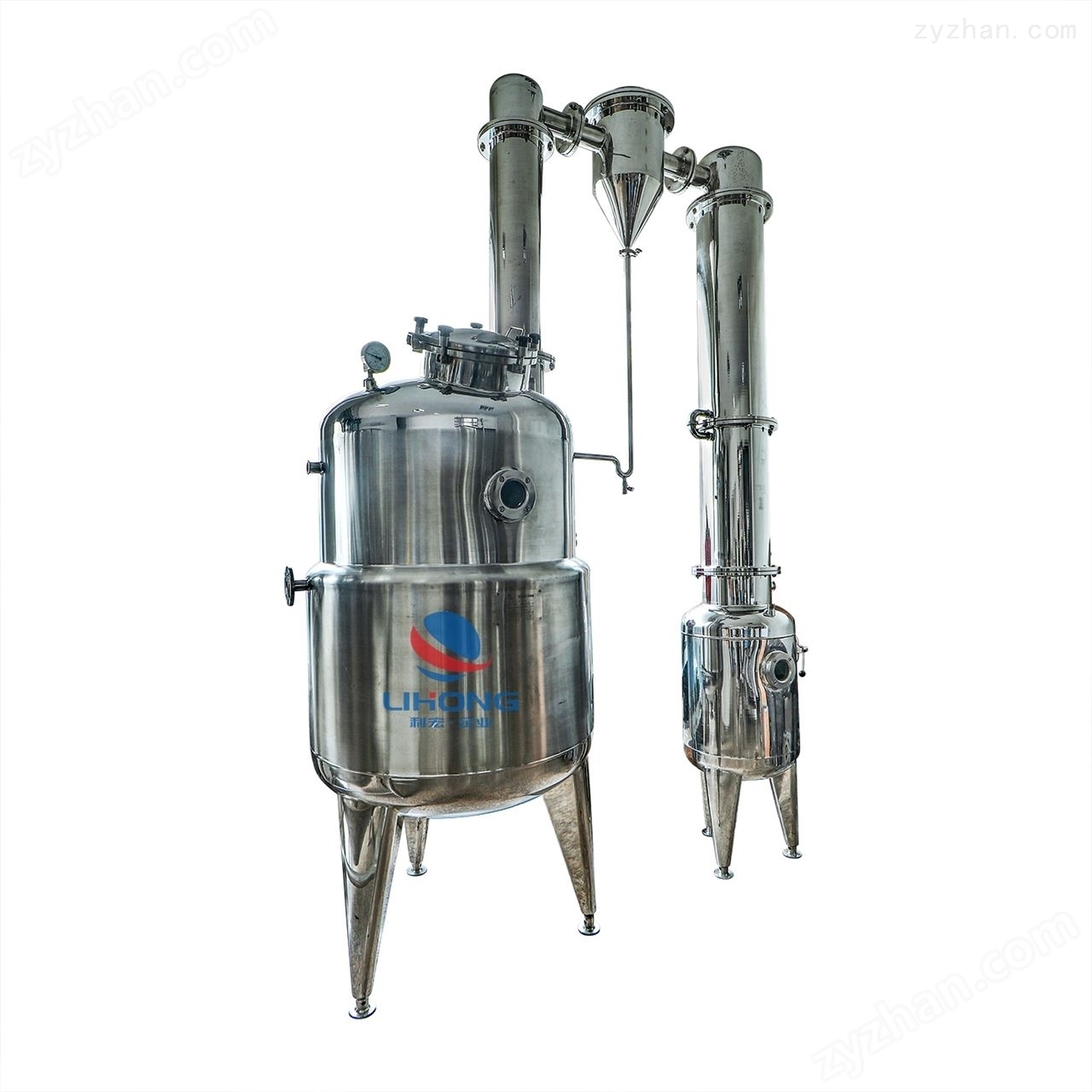
What is the process principle of vacuum depressurization and concentration tank?
Date: 2025-09-04Read: 73
The process principle of vacuum pressure reduction and concentration tank is based on the physical characteristics of reducing the boiling point of liquid under pressure reduction conditions, and achieves low-temperature concentration of materials through the synergistic effect of vacuum system, heating evaporation, and condensation recovery. The core process can be divided into the following steps:
1. Establishment of vacuum environment
By using a vacuum pump to extract gas from the tank, a low-pressure environment (usually below atmospheric pressure) is formed, which significantly reduces the boiling point of the solution. For example, the boiling point of water can drop to about 40 ℃ at a vacuum degree of 0.09MPa.
2. Heating and evaporation
Using a jacket steam or coil heating system to uniformly supply heat to the solution, the solvent rapidly vaporizes at low temperatures, avoiding the decomposition of heat sensitive substances (such as proteins and traditional Chinese medicine ingredients) due to high temperatures.
3. Condensation recovery
The steam generated by evaporation is cooled and liquefied by a condenser (such as a tubular or serpentine condenser), the solvent is recycled, and the uncondensed gas is discharged by a vacuum unit.
4. Cyclic concentration
By continuously adjusting the vacuum degree and heating temperature, a cycle of solvent evaporation condensation is achieved, ultimately reaching the target concentration. The non-volatile components gradually concentrate in the tank and complete the separation.
This technology is widely used in the fields of pharmaceuticals, food, and chemical engineering, especially suitable for low-temperature treatment of thermosensitive materials. Its advantages include energy efficiency and protection of active ingredients, but it should be noted that the unit energy consumption is higher than that of atmospheric evaporation.