-
E-mail
3495811982@qq.com
-
Phone
13619217766
-
Address
No. 3 Xingzhong Road, Lianhu District, Xi'an, China
Xi'an Kaixin Biotechnology Co., Ltd
Cholesterol-Cyanine3: Can be used to evaluate the effects of compounds on cholesterol metabolism and distribution
Date: 2025-12-23Read: 0
/Reagent information/
Chinese name: Cy3 cholesterol; Cholesterol Cy3; Triphosphamide dye cholesterol
英文名称: Cy3-cholesterol; Cyanine3-Cholesterol; Cholesterol-Cyanine3; cholesterol-Cy3
Appearance: Red powder
Solubility: soluble in DMSO (50 mg/mL), chloroform (20 mg/mL), insoluble in water
Purity: 95%+
Transportation: Low temperature transportation
Application: Cell labeling and imaging
Structural formula:
Storage conditions: Freeze and dry below -20 ℃ to avoid repeated freeze-thaw cycles
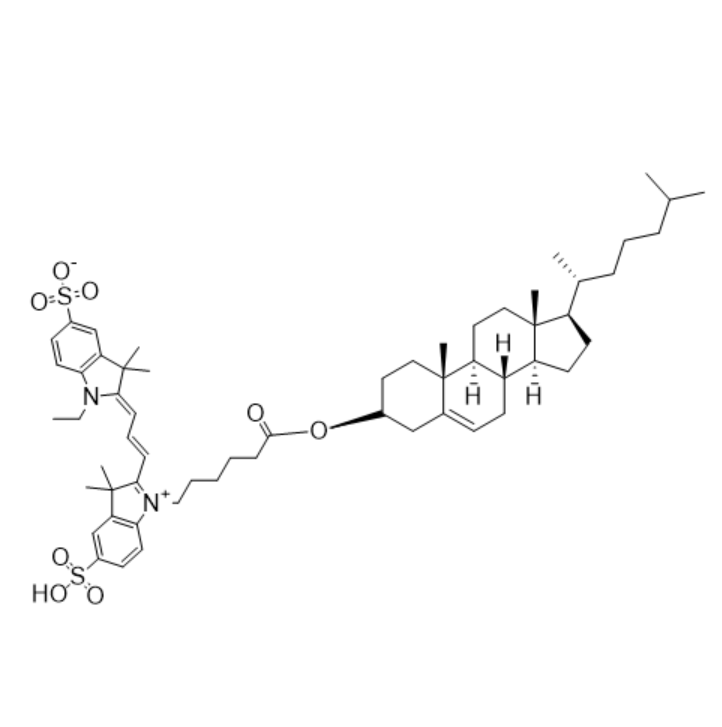
Attention: When using, be sure to dry and avoid frequent dissolution and freeze-drying
Security protection:
During the operation, disposable protective clothing, masks and other protective equipment should be worn to ensure self safety.
/Reagent description/
Cy3-Cholesterol, The label formed by modifying cholesterol with fluorescent Cy3 is constructed by binding the fluorescent dye Cy3 to cholesterol. Among them, Cy3 fluorescent dye, as the core luminescent unit, has extremely significant fluorescence characteristics.
/Optical characteristics/
Its emission wavelength range is between 570 and 620nm, which can generate strong and stable fluorescence signals, and the fluorescence quantum yield is high. This indicates that it can efficiently convert absorbed light energy into observable fluorescence, presenting bright and persistent fluorescence performance during detection, providing clear and prominent identification for experimental observation. At the same time, the cholesterol component ensures the stable presence of the marker in cells, and relying on the natural affinity between cholesterol and the cellular environment, Cy3 Cholesterol can smoothly integrate into cells. This characteristic makes it a key tool for exploring the complex processes of cholesterol distribution, metabolism, transport, and signal transduction in cell membranes.
/Application/
In the field of imaging technology, it can accurately locate cholesterol and clearly display its position and dynamic changes in the cell membrane;
It can also be used to evaluate the effects of compounds on cholesterol metabolism and distribution, providing a basis for drug development and other work.
In the development of targeted compound delivery systems, by leveraging their cholesterol related properties, precise transportation can be achieved, promoting continuous and in-depth biomedical research.
How to ensure the stability of Cholesterol-CY3 probe in live cells?
To ensure the stability of Cholesterol-CY3 probe in live cells, it is necessary to focus on both the probe's own characteristics and experimental procedures:
Cholesterol structural support: The probe retains the steroid skeleton and hydroxyl functional groups of cholesterol, allowing it to naturally embed into the lipid bilayer of the cell membrane and participate in membrane microdomain formation. This natural affinity ensures the stable presence of the probe in the cell membrane environment, reducing the possibility of free or abnormal aggregation.
Concentration regulation: In the experiment, it is necessary to optimize the probe concentration to avoid excessive concentration that may cause changes in membrane structure or interfere with endogenous cholesterol function, in order to maintain the normal fluidity and stability of the cell membrane.
Light stability management: Although CY3 fluorophores have high light stability, prolonged high-intensity excitation may lead to photobleaching. Reasonable adjustment of imaging parameters (such as excitation light intensity and exposure time) is necessary to prolong the persistence of fluorescence signals.
Membrane penetration adaptation: For the observation of deep intracellular cholesterol, membrane penetration methods or other auxiliary dyes can be combined to avoid affecting stability evaluation due to the probe only binding to the membrane surface.
/Related reagents/
HO-PEG-GA
Biotin-PEG-DSPE
Folalte-PEG-Biotin
COOH-PEG-PPHE
tBoc-NH-PEG-Tert
Hydroxyl-PEG-GA
HO-PEG-Glutaric Acid
Hydroxyl-PEG-Glutaric Acid
Cy7 PEG azide/Cy7 PEG azide
CY5-PEG-DSPE CY5 PEG 磷脂
Alexa 488Alexa 488 / Alexa 488
SPDP-PEG-SPDP / SPDP-PEG-SPDP
Acid-PEG-Cy5Acid-PEG-Cy5 / Acid-PEG-Cy5
BCN-PEG-cRGDBCN-PEG-cRGD / BCN-PEG-cRGD
Amine-PEG-Cy7Amine-PEG-Cy7 / Amine-PEG-Cy7
BDP 558/568 N3BDP 558/568 N3 / BDP 558/568 N3
The above content is edited and organized by YNN of Xi'an Kaixin Biotechnology Co., Ltd
This reagent is only used for scientific research experiments and cannot be used on the human body
Please click here to enterwestAnkai New Biotechnology Co., LtdShop View
Please clickEnter herewestAnkai New Biotechnology Co., LtdShop View
