-
E-mail
chx@tj-sci.com
-
Phone
19352617016
-
Address
Building 1, No. 5500 Yuanjiang Road, Minhang District, Shanghai
Yiyan Zhizao (Shanghai) Drug Testing Instrument Co., Ltd
The latest interpretation of the 2025 version 0633 viscosity measurement method
Date: 2025-12-03Read: 43
1、 Newtonian fluids and non Newtonian fluids
1. The characteristics of Newtonian fluids are that shear stress is linearly related to shear rate, viscosity remains constant, and solutions of pure liquids and low molecular weight substances usually belong to Newtonian fluids. For example, pure liquids such as water, alcohol, light oil, and low molecular compound solutions (such as saltwater, sugar water) belong to Newtonian fluids.
2. Polymer solutions, colloidal solutions, suspensions, etc. belong to non Newtonian fluids due to their viscosity varying with shear rate.
2、 Kinematic viscosity, dynamic viscosity, intrinsic viscosity
1. The viscosity is measured using a viscometer. There are various types of viscometers, and this method uses three measurement methods: Ping's capillary viscometer, Ubbelohde capillary viscometer, and rotational viscometer. Capillary viscometer is suitable for measuring the viscosity of Newtonian fluid motion; The rotational viscometer is suitable for determining the dynamic viscosity of Newtonian or non Newtonian fluids.
2. The kinematic viscosity is the ratio of the dynamic viscosity of a Newtonian fluid to its density at the same temperature, measured in m2/s. Due to the large unit size of m2/s, mm2/s is often used.
3. Dynamic viscosity, also known as viscosity coefficient (η), is measured at a certain shear rate and is referred to as apparent viscosity.
3、 Three methods specified in pharmacopoeia standards
The first method is to use a Ping's capillary viscometer to determine viscosity
1. This method uses the relative method to measure the time required for a certain volume of liquid to flow through a capillary under the action of gravity, in order to obtain the kinematic viscosity or dynamic viscosity of the fluid.
2. The total average value obtained from two consecutive samples is calculated according to the following formula, which is the kinematic viscosity and dynamic viscosity of the test sample.
ν=Kt
α=Kt·ρ
In the equation, K is the viscosity constant measured from a standard liquid with known viscosity, mm2/s2;
T is the measured average outflow time, s;
ρ is the density of the test sample at the same temperature, g/cm3。 Unless otherwise specified, the measured temperature should be 20 ℃± 0.1 ℃. At this time,
The second method is the Ubbelohde capillary viscometer measurement method
1. The Ubbelohde capillary viscometer is commonly used to determine the intrinsic viscosity of extremely dilute polymer solutions, in order to calculate the average molecular weight.
2. Calculate the characteristic viscosity using the following formula:
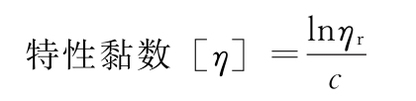
In the formula, η r is T/T; C is the concentration of the test solution, g/ml。
The third method is the determination of rotational viscosity using a viscometer
Rotational viscometers can be classified into three types based on the type of measurement system: coaxial cylinder rotational viscometers, cone plate rotational viscometers, and rotor rotational viscometers. According to the nature of the measurement results, it can be divided into two categories: jue viscosity meters and relative viscosity meters. The measurement system of jue viscosity meters has a determined geometric shape, and its measurement results are jue viscosity values, which can be reproduced by other jue viscosity meters. Coaxial cylinder rotary viscosity meters and cone plate rotary viscosity meters belong to this category; The measurement system of a relative viscometer does not have a definite geometric shape, and its measurement results are obtained by comparing the relative viscosity value with a standard viscosity liquid. It cannot be reproduced by other viscometers or relative viscometers unless the measurement results are obtained using the same instrument and rotor under the same measurement conditions. Rotary viscometers belong to this category.
(1) Coaxial cylindrical rotational viscometer
Coaxial cylinder rotational viscometers include inner cylinder rotational viscometers (such as Searle viscometers) and outer cylinder rotational viscometers (such as Couette viscometers). But the inner cylinder rotary viscometer is more commonly used.
(2) Cone plate rotary viscometer
Cone plate type rotational viscometer (cone rotor rotation) is commonly used, while cone plate type rotational viscometer (flat plate rotation).
(3) Rotary viscometer (relative viscometer)