-
E-mail
905799038@qq.com
-
Phone
13812874618
-
Address
No. 888 Jingang Avenue, Tangshi Town, Zhangjiagang City
Zhangjiagang Kaichuang Machinery Manufacturing Co., Ltd
Analysis of the working principle of ZSJC series sugar crusher
Date: 2025-10-20Read: 3
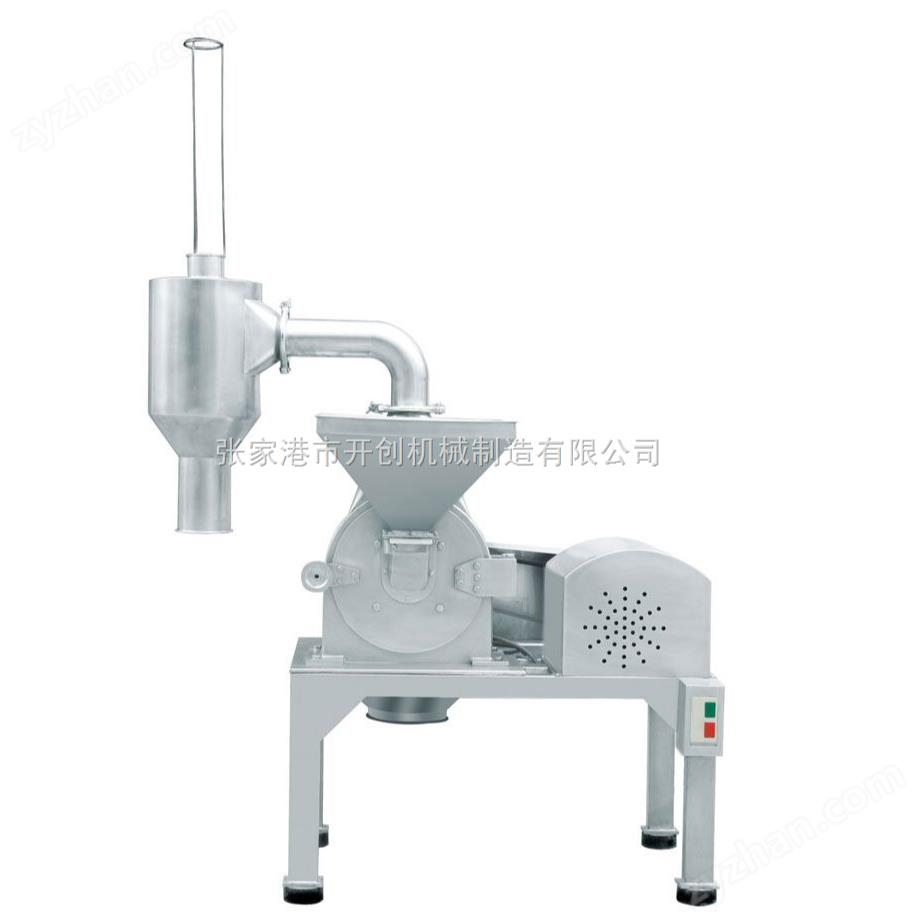
The ZSJC series sugar crusher is a crushing equipment designed for sugar materials such as white sugar, rock sugar, glucose, etc. It can adapt to the characteristics of sugar that is easy to absorb moisture and has viscosity, avoiding clumping or melting during the crushing process. Its working principle revolves around the process of "stable conveying targeted crushing uniform separation", achieving fine crushing of sugar materials through the coordinated cooperation of various links.
1、 Overall working logic: Grinding process adapted to the characteristics of carbohydrates
Sugar materials are prone to melting due to friction or sticking to the interior of the equipment due to moisture absorption during crushing, resulting in a decrease in crushing efficiency. The core working principle of the ZSJC series sugar crusher is to optimize various stages of material processing to reduce such problems: the material first enters the equipment smoothly through the feeding system, and is crushed by specific components in the crushing chamber. At the same time, the structure design reduces friction heat generation and adhesion. Finally, the separation device screens out the finished product that meets the fineness requirements. Coarse particles that do not meet the standards are returned to the crushing chamber for secondary processing to ensure uniform particle size of the finished product.
2、 Staged analysis: the core mechanism from feeding to discharging
1. Feeding stage: Stable conveying to prevent blockage
The material enters the equipment through the feeding hopper, and the inner wall of the feeding hopper is smoothed and the inclination angle is adapted to the fluidity of the sugar material, avoiding material accumulation and blockage in the hopper;
Some models are equipped with low-speed conveying components (such as screw conveyors) to slowly feed materials into the crushing chamber, preventing a large amount of materials from entering at once and causing overload of the crushing chamber. At the same time, friction between the materials and the conveying components is reduced to avoid premature heating and melting.
2. Crushing stage: Targeted crushing to reduce adhesion and heat generation
The crushing chamber is the core working area, which is equipped with crushing components (such as toothed discs and hammers) that are suitable for sugar. The surfaces of these components are often treated with anti sticking measures to reduce the adhesion of sugar materials;
During the operation of the crushing component, block or granular sugars are crushed through impact and shearing actions, while leaving a reasonable space inside the crushing chamber to avoid excessive squeezing and friction of materials and reduce heat generation; Some devices will also use cavity wall heat dissipation design to further control the temperature during the crushing process and prevent sugar from melting and clumping.
3. Separation and discharge stage: screening, collecting and ensuring uniformity
The crushed sugar particles enter the separation device (such as a built-in sieve or cyclone separator) with the airflow, and particles that meet the fineness requirements will enter the finished product warehouse through the sieve or under the action of centrifugal force;
Coarse particles that do not meet the standards cannot pass through the separation device and will return to the crushing chamber along the preset channel, where they will come into contact with the crushing components again to form a "crushing separation reflux" cycle, ensuring that the final discharged finished product has consistent particle size and no obvious large particles;
The connection between the discharge port and the finished product warehouse is also smoothed to avoid residual adhesion of finished products. At the same time, some equipment is equipped with dust-proof devices to reduce dust diffusion during discharge and maintain a clean operating environment.
3、 Key Design: Principle Support for Adapting Sugar Characteristics
•Anti adhesion design: Smooth treatment and anti adhesion coating of the crushing components and the inner wall of the crushing chamber, reducing the adhesion of sugar materials to the equipment due to viscosity, reducing cleaning difficulty, and avoiding the influence of adhered materials on subsequent crushing;
•Temperature control design: By reducing the friction strength between materials and components, optimizing the heat dissipation of the crushing chamber, controlling the temperature during the crushing process, preventing sugar from melting due to friction, and ensuring stable crushing effect;
•Circular crushing design: The reflux mechanism for substandard particles avoids direct discharge of coarse particles, ensuring uniform particle size of the finished product and meeting the requirements for use in food, pharmaceutical excipients, and other scenarios after sugar processing.
The working principle of the ZSJC series sugar crusher is essentially to optimize the various processes around the characteristics of sugar materials, without the need for complex technology. By designing targeted structures and processes, common problems in sugar crushing can be solved, providing stable crushing support for sugar processing.
Last Article: Maintenance and Performance Extension of Fully Automatic Dry Granulator
Next Article: The usage method of air-cooled crusher