-
E-mail
zzcc8162@zzgwsit.cn
- Phone
-
Address
1119 Science Avenue, Shangjie District, Zhengzhou City
Zhengzhou Changcheng Technology Industry and Trade Co., Ltd
What is the process principle of laboratory glass reaction kettle?
Date: 2025-10-10Read: 1
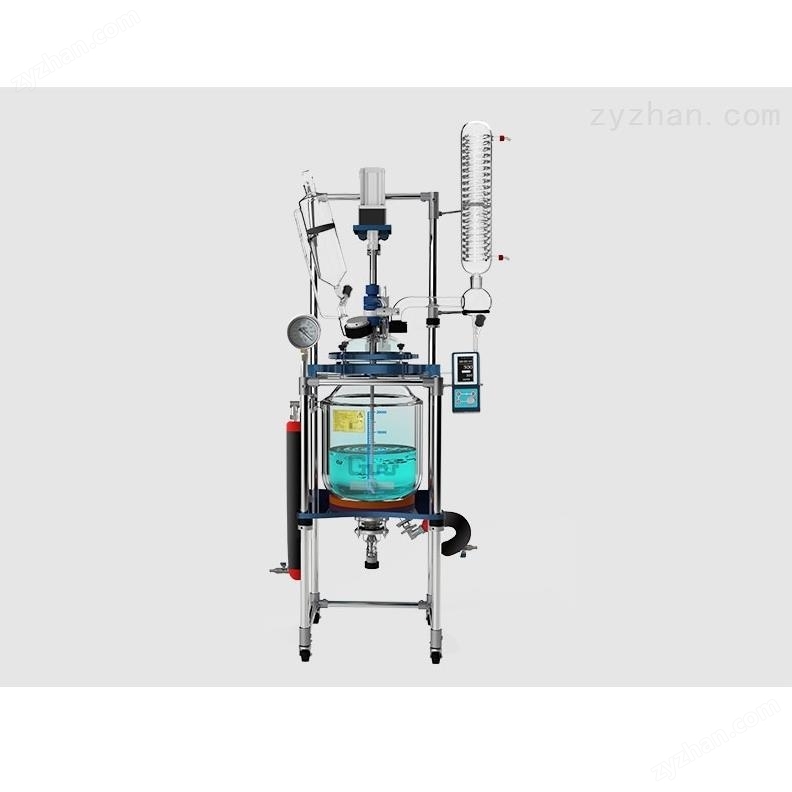
The process principle of laboratory glass reaction kettle is mainly based on its double-layer or single-layer glass structure design, which achieves precise temperature control through interlayer circulating medium, and completes reaction processes such as stirring, evaporation, and reflux under normal or negative pressure conditions. Its core working principle can be decomposed into the following three parts:
1. Temperature control system
Injecting a constant temperature medium (such as refrigerant, hot water, or hot oil) through a sandwich layer to form a closed-loop circulation system, achieving high-precision heating or cooling of the reaction system. The high-temperature reaction can reach 300 ℃, and the low-temperature reaction can reach -80 ℃.
2. Reaction and Mass Transfer Mechanism
The inner container contains the reactants, and the concentration gradient is broken through a stirring device (such as a paddle or turbine stirrer) to enhance mass transfer uniformity. The synergistic effect of axial flow and radial flow avoids local overheating and improves reaction efficiency.
3. Pressure and sealing management
Sealed with flanges or PTFE components, supporting normal pressure, negative pressure, or vacuum environments. Negative pressure conditions can accelerate evaporation or filtration processes, especially suitable for thermal filtration of crystalline materials.
Special functional types (such as filter glass reaction vessels) also integrate vacuum filtration devices to achieve rapid solid-liquid separation through pumping, suitable for fields such as pharmaceuticals and organic synthesis.