-
E-mail
848186302@qq.com
-
Phone
15639761399
-
Address
No. 182 Industrial Road, Shangjie District, Zhengzhou City
Zhengzhou Huachen Instrument Co., Ltd
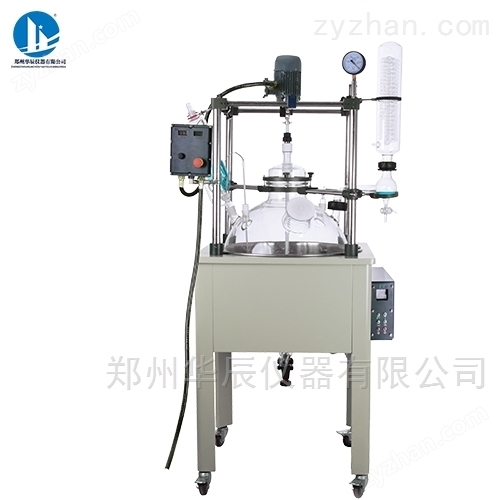
What is the process principle of explosion-proof single-layer glass reaction kettle?
Date: 2025-10-22Read: 8
The process principle of explosion-proof single-layer glass reaction kettle is mainly based on the following core mechanisms:
1. Direct heating and temperature control
The kettle body is heated directly through an electric heating sleeve or a water bath/oil bath pot, using high borosilicate glass (G3.3 material) to withstand temperature differences of -80 ℃ to 250 ℃, and precise temperature control is achieved through a digital controller. Explosion proof design ensures the safety of high or low temperature reactions, such as in flammable and explosive scenarios such as petroleum refining.
2. Optimization of agitation and mass transfer
Equipped with explosion-proof motor and PTFE stirring shaft, the material is uniformly mixed through paddle/anchor stirring paddle, avoiding local overheating or uneven concentration, and improving mass transfer efficiency. The bottom discharge design ensures no liquid accumulation, further reducing residual risk.
3. Negative pressure and gas-liquid treatment
Supports normal or negative pressure (-0.1MPa) operation, and achieves gas-liquid separation processes such as distillation and reflux through condensation reflux components (serpentine condenser+receiving bottle). After condensation and liquefaction, some of the steam is refluxed to maintain reaction equilibrium, while others are collected as products.
4. Sealing and safety protection
Using PTFE material and special rubber composite sealing ring, it is resistant to solvent corrosion and maintains high vacuum degree. Combined with explosion-proof motor and controller, it ensures safe operation in flammable and explosive environments.