-
E-mail
848186302@qq.com
-
Phone
15639761399
-
Address
No. 182 Industrial Road, Shangjie District, Zhengzhou City
Zhengzhou Huachen Instrument Co., Ltd
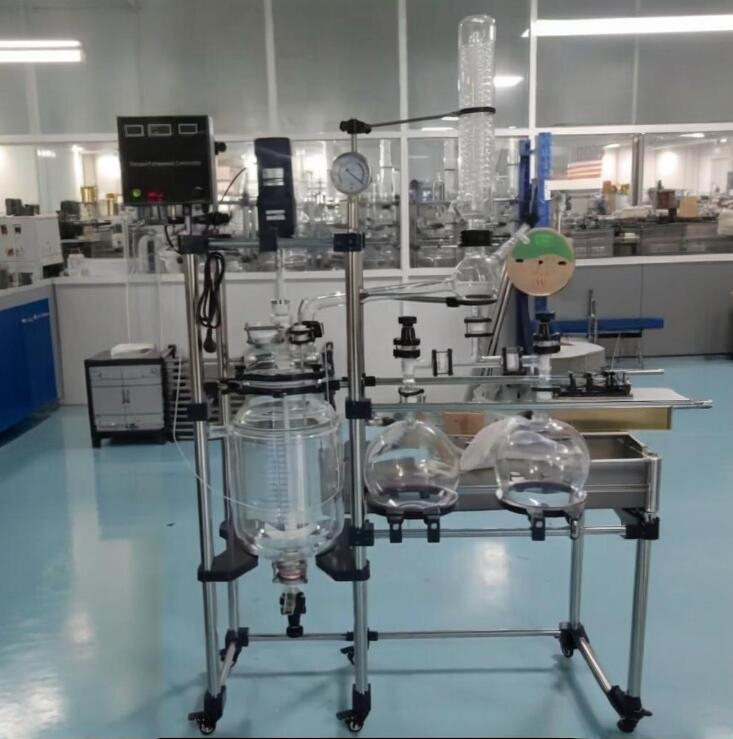
Guidelines for selecting pit avoidance for jacketed glass reaction vessels
Date: 2025-09-18Read: 7
Guidelines for selecting pit avoidance for jacketed glass reaction vessels
1、 Core parameters: Matching capacity and scale
1. Capacity calculation
According to experimental or production requirements, calculate the capacity based on the formula: the required volume of the kettle body=the total amount of materials x 1.33. For example, when processing 5L of material, a 6.65L (rounded up to 7L) reactor should be selected to avoid overflow or uneven concentration of reactants due to insufficient capacity.
2. Scale adaptation
-Laboratory trial: Prioritize the 1L-5L model to save space and reduce costs.
-Pilot scale up: Select 10L-50L models, balancing efficiency and scalability.
-Industrial production: When selecting models above 50L, it is necessary to confirm whether the equipment supports modular expansion (such as parallel connection of multiple reactors).
-Avoiding pitfalls: If the capacity is too large, it will waste resources; if it is too small, it will limit the reaction scale, and a 20% -30% margin should be reserved according to the process route.
2、 Material selection: Corrosion resistance and temperature resistance
1. Glass material
-Ordinary glass: only suitable for weak acid-base reactions (such as pH 5-9), avoid contact with strong corrosive substances such as hydrofluoric acid and concentrated sulfuric acid.
-High borosilicate glass: with a temperature resistance range of -80 ℃ to 220 ℃ and a 30% increase in acid and alkali corrosion resistance, it is a good choice for strong acid and alkali reactions.
-Glass lined material: suitable for high temperature and high pressure reactions (such as 300 ℃, 5MPa), but should avoid thermal shock (temperature difference ≤ 100 ℃/h).
2. Accessory material
-Stirring blade/seal: PTFE (polytetrafluoroethylene) or Hastelloy is preferred, with better corrosion resistance than 316L stainless steel.
-Material of jacket: If steam heating is required, the jacket should be made of 304 stainless steel to avoid corrosion of ordinary carbon steel.
-Avoiding pitfalls: Low priced products may use ordinary glass to impersonate high borosilicate glass, and material testing reports are required.
3、 Temperature and pressure control: safety red line
1. Temperature range
-Room temperature reaction: Select standard type, no additional temperature control system required.
-High temperature reaction: Confirm the upper temperature limit of the equipment (such as 220 ℃ for high borosilicate glass), and pair it with a high and low temperature integrated machine (such as -80 ℃ to 200 ℃).
-Low temperature reaction: A low-temperature cooling circulation pump is required to avoid glass cracking.
2. Pressure bearing
-Atmospheric pressure reaction: single layer or double-layer glass reaction vessel (no pressure design).
-Pressure reaction: Choose a three-layer glass reaction vessel (pressure resistance ≤ 0.5MPa), or switch to a stainless steel reaction vessel (pressure resistance ≤ 10MPa).
-Avoidance point: Overtemperature and overpressure operation can cause glass breakage, and an overtemperature alarm and pressure relief valve need to be configured.
4、 Mixing system: key to mixing efficiency
1. Mixing type
-Magnetic stirring: suitable for small kettles below 5L, with no risk of leakage, but with a speed of ≤ 800rpm.
-Mechanical stirring: suitable for large vessels or high viscosity materials (such as polymer reactions), with a speed of up to 1500rpm, but regular maintenance of seals is required.
2. Mixing blade design
-Low viscosity materials: Choose propeller or turbine blades for high mixing efficiency.
-High viscosity materials: Choose anchor or frame type propeller blades to avoid dead corners.
-Avoidance point: The gap between the stirring blade and the kettle body should be ≤ 5mm, otherwise it is easy to generate eddy currents and cause material splashing.
5、 Safety device: risk prevention and control
1. Basic security configuration
-Explosion proof motor: If the laboratory is located in an explosion-proof area (such as containing organic solvents), an Ex d Ⅱ BT4 level motor should be selected.
-Emergency stop button: The power must be cut off within 1 second to prevent the accident from escalating.
-Overheating protection: Automatically stops heating when the temperature exceeds the limit to prevent glass softening.
2. Advanced security features
-Vacuum protection: If vacuum is required (such as distillation reaction), a vacuum buffer tank should be equipped to prevent the glass from being concave and broken.
-Pressure relief valve: automatically releases pressure when the pressure exceeds the set value (such as 0.3MPa).
-Avoiding pitfalls: Low priced products may omit safety devices and require suppliers to provide safety certification certificates (such as CE, ISO).