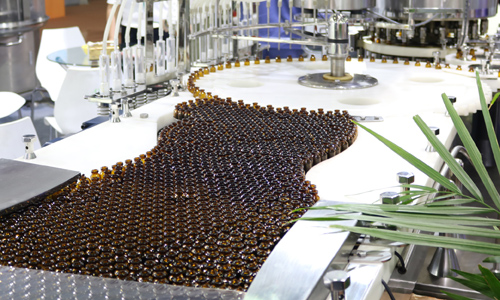
The process principle of aluminum-plastic blister packaging machine achieves sealed packaging of drugs, food and other products through continuous automation process, mainly including the following key links:
1、 Process flow
1. Material preparation and heating
PVC/PET hard sheets and aluminum foil rolls are fed into the production line through a unwinding device, and the heater heats the PVC sheets to 110-140 ℃ to soften them and enable them to undergo plastic deformation.
2. Bubble forming
Softened sheets are formed by positive or negative pressure:
Positive pressure molding: using compressed air (0.2-0.4MPa) to blow the sheet into the high-precision mold cavity, suitable for flat plate models;
Negative pressure forming: using vacuum adsorption (-0.08~-0.1MPa) to make the sheet stick to the roller mold for forming, commonly used in high-speed roller machines.
The dimensional accuracy of the mold cavity needs to reach ± 0.05mm, and the surface smoothness Ra should be ≤ 0.4 μ m to ensure the consistency of the bubble cover.
3. Cooling and filling
The molded blister is cooled and shaped, and the medicine is accurately filled into the blister holes by a vibrating feeding device or robotic arm, with a filling error controlled within ± 0.5mm.
4. Heat sealing
After covering with aluminum foil, the heat sealing device completes the sealing at 160-180 ℃ through roller or flat pressure (0.3-0.6MPa). Roller sealing is a continuous rolling process, while flat sealing is an intermittent pressurization process to ensure that the aluminum foil and PVC are bonded without bubbles.
5. Information Marking and Punching
Using steel molds or laser printing to print batch numbers, expiration dates, and other information, the continuous film material is then cut into independent sections by a punching die, and the waste is automatically collected by a winding device.
2、 Core control technology
1. Molding accuracy control: PLC program integrates air pressure/vacuum degree, mold temperature (± 1 ℃) and molding speed adjustment to adapt to different bubble cover shape requirements;
2. Energy saving design: Fluorine coated heating plate reduces energy consumption, and the borderless punching structure reduces packaging material loss by 4% -6%;
3. Mold process: High wear-resistant materials such as H13 alloy steel are used, and the surface of the heat sealed mold is polished to enhance the sealing strength;
4. Automation integration: The photoelectric matching system synchronizes the position of the bubble cover and aluminum foil, and variable frequency speed regulation achieves coordinated operation of multiple workstations.