09,08,2026 8 views
In the fields of precision manufacturing, medical equipment, and laboratory automation, micro quantitative valves have become key components for fluid control due to their high precision and reliability. This type of valve is designed specifically for extremely low flow scenarios, achieving precise metering and distribution of small media through innovative structures. Its core advantages are not only reflected in technical performance, but also significantly improve the stability and efficiency of the process flow.
Overview of Operating Principles
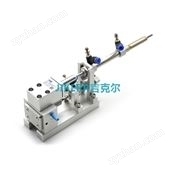
The core of a micro quantitative valve lies in its precise control mechanism. The valve adopts a specially designed valve core and seat inside, and the opening is adjusted through a small stroke driving mechanism (such as pneumatic or electric actuator). When the control signal is input, the valve responds quickly and changes the cross-sectional area of the flow channel with very small actions, thereby linearly adjusting the flow output.
Detailed explanation of core advantages
1. Ultra precision flow control capability
One of the core advantages of micro quantitative valves is the ability to achieve sub microliter level flow regulation. The precise fit between the valve core and valve seat enables the opening change to be precise to the micrometer level, and the flow error is controlled within a very small range. For example, in the pharmaceutical filling process, the valve can stably output a few microliters of liquid medicine per minute, ensuring consistency in the dosage of each drug and significantly improving product quality. This type of precision far exceeds that of ordinary valves, meeting the requirements of highly sensitive applications.
2. Anti drip and suction function
The built-in suction mechanism of the valve is another major highlight. At the moment of closure, the actuator generates reverse suction force, quickly cutting off the flow channel and suctioning back the residual medium, completely eliminating the dripping phenomenon. This feature is crucial in scenarios with high cleanliness requirements, such as semiconductor manufacturing or sterile formulation production, to avoid cross contamination and material waste.
3. Wide media compatibility
For corrosive, high viscosity or high-temperature media, the micro type quantitative valve adopts special materials and flow channel design. The valve body can be made of corrosion-resistant materials such as Hastelloy and PTFE lining, which are suitable for acidic and alkaline solutions; The flow channel is optimized with smooth inner walls and a large cross-sectional area to reduce the resistance of high viscosity fluids (such as grease) and ensure stable transportation. This compatibility extends the application of valves in various fields such as chemical engineering and food.
4. Compact structure and flexible installation
Valve design emphasizes space efficiency, high integration, and no redundant components. For example, the built-in spring structure significantly reduces volume while maintaining protection, making it easy to embed into compact devices. In addition, the actuator supports 360 degree rotation installation, adapting to complex pipeline layouts, and on-site calibration does not require disassembly, significantly improving deployment convenience.
5. Automation and low maintenance requirements
The micro quantitative valve is seamlessly integrated into the automation system, achieving remote control through electrical or pneumatic signals, reducing manual intervention. Its filler free design eliminates frictional resistance, not only improving sensitivity, but also reducing the risk of leakage and maintenance frequency. During long-term operation, the valve exhibits excellent stability and is suitable for continuous production environments.
6. Safety overload protection mechanism
The valve is equipped with intelligent overload protection. When the system pressure is abnormal, the mechanism automatically releases force to avoid damage to the diaphragm and actuator. For example, when the downstream pressure suddenly increases to the level in front of the valve, the protective device responds instantly, ensuring that the equipment can still operate safely under harsh conditions and extending its service life.
Application scenarios and value
These advantages jointly promote the role of micro quantitative valves in multiple key fields. In the pharmaceutical industry, it ensures the accuracy of aseptic filling; In precision instrument manufacturing, the quantitative addition of lubricants has been achieved; In laboratory automation, precise proportioning of chemical reagents is ensured. By improving control accuracy, reducing waste, and enhancing system reliability, this valve has become the cornerstone of modern industry's pursuit of efficiency and quality.