-
Phone
15224953586
-
Address
West side of Future Road South Section in Taikang County (Fuchaolou Town Development Zone)
Product Categories
Henan Yongxing Boiler Group Co., Ltd

Autoclave equipment (aerated concrete equipment)
NegotiableUpdate on 04/25
- Model
- Nature of the Manufacturer
- Producers
- Product Category
- Place of Origin
Overview
Product Introduction:
Product Details
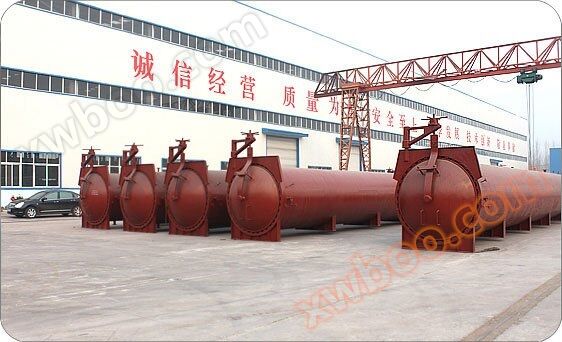
FGZCS Series Unburned Brick Autoclave - Installation and Use Manual】
Brief introduction
Autoclave is a widely used large pressure vessel with a large volume and weight. It is the main equipment for manufacturing silicate building products such as gray sand bricks, and is also widely used in rubber vulcanization, heavy metal smelting, refractory brick oil immersion carburizing, composite glass steam curing, wood drying and anti-corrosion treatment, high-pressure treatment of chemical fiber products, high-temperature and high-pressure treatment of food cans, pulp steaming, cable vulcanization, and aerospace industry. Although the working pressure of Yan autoclave is not high (generally less than 1.3MPa), due to its large volume (generally exceeding 45m3), the product of pressure and volume is large. Once an accident occurs, a large amount of energy will be released, causing significant harm. Therefore, its safe use should be highly valued. This chapter mainly introduces the basic knowledge and safety production requirements for autoclaves used in silicate building products.
The specifications for steam pressure vessels used in silicate building products are mostly the 1650m series, tP2000nlm series, and 2850 series in diameter. They have a quick opening structure (mostly double door through type), and the door opening method is manual or side opening. The design pressure is generally less than 1.6MPa.
The safety management of autoclaves must comply with the "Safety Technical Supervision Regulations for Pressure Vessels" issued by the State Administration of Quality and Technical Supervision, the "Safety Production Regulations for Silicate Products Autoclaves" formulated by the National Building Materials Industry Bureau, as well as relevant standards, regulations, and provisions.
2、 The main components of the autoclave
The structure of autoclaves used in various industries is roughly the same, but there are also differences to varying degrees. The steam pressure kettle used in the building materials industry has the following main components.
(1) Kettle body device
The kettle device is mainly composed of a cylinder and a kettle flange welded together, and is the main pressure bearing component. Several teeth that mesh with the kettle cover flange are evenly distributed on the inner circumference of the flange; At the bottom of the kettle, there is no track for the steam curing trolley to travel, and several pipe sockets and connections are arranged on the outside for steam inlet, exhaust, drainage, and installation of instruments and valves.
Due to the use of saturated steam as the working medium in autoclaves, in order to minimize the deformation caused by uneven heating of the kettle body, it is not advisable to use centralized steam inlet for K-type autoclaves. Instead, steam distribution pipes should be installed along the length direction of the kettle inside. Steam should be distributed throughout the kettle through the distribution pipes after entering from the steam inlet, so that the entire kettle body is uniformly heated. When the autoclave is pressurized, there is condensed water at the bottom of the kettle, and the temperature at the bottom is lower than that at the top. When factors such as operation and trolley movement are not affected, the distribution pipe should be as close as possible to the bottom of the kettle body.
The steel rails used for steam curing vehicles in the autoclave should be connected to the kettle body in a movable manner. Due to the expansion of the steam pressure vessel after being pressurized and heated, and the contraction of the exhaust steam after being cooled and depressurized, the expansion and contraction rates of the vessel body and the steel rail are not equal. If direct welding is used, high stress will be generated at the welding point between the vessel body and the rail, leading to cracks and accidents. Such accidents have occurred in foreign countries.
(2) Kettle lid device
The kettle cover device is mainly composed of the kettle cover flange and the head welded together, and is the main pressure bearing component. Suspended on the rod of the swinging device through a handle and a pin. The kettle lid can swing along with the swinging device or freely rotate around its own central axis. The teeth on the outer circumference of the kettle cover flange mesh with the teeth on the kettle body flange to open and close the autoclave.
(3) Swing device
The swinging device consists of a spindle, a cantilever beam, a support plate, etc., and plays the role of suspending and swinging the kettle cover device.
(4) Hand cranked reducer
The hand cranked reducer is fixed on the side of the flange of the kettle body, and engages with the umbrella toothed plate on the flange of the kettle cover through the umbrella toothed shaft, driving the kettle cover to rotate around its central axis, so as to engage or disengage the teeth on the flange of the kettle body and the flange of the kettle cover.
(5) Support bracket
The support is used to support the kettle body. Each autoclave has a fixed support and several movable supports. Generally, the simplified structure of a steam pressure vessel is relatively long, with fixed supports located in the middle of the structure and movable supports on the other two sides. This is because after the autoclave is heated, the body of the autoclave expands significantly in the length direction. In order to ensure the free expansion of the autoclave and reduce additional stress, only one fixed support is allowed, and the rest are movable supports that can move with the body in the expansion direction.
If the autoclave has only two supports, it is generally fixed with the support near the kettle door, and the other is a movable support. The fixed support is directly fixed to the foundation with anchor bolts. There are 2-3 rollers between the support frame of the movable support and the bottom plate fixed on the foundation with anchor bolts, allowing the support frame to move freely with the kettle body. The supporting arc plate of the movable support for the flange of the kettle body should be intermittently welded to the flange of the kettle body.
(6) Insulation layer
The insulation layer is composed of insulation materials, skeleton, and protective plate, etc., to prevent heat loss during the use of the autoclave and improve working conditions.
(7) Safety device
The safety accessories of the steam pressure kettle include safety valves, pressure gauges, thermometers, safety interlock devices for opening and closing the kettle lid, and steam blocking exhaust
Performance advantages
Technical Parameter
Working principle


