-
Phone
13910499766
-
Address
Building 5, Guanghua Entrepreneurship Park, No. 18 Anningzhuang East Road, Haidian District, Beijing
Product Categories
- Fourier transform infrared spectroscopy measurement
- Monitoring and Sampling of Gas Particulate Matter
- Water quality and quantity measurement
- Hyperspectral imaging measurement
- Hydrochemical analysis
- Trace gas measurement
- Plant measurement
- Meteorological and flux monitoring
- Greenhouse gas and trace gas measurement
- other
Beijing Lijia United Technology Co., Ltd

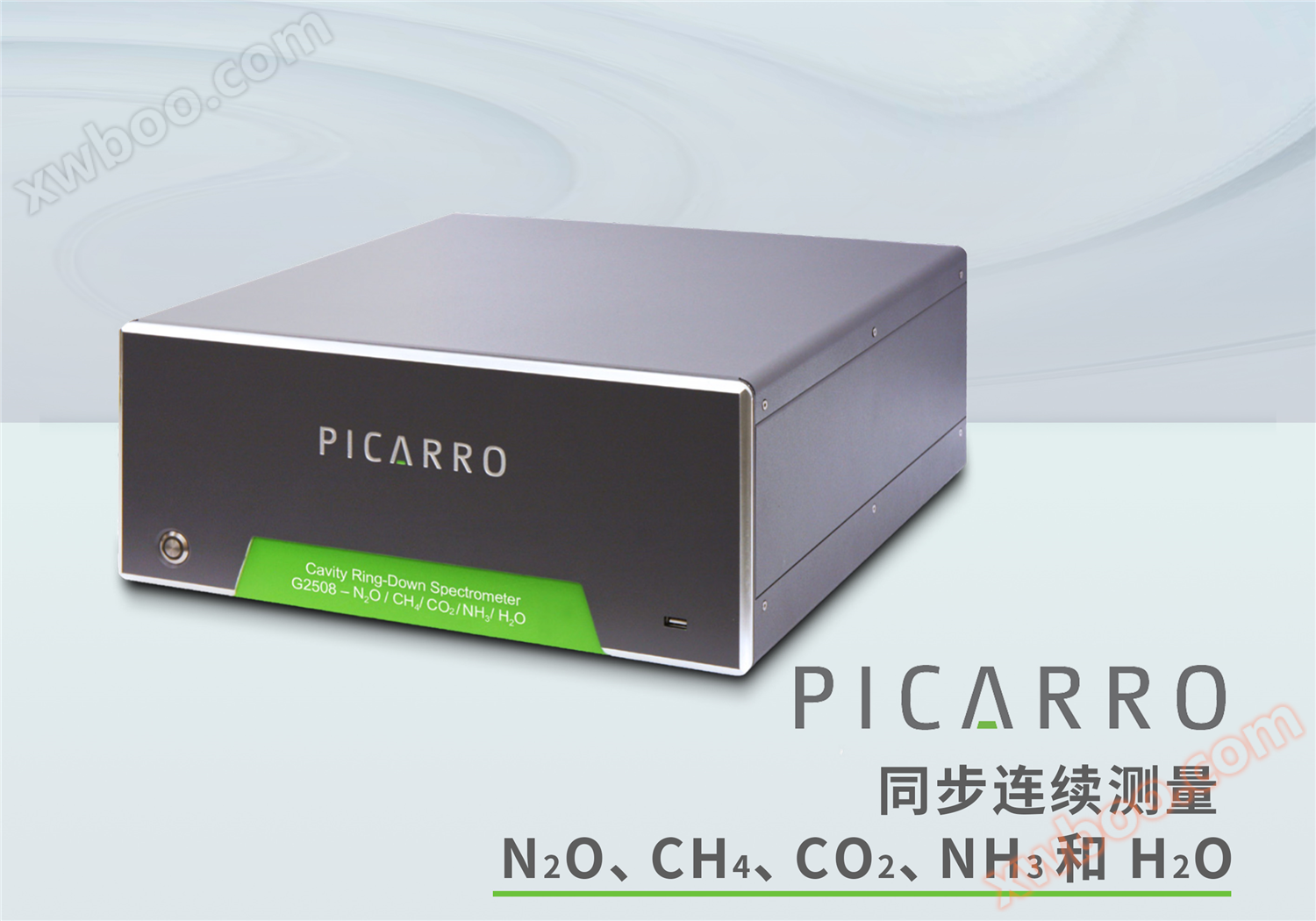
G2508 gas concentration analyzer measures N2O, CH4, CO2, NH3, and H2O
NegotiableUpdate on 02/24
- Model
- Nature of the Manufacturer
- Producers
- Product Category
- Place of Origin
Overview
G2508 gas concentration analyzer measures N2O, CH4, CO2, NH3, and H2O
Product Details
The Picarro G2508 gas concentration analyzer is capable of synchronously measuring nitrous oxide (N) with a sensitivity of one billionth (ppb)2O)、 Methane (CH)4)Carbon dioxide (CO)2)Ammonia (NH)3)At the same time, measure water vapor (H) with a sensitivity of one millionth (ppm)2O) 。 For agricultural soil science, ecology, and quantitative emissions, drift can be ignored. This analyzer can operate in open or closed systems and can be easily integrated with chamber systems.
● Synchronous continuous measurement of N2O, CH4, CO2, NH3, and H2O
● Billion parts per billion (ppb) sensitivity, capable of achieving excellent rate of increase quantification
Fast response time and continuous measurement function ensure data is provided with high time resolution
Can operate in open or closed systems and easily integrate with chamber systems
● Equipped with water vapor correction function, automatically reporting dry gas mole fraction
For N2O, the accuracies at 1 minute and 5 minutes are<10 ppb='' and=''>10><5 ppb, for CH4=''>5><7 ppb='' and=''>7><5 ppb, for CO2=''>5><300 ppb='' and=''>300><200 ppb, and for NH3=''>200><3 ppb='' 'and=' '>3><1>
| G2508 Performance Indicators and Performance in Air Background | |||||
| specifications | N2O | CH4 | CO2 | NH3 | H2O |
| Initial accuracy (1 σ) | < 25='' ppb='' +=''> Typical value=5.0 ppb* |
< 10='' ppb='' +='' 0.05%=''> Typical value=0.3 ppb* |
< 600='' ppb='' +=''> Typical value=240 ppb* |
< 5='' ppb='' +=''> Typical value=0.16 ppb* |
< 500=''> |
| Accuracy, 1 minute (1 σ) | < 10='' ppb='' +=''> Typical value=1.1 ppb* |
< 7='' ppb='' +=''> Typical value=0.1 ppb* |
< 300='' ppb='' +=''> Typical value=74 ppb* |
< 3='' ppb='' +=''>< 250=''> Typical value=0.07 ppb* |
< 250=''> |
| Accuracy, 5 minutes (1 σ) | < 5='' ppb='' +=''> Typical value=0.6 ppb* |
< 5='' ppb='' +=''> Typical value=0.1 ppb* |
< 200='' ppb='' +=''> Typical value=38 ppb* |
< 1='' ppb='' +=''> Typical value=0.04 ppb* |
< 100=''> |
| Ensure accuracy range | 0.3–200 ppm | 1.5–12 ppm | 380–5000 ppm | 0–300 ppb | 0–3 % |
| measuring range | 0–400 ppm | 0–15 ppm | 0–2 % | 0–2 ppm | 0–7 % |
| Measurement rate | < 8=''> | < 8=''> | < 8=''> | < 8=''> | < 8=''> |
| Gas response (Up - Down 10-90%, 90-10%) |
~8 seconds | ~8 seconds | ~8 seconds | See the annotation below | See the annotation below |
| Report dry mole fraction | correct | correct | correct | deny | Not Applicable |
Note: The response of H2O and NH3 is limited by their adsorption on the surface of the experimental setup. Although the analyzer will accurately measure the concentrations of NH3 and H2O inside the optical cavity, calculating the actual flux of NH3 and H2O in the soil using these measurements will become complex due to the adsorption dynamics within the system.
*The typical performance is defined as the median of the test results of 50 G2508 analyzers manufactured in sequence. Typical environmental concentration measurement values.
Specificity of the analyzer: Compared with other spectroscopic measurement techniques, Picarro CRDS technology utilizes an extremely narrow spectral region, which can significantly reduce the possibility of interference from other types of gases. However, interference may still occur in actual samples. The Picarro analyzer not only has built-in interference detection software, but also has tested and characterized the effects of the following gases on the analyzer:
| Picarro G2508 Trace Interference Gas | N2O sensitivity | ||||
| carbon dioxide | No automatic calibration up to 20000 ppm CO2 | ||||
| methane | No - can automatically calibrate up to 200 ppm CH4 | ||||
| ammonia | No - Automatic calibration is good, reaching 2 ppm NH3 | ||||
| ethane | 0.2 ppb N2O / ppm C2H6 , The highest test value is 120 ppm | ||||
| ethylene | 0.5 ppb N2O / ppm C2H4 , The highest test value is 16 ppm | ||||
| acetylene | Not applicable for acetylene experiment | ||||
| background gas | Designed for use in ambient air, not suitable for background gases with drastic changes in composition or high-purity background gases such as N2, O2, H2, He, etc | ||||
| ChemDetect ™ software | Picarro's unique algorithm detects and marks data that may be inaccurate due to spectral interference | ||||
| Picarro G2508 system operating parameters | specifications | ||
| ambient temperature | 10 to 35 ℃ | ||
| ambient humidity | <85%>85%> | ||
| Sample pressure | 300 to 1000 Torr (40 to 133 kPa) | ||
| Sample flow rate | ~230 standard milliliters per minute | ||
| Sample humidity | Under non condensing conditions, with a relative humidity of less than 99%, the water vapor calibration test is conducted to a temperature of 25 ° C, which is greater than 99% | ||
| Sample pressure | 300 to 1000 Torr (40 to 133 kPa) | ||
| sample temperature | -10 to 45 ℃ | ||
| Optical cavity temperature control | ±0.005 ℃ | ||
| Optical cavity pressure control | ± 0.0002 atmospheric pressure | ||
| Closed circuit/recirculation capability | Compatible with Picarro closed-loop system pump A0702 | ||
| Air inlet accessories | ¼ inch Swagelok ® | ||
| External dimensions | 17 inches wide x 7 inches high x 17.5 inches long (43.2 x 17.8 x 44.6 centimeters), excluding 0.5 inch bracket | ||
| weight | 50 pounds (22.6 kilograms) | ||
| Power requirements | 100-240 volts AC; 47-63 Hz (automatic detection); At startup (total) less than 375 watts Steady state operation: 120 watts (analyzer), 150 watts (pump). |
||
| Installation form | Desktop (standard) or 19 "rack mounted chassis (optional) | ||
| attachment | Including: keyboard, mouse. Optional accessories: LCD display. Excluding: vacuum pump. | ||
| option | A0702: Picarro Closed Circuit System Pump S0528: O2 sensor, used for O2 measurement and calibration in different O2 environments S0517: Expand CH4 operating range up to 800 ppm |
||
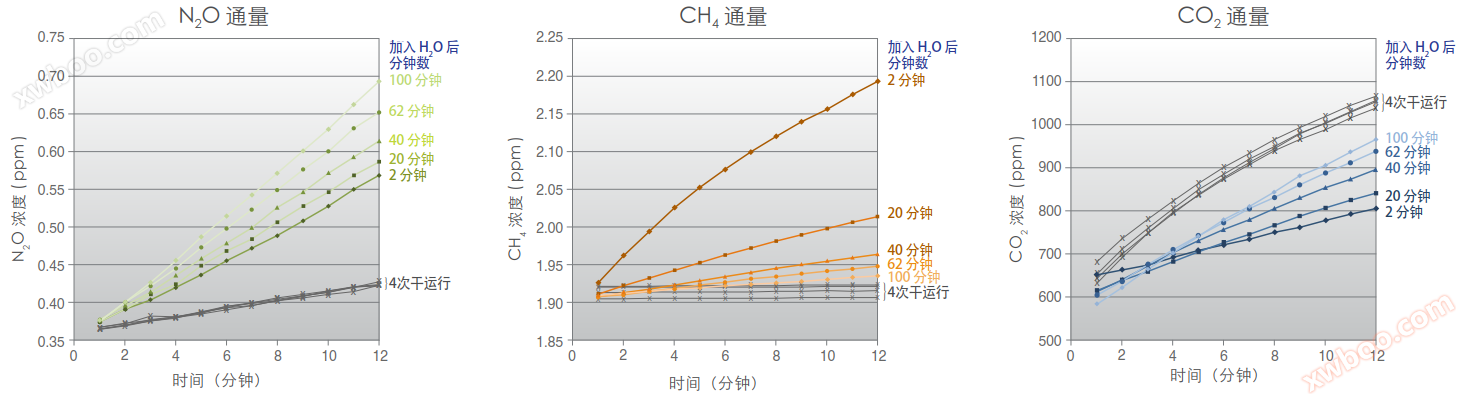
Laboratory study on a closed system chamber simulating rainfall: displaying concentration time series of N2O, CH4, and CO2 measured in dry and wet soil. After adding water, the N2O emission rate increased threefold within 2 minutes and continued to rise, while the CH4 emission rate first increased and then decreased, while the CO2 emission rate was inhibited but slowly recovered.
Similar Product Recommend


