-
E-mail
1622018819@qq.com
-
Phone
+8613729962354,+8615369622507
-
Address
No. 181 Dongcheng West Road, Guancheng District, Guangdong Province/511, Building B, Huaqiang Office Building, Xiaobao North Street, Songzhuang Town, Tongzhou District, Beijing
Product Categories
Dongguan Youte Purification Technology Co., Ltd
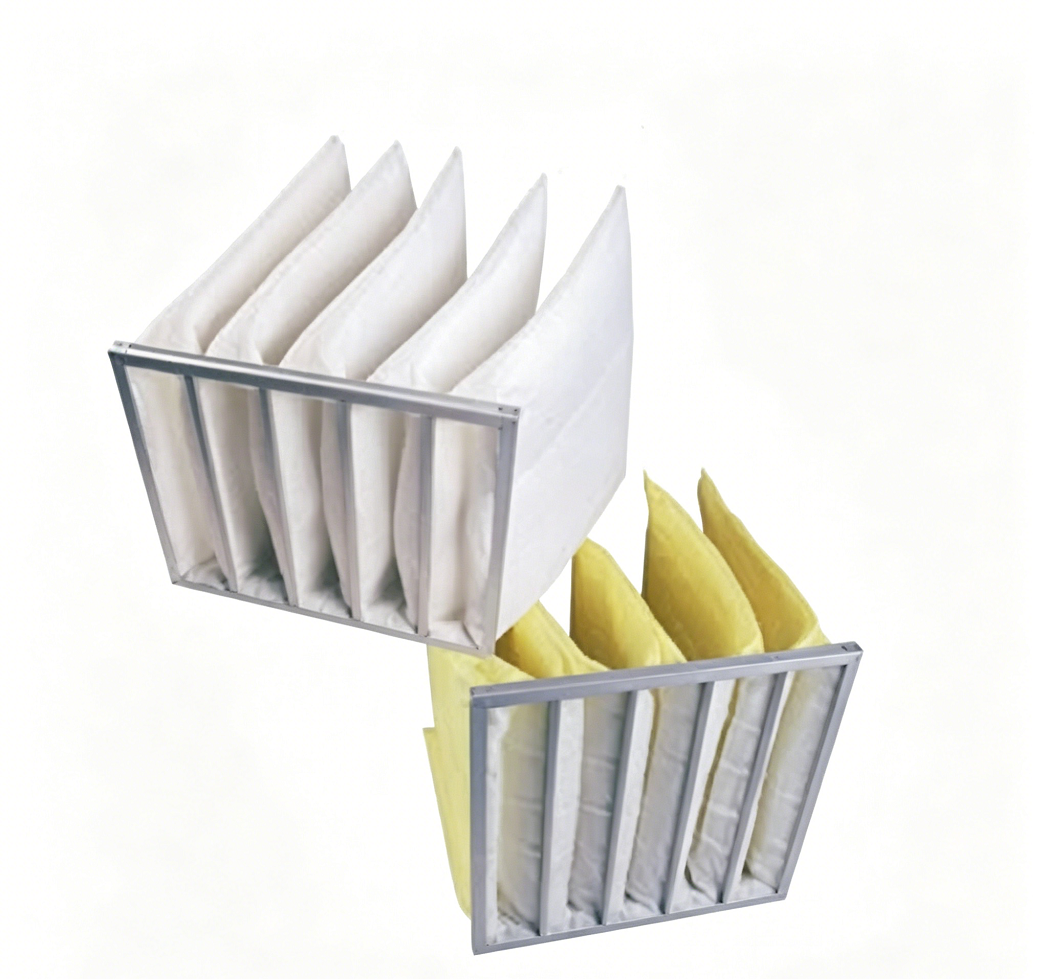
Medium-efficiency bag air filter
NegotiableUpdate on 05/18
- Model
- Nature of the Manufacturer
- Producers
- Product Category
- Place of Origin
Overview
Medium-efficiency bag filters belong to the F-series of air filters. They are divided into bag type and non-bag type. The bag type includes F5, F6, F7, F8, and F9, while the non-bag type includes FB (panel medium-efficiency filter), FS (partition medium-efficiency filter), and FV (combined medium-efficiency filter).
Product Details
Medium-efficiency bag air filter
Mainly used in intermediate filtration of air conditioning and ventilation systems, and industrial purification in pharmaceuticals, hospitals, electronics, food, etc.
It can also be used as a pre-filter for high-efficiency filters to reduce the load on the high-efficiency filters and extend their service life.
Due to its large air-facing surface, it has a large dust capacity and low air velocity, thus being considered a medium-efficiency filter structure.
Features:
1. Captures 1-5µm particulate dust and various suspended solids.
2. Employs a heat-fusion process, ensuring structural stability and reducing the risk of leakage.
3. Large air volume.
4. Low resistance.
5. High dust holding capacity.
6. Reusable and reusable after cleaning.
7. Types: Frameless and framed bag type.
8. Filter media: Special non-woven fabric or glass fiber.
9. Efficiency: 60%~95%@1~5µm (colorimetric method).
10. Operating Temperature and Humidity: 80℃, 80%
Medium-Efficiency Bag Air Filter
1. Interception: Airborne dust particles move with the airflow due to inertial motion, random Brownian motion, or the influence of some field force.
When particles collide with other objects, the van der Waals forces (forces between molecules and molecular clusters) cause the particles to adhere to the fiber surface. Dust entering the filter media has more opportunities to collide with the media, and upon impact, it becomes stuck. Smaller dust particles collide and agglomerate to form larger particles that settle, resulting in a relatively stable concentration of dust particles in the air. This is why indoor surfaces and walls fade. It is a misconception to view fiber filters like sieves.
2. Inertia and Diffusion: Particulate dust moves with inertia in the airflow. When it encounters randomly arranged fibers, the airflow changes direction, and the particles, due to inertia, deviate from their direction and collide with the fibers, becoming stuck. Larger particles are more likely to collide, resulting in better performance. Small dust particles undergo random Brownian motion.
The smaller the particle, the more violent its random motion, the more opportunities it has to collide with obstacles, and the better the filtration effect. Particles smaller than 0.1 micrometers in the air mainly undergo Brownian motion; smaller particles result in better filtration. Particles larger than 0.3 micrometers mainly undergo inertial motion; larger particles have higher efficiency. Particles with little diffusion or inertia are difficult to filter out. When measuring the performance of high-efficiency filters, the efficiency value for difficult-to-measure dust particles is often specified.


