-
E-mail
info@z-dream.cn
-
Phone
19916533110
-
Address
Building 1, No. 139 Xuanqiu Road, Pudong New Area, Shanghai
Product Categories
- Fully automatic microscope method insoluble particle analyzer
- Optical resistance method for large milk particle analyzer
- Nano particle zeta potential analyzer
- Microscopic insoluble particle tester
- Pig skin pulverizer and grinder
- Particle size analyzer
- Transdermal cream particle size analyzer
- Multi functional particle size analyzer
Shanghai Zimeng Technology Co., Ltd

Nano particle size and ZETA potential analyzer
NegotiableUpdate on 01/04
- Model
- Nature of the Manufacturer
- Producers
- Product Category
- Place of Origin
Overview
Zimeng Nano Particle Size and ZETA Potential Analyzer $r $n Particle Size Measurement $r $n $r $n Principle of Dynamic Light Scattering (DLS) Method $r $n $r $n When laser is irradiated on tiny particles dispersed in a liquid medium, the Brownian motion of the particles causes a frequency shift of the scattered light, resulting in a dynamic change in the scattered light signal over time. The size of this change is related to the Brownian motion speed of the particles, which in turn depends on the size of the particle size. Large particles have a slower Brownian motion speed, while small particles have a faster one. Therefore, dynamic light scattering technology is used to analyze the fluctuation law of the scattered light intensity of sample particles over time, using photon detection
Product Details
Particle size measurement
Principle of Dynamic Light Scattering (DLS) Method
When laser is irradiated onto tiny particles dispersed in a liquid medium, the frequency shift of scattered light is caused by the Brownian motion of the particles, resulting in dynamic changes in the scattered light signal over time. The magnitude of this change is related to the Brownian motion speed of the particles, which in turn depends on the size of the particles. Large particles have slower Brownian motion speed, while small particles have faster Brownian motion speed. Therefore, dynamic light scattering technology analyzes the fluctuation law of the scattered light intensity of sample particles over time. Photon detectors are used to collect scattered light at a fixed angle, and autocorrelation operations are performed through correlators to obtain correlation functions, which are then mathematically inverted to obtain particle size information.
Performance Characteristics
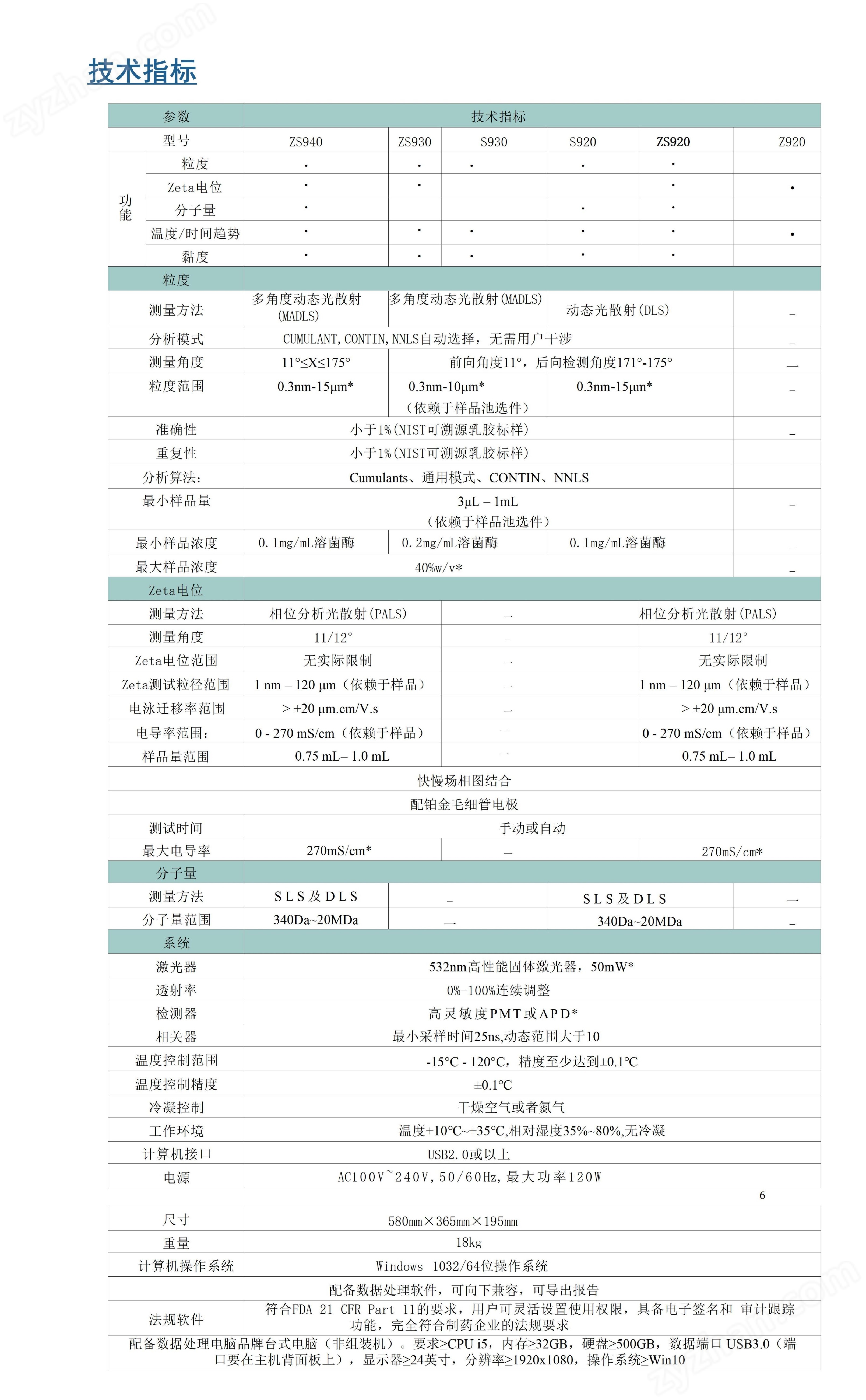
1. Efficient optical path system: using solid-state lasers and integrated fiber optics to meet the requirements of spatial coherence, improving the signal-to-noise ratio of the light intensity autocorrelation function, and ensuring the accuracy of subsequent data inversion.
2. High sensitivity photon detector: using counting type photomultiplier tubes or avalanche photodiodes, it has high sensitivity and signal-to-noise ratio to photon signals; Using edge triggered mode for counting, instantly capturing changes in photon pulses.
3. Large dynamic range high-speed photon correlator: A photon correlator that uses a combination of high and low speed channels effectively solves the contradiction between hardware resources and channel quantity, and obtains real-time correlation functions with large dynamic range and stable baseline.
4. High precision temperature control system: Based on semiconductor refrigeration technology, using adaptive PID control algorithm, the temperature control accuracy of the sample cell reaches ± 0.1 ℃.
5. Data filtering function: Introducing the method of quantile detection for outliers, identifying scattered light data affected by dust interference, and removing outliers to improve the accuracy of granularity measurement results.
6. Optimized inversion algorithm: The optimal+fitting cumulative inversion algorithm is used to calculate the average particle size and polydispersity coefficient, and the non negative constraint regularization algorithm is used to invert the particle size distribution. The accuracy and repeatability of the measurement results are both better than 1%.
7. Backscattered light path: When using a backscattered light path to measure high concentration samples, the backscattered light does not need to pass through the entire sample, thereby reducing the scattering path length and weakening the multiple scattered light, allowing for the measurement of particle size in higher concentration samples.
Zeta potential measurement
Charged particles undergo electrophoretic motion in the opposite direction to the electrode under the action of electric field force, and the electrophoretic velocity per unit electric field strength is defined as electrophoretic mobility. During electrophoretic migration, particles move together with tightly adsorbed layers and partially diffused layers, forming a sliding surface with the liquid. The potential difference between the sliding surface and the interior of the liquid is the Zeta potential. Zeta potential is an important indicator for characterizing the stability of dispersed systems. The higher the Zeta potential, the greater the mutual repulsion between particles, and the more stable the colloidal system. Therefore, measuring Zeta potential can predict the stability of colloids.
Principle of Phase Analysis Light Scattering (PALS) Method
The relationship between Zeta potential and electrophoretic mobility follows the Henry equation, and the Zeta potential of particles can be calculated by measuring their electrophoretic mobility in an electric field. The electrophoretic light scattering (ELS) method obtains the electrophoretic mobility of particles and determines the Zeta potential by measuring the frequency shift of scattered light. The Phase Analysis Light Scattering (PALS) method obtains the electrophoretic mobility of particles by measuring the phase change of scattered light signals, with a measurement resolution two orders of magnitude higher than the ELS method, thereby improving the measurement accuracy of Zeta potential.
Similar Product Recommend